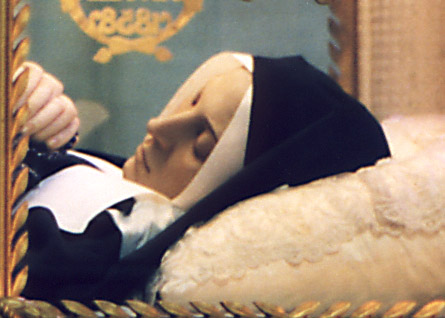
I finally scanned some of the pictures I took at World Youth Day! They came out better than expected but they may still be a little dark in some areas - you be the judge!
Click here to check them out!
If God is infinite, then how is it possible for any human being, finite in nature, to know anything about this concept? Would not any attempt at discovering the infinite be doomed to failure?My memory is faint, so I will reconstruct the conversation as cleanly as I can remember. My response was a resounding Of course it would be doomed to failure!. Satisfied yet confused, my friend could not accept my easy concession without concluding that he had been trapped. What is then the point? At best, one could live an agnostic existence, never being certain of God's existence or never having a satisfactory conception of the infinite that would have any effect over the tangible routine of daily life. Behold, I am no skilled manipulator of language, so I simply explained my response.
As a sacred synod has affirmed, God, the beginning and end of all things, can be known with certainty from created reality by the light of human reason (see Rom. 1:20); but teaches that it is through His revelation that those religious truths which are by their nature accessible to human reason can be known by all men with ease, with solid certitude and with no trace of error, even in this present state of the human race.Doing it all ourselves also ignores the idea of willful creation - the idea that God would create us with an orientation toward the infinite, manifested by an ever present desire to know more than what we perceive plainly. This concept is much more elusive, but certainly real. Another thing I believe it ignores is divine grace or assistance. That God would not only willfully create us, reveal Himself to us in a way that we can conceive, but would also provide us with grace that further enables us to live according to that revelation and achieve that which He has willed for us - unity with Him. This is the difference between knowing about Him and actually having a relationship with Him.
How can we trust this revelation as coming from God, the Infinite, which is transmitted to us through a book written by human authors and a tradition transmitted by human teachers - human teachers who are sinful and often times perform less than godly acts?Very good! Ay, there's the rub, I responded. My friend was attempting to catch me. How do we know without relying on ourselves? And we can't rely on ourselves alone. The final issue is then one of authority and faith. Again, left to ourselves, we are caught - but we remember that that is why we are given grace. We need grace to believe because faith is a grace. Again, Dei Verbum expresses this best:
"The obedience of faith" (Rom. 13:26; see 1:5; 2 Cor 10:5-6) "is to be given to God who reveals, an obedience by which man commits his whole self freely to God, offering the full submission of intellect and will to God who reveals," (4) and freely assenting to the truth revealed by Him. To make this act of faith, the grace of God and the interior help of the Holy Spirit must precede and assist, moving the heart and turning it to God, opening the eyes of the mind and giving "joy and ease to everyone in assenting to the truth and believing it." (5) To bring about an ever deeper understanding of revelation the same Holy Spirit constantly brings faith to completion by His gifts.Faith enables us to cooperate with God's grace and to understand God's revelation and the authority under which it was given and entrusted to the Church, the authority given by Christ to the Apostles, which is thus communicated to their successors and handed down to us today. That such a teaching authority, entrusted to human sinners, is free of corruption is ensured by the merits of Christ's death and resurrection, and Christ does this because He desires that all the world know of Him.
I think I understand what you are saying. The agnostic assumes that the initiative belongs to human beings to know the Infinite, which they really cannot do, whereas you are saying that the initiative belongs to God. It starts with God and ends with God, not the other way around. The Infinite God chose to create us, He revealed Himself to us, and He gives us, finite as we are, what we need to know Him infinitely in time.I explained that it is important to remember that faith is not only the passive reception of a gift from God, but the active free response to God. Some people spend their whole lives fighting against it. But alas, it is a great mystery. Do you desire faith?, I asked. He responded,
Certainly.The desire to have it is already a sign of its work, and the continuing cooperation with grace is itself a work of grace. As the Catechism articulates,
"The preparation of man for the reception of grace is already a work of grace. This latter is needed to arouse and sustain our collaboration in justification through faith, and in sanctification through charity."As we cooperate with grace through faith, we are sanctified by grace and created anew to perform acts of charity which nourish faith. Without grace, it is impossible to please God. And that, said I, is only the beginning of an incredible journey into the Great Mystery, the heights and depths of glorious Truth.
She says a lot of people are having fun finding new titles for Ernest Hemingway's "The Old Man and the Sea" which presents problems with every word except "and" and "the." [Dianne] Ravitch said old is ageist, man is sexist and sea can't be used in case a student lives inland and doesn't grasp the concept of a large body of water.Granted - some words are explicitly offensive and have no place. But this is ridiculous. It seems to me that the cure for this has more to do with educating rather than erasing every words that is, could possibly be, or might remotely be offensive.
The New York Times recently reported that National Institute of Health researchers on AIDS are not only avoiding using words like gay and homosexuals in e-mails so as not to offend conservatives in the Bush administration, they are also inventing code words. Times journalist Erica Goode reported that one researcher was told to "cleanse" the abstract of his grant proposal of words like gay, homosexual and transgender even though his research was on HIV in gay men.Hmm. How is education helped by a standard taken to extremes? And just who is responsible for drawing the line?
"Everyone gets their pet causes incorporated in textbooks. The history texts are reluctant to criticize any dictator unless they are long dead. And even then, there are exceptions like Mao is praised in one text for modernizing China but his totalitarian rule is not mentioned," [Ravitch] said.
VOTF does not seek any change in church doctrine. The problems which have come to light in the present crisis are more truly cultural than structural in nature.They do not seek to change doctrine, but this statement is flimsy given how each person chooses to define what doctrine is and what it isn't. And how is it cultural? And not truly structural in nature? Then why the emphasis on structural change?They then go on to state this:
We respect the teaching authority of the Church and recognize the role that the hierarchy should exercise in discernment. It is essential, however, that all the people of God be involved in this process of discernment. We will, therefore, devote ourselves to advancing meaningful and active engagement of the laity in the life of the Church.What does this mean? How does this relate to what they previously stated? Discernment in what? They also state this:
In order to move toward the vision of the Second Vatican Council, we believe it is vitally important that the faithful of each parish engage in, and enthusiastically support, the formation and actions of Pastoral and Finance Councils and Safety Committees. We must empower the laity to protect our children and all the people of God.I do not agree that we have ignored the teachings of the Second Vatican Council. But what is this vision that they refer to? They never really explicitly define this. This is significant. Also, does this statement imply that lay Catholics will be more capable of protecting children? Last time I checked, we were all sinners, clergy and laity both. And sexual abuse is pretty widespread amongst non-ordained clergy - Approx. 90% occurs within families. No, this goal misses the point of reform.
Q. What does Voice of the Faithful feel will be the effect of bringing laity into the governance structure of the Church?This is just crying out for elaboration.
A. The Church hierarchy can learn much from the Catholic laity. We have intellectual, emotional and spiritual contributions to make and knowledge to impart on myriad real-life issues. These include, but are not limited to: human sexuality, women's rights, democratic processes, and the contextual roles of science and history in the healthy life of the Church.
The Vatican appealed to the Russian Orthodox Church to recognize the spiritual needs of the country's 500,000 Catholics, who numerically pose no threat to Orthodoxy.
Archbishop Jean-Louis Tauran, Vatican secretary for relations with states, made this appeal public in an interview Sunday with the Italian newspaper Il Corriere della Sera. He was commenting on the charges of "proselytism" leveled against Rome by the Moscow Orthodox Patriarchate.
...Archbishop Tauran believes, in part, that the present situation is due to the fact that Russian Orthodox Church leaders regard the Catholic Church as a "church of foreigners."
...Catholics in Russia "are Russian citizens -- not foreigners -- and, therefore, have a right to pastoral care, like all Catholics spread throughout the world and like all Orthodox Christians in Russia and in any other place," he explained.
"This would also help to overcome that psychological attitude of 'besieged fortress' that impedes the Orthodox Church, which suffered so much during the years of Communism, to offer Europe and the world the contribution of its great spiritual riches," Archbishop Tauran concluded.

Fr. Johannes Grohe, an Opus Dei priest who teaches church history at Santa Croce, spoke on the history of church councils. He offered several interesting nuggets, such as the fact that a regional council in Persia in 410 produced one of the earliest insertions of the famed "filioque" clause into the Creed, specifying that the Holy Spirit proceeds from the Father "and from the Son." This council, as Grohe points out, was an Eastern affair, and its adoption of the filioque came out of the rich theological reflection of early Persian Christianity. Hence the notion that the filioque is solely an imposition of the medieval Western Church upon the East, born of later controversies between Rome and Byzantium, is historically dubious.Interesting! I agree with Bill that this could have a very positive effect on current Catholic/Orthodox dialogue. But it will be interesting. I sincerely hope that this is treated seriously. Ut Unum Sint!


Following a standing ovation by the crowd, Gibson began his address "I could hit you with a dozen cliches today. Follow your dreams. Fight for what you believe in... until the cops show up."I would've asked him to talk about why, in his movie Braveheart, the Battle of Sterling Bridge was missing the bridge! But then maybe his keynote would not have been as inspirational!
Delivering a speech peppered with wry humor and anchored with sincerity, Gibson's address focused on society's constant search to be happy in life.
"Perfect happiness is not attainable in this imperfect world we live in," he said. "This creates a void, and people seek to fill that void with relationships, drugs, alcohol, or work... I hope you look to fill that void in an unlikely place. Treading boldly where you would rather not, and inhabiting the place that seems most likely not to fill the void is often where peace can be found."
... Closing his speech, Gibson advised, "I hope you can learn to love not only yourself and those who love you, but love those who don't love you. If you can do that, your life will be rich and full in ways the world can never make it."
957. "Communion with the saints. 'It is not merely by the title of example that we cherish the memory of those in heaven; we seek, rather, that by this devotion to the exercise of fraternal charity the union of the whole Church in the Spirit may be strengthened. Exactly as Christian communion among our fellow pilgrims brings us closer to Christ, so our communion with the saints joins us to Christ, from whom as from its fountain and head issues all grace, and the life of the People of God itself'[LG 50; cf. Eph 4:1-6 .]:What strikes me about the Communion of Saints is precisely the nature of this Communion that we have in Christ. We who are Christians are inseparably linked in a spiritual communion with our brothers and sisters in Heaven because we are in Christ as they are in Christ, albeit they are in a perfect relationship with Him. But if we do have this type of spiritual relationship with them in Heaven, then certainly we have this type of spiritual relationship with all who are in Christ here on the Earth, albeit not perfectly. We are called to the fullest manifestation of this communion with the whole Church particularly when we participate in the sacraments. Hence our spiritual communion on earth is one of vocation -- the communal call to holiness. The Catechism also states in paragraph 946 and 947:We worship Christ as God's Son; we love the martyrs as the Lord's disciples and imitators, and rightly so because of their matchless devotion towards their king and master. May we also be their companions and fellow disciples![Martyrium Polycarpi, 17: Apostolic Fathers II/3, 396.]"958. "Communion with the dead. 'In full consciousness of this communion of the whole Mystical Body of Jesus Christ, the Church in its pilgrim members, from the very earliest days of the Christian religion, has honored with great respect the memory of the dead; and 'because it is a holy and a wholesome thought to pray for the dead that they may be loosed from their sins' she offers her suffrages for them.'[LG 50; cf. 2 Macc 12:45 .] Our prayer for them is capable not only of helping them, but also of making their intercession for us effective." 959. "In the one family of God. 'For if we continue to love one another and to join in praising the Most Holy Trinity - all of us who are sons of God and form one family in Christ - we will be faithful to the deepest vocation of the Church.'[LG 51; d. Heb 3:6 .]"
What is the Church if not the assembly of all the saints? The communion of saints is the Church. Since all the fathful form one body, the good of each is communicated to the others... We must therefore believe that there exists a communion of goods in the Church. But the most important member is Christ, since He is the head... Therefore, the riches of Christ are communicated to all the members, through the sacraments.Certainly we intercede for one another. But if we are in communion with one another in a way that achieves its perfection in Christ, particularly as revealed by our brothers and sisters in Heaven, then this is truly a profound concept, is it not? That our relationship with the rest of the Church both on Earth and in Heaven transcends and surpasses the physicality of our human relationships. In a way, our spiritual relationship with one another redefines and transforms our physical relationship with one another. And the gifts of God, the riches of Christ, are communicated through the sacraments. At the core of all of this is prayer. So when in life you have passing thoughts about a brother or sister, don't let them fall into a void. Rather, pause and pray for them - that we might empower one another spiritually and be that family Christ calls us to be. This is our vocation.
Fr. Robert Spitzer, president of Gonzaga University and deeply committed to engaging our culture in the pro-life message, unfolds a theme of developing health, happiness, and purpose within the individual and thus within society. His philosophical and theological discussions are couched in language the laity understands and appreciates, and, most importantly, will be motivated to put into practice.The episode list is short but pretty comprehensive. As I mentioned in my earlier blog, Fr. Spitzer is co-founder for the Center For Life Principles and is a very engaging speaker. Tune him in!
We at times fail to distinguish between two ways of knowing anything. For example, typhoid fever can be known as we know it now, negatively; we do not have it. The evil is known by negation. There are some people who know typhoid fever experimentally; they suffer from it.. It is one thing to know intellectual errors, as the negation of truth; it is quite another thng to know evil by infection. The germ could ruin us. To know what dishonesty is one need not be a thief. To know what life is, one need not be an adulterer. Drunkenness can be known without being drunk. Education which emphasizes the necessity of living evil in order to know evil is in danger of making the mind captive to evil. Values and joys are associated with temperance, which the alcoholic does not know, and with innocence, which the sex addict can never experience. Let a drunken man become sober and he will see things as they are; let a skeptic turn to the Diety and he will begin to know truth.So knowing evils by negation isn't necessarily a worse knowledge than knowing evils experimentally. I can see the effects of crack cocaine on the body to know that it is harmful without doing it. I can see the effects of jumping off a 10 storey building onto concrete to know that it is deadly. The same goes for spiritual evils, or sin. While I am a sinner, I know sin by the effects of it in my own life - yet I also know that by cooperating with grace and embracing the cross in faith, I can avoid sin. And because I also trust Our Lord when He tells us of how sin harms our soul, I know sin without indulging in it. Now, I don't dare boast that I have mastered this, but it is a daily walk, and were it not for God's grace, I could not do it. Hence we have the sacraments as tangible ways in which we are strengthened by His grace.
Education which emphasizes the necessity of living evil in order to know evil is in danger of making the mind captive to evil.We endanger our bodies to addiction and death by indulging in crack to know the effects of crack. We endanger our souls by indulging in sin to know the effects of sin.

The redesigned currency is safer, smarter and more secure: Safer because it is harder to fake and easier to check; Smarter to stay ahead of tech-savvy counterfeiters; and More Secure to protect the integrity of U.S. currency.
The most noticeable difference in the new design is the subtle introduction of background color, which makes it more burdensome for potential counterfeiters because it adds complexity to the note. The color will also make it easier to distinguish between denominations because different background colors will be used for each denomination.
However, despite the addition of color, the new note preserves the distinct size, look and feel of the traditional American “greenback” – the world’s most familiar and circulated currency.
Particularly, among the fundamental rights of man, the Catholic Church claims for every human being the right to life as the primary right. She does it in the name of the truth about man and to protect his freedom that cannot be sustained without respect for the right to life. The Church affirms the right to life of every innocent human being and at every moment of his existence.
-- Pope John Paul II to the Pontifical Academy of Life (February 27, 2002)
Truth and solidarity are necessary if humanity is to succeed in building a culture of life, a civilization of love, a world of peace.
-- John Paul II, address to the Pontifical Council for Social Communications, March 25, 2003, in reference to World Communications Day, June 1, 2003 Judiciary Committee
The church respects and supports scientific research when it has a genuinely humanist orientation, avoiding any form of instrumentalization or destruction of the human being and keeping itself free from the slavery of political and economic interests.
-- John Paul II, address on Biomedical Research: Benefits, Limits of Science, February 24, 2003
At morn- at noon- at twilight dim-As you may know, the Angelus is a beautiful and powerful prayer to Mary that expresses four ideas of depth:
Maria! thou hast heard my hymn!
In joy and woe- in good and ill-
Mother of God, be with me still!
When the hours flew brightly by,
And not a cloud obscured the sky,
My soul, lest it should truant be,
Thy grace did guide to thine and thee;
Now, when storms of Fate o'ercast
Darkly my Present and my Past,
Let my Future radiant shine
With sweet hopes of thee and thine!
The annoucement to Mary via the angel Gabriel (God's Initiation)
Mary's Obedience to the Lord (Obedience)
Enfleshment of the Lord (the Incarnation)
Sharing in His Passion (daily conversion to Christ)
| In Latin:
Angelus Domini nuntiavit Mariae. Et concepit de Spiritu Sancto. Ave Maria, gratia plena, dominus tecum. Benedicta tu in mulieribus, et benedictus fructus ventris tui, Jesus. Sancta Maria, Mater Dei, ora pro nobis, peccatoribus, nunc et in hora mortis nostrae. Amen. Ecce ancilla Domini. Fiat mihi secundum verbum tuum. Ave Maria... Et Verbum caro factum est. Et habitavit in nobis. Ave Maria... Ora pro nobis, sancta Dei Genitrix. Ut digni efficiamur promissionibus Christi. Oremus. Gratiam tuam, quaesumus, Domine, mentibus nostris infunde; ut, qui, angelo nuntiante, Christi Filii tui incarnationem cognovimus, per passionem ejus et crucem, ad resurrectionis gloriam perducamur. Per eumdem Christum Dominum nostrum. Amen. | In English:
The angel of the Lord declared unto Mary. And she conceived of the Holy Ghost. Hail Mary, Full of Grace, the Lord is with you. Blessed are you among women, and blessed is the fruit of your womb, Jesus. Holy Mary, Mother of God, pray for us sinners, now, and at the hour of our death. Amen. Behold the handmaid of the Lord. Be it done unto me according to Thy word. Hail Mary... And the Word was made flesh. And dwelt among us. Hail Mary... Pray for us, O holy Mother of God. That we may be made worthy of the promises of Christ. Let us pray Pour forth, we beseech Thee, O Lord, Thy grace into our hearts, that we to whom the Incarnation of Christ, Thy Son, was made known by the message of an angel, may by His Passion and Cross be brought to the glory of His resurrection. Through the same Christ our Lord. Amen. |
Spend a lot of time thinking about and trying to understand themselvesOther Intrapersonal thinkers include
Reflect on their thoughts and moods, and work to improve them
You understand how your behaviour affects your relationships with others
Sigmund Freud, Gandhi, Grahame GreeneCareers which suit Intrapersonal Thinkers include
Psychologist, Teacher, Pilot, Child care worker, Explorer, Drama therapistWhat type of thinker are you?
In his book, Eugene Kennedy writes of "a once totally passive Catholic community conditioned to receive and accept as God's will whatever the official Church bade its members do" (p. 101).
Nineteenth century anti-Catholics would have concurred with him. As Philip Hamburger documents so thoroughly in his recent "Separation of Church and State" (Harvard U.P, 2002), that was precisely the stereotype they used to advocate the exclusion of Catholics from the franchise and political life.The very people Kennedy so denigrates faced constant and malignant prejudice, and by their courage, faith and resistance, they contributed enormously to the transformation of America into a pluralistic, open and diverse nation. In the church that they built for themselves, they found a refuge from their sufferings, and they created one of the most vibrant expressions of Catholicism ever.
... The depth of his confusion and lack of understanding of contemporary Catholicism appears in his astonishing and unsupported statement: "Distracted from or forgetting it, the church misses entirely the meaning of its central teaching that God took on our flesh in Jesus, sparing Himself none of our experiences, save sin, in order to heal our wounds and make us whole" (10).
... his view of history and life is based on crass conspiracy theory and reductionism. The Catholic people are seen as mindless sheep, manipulated by conspiring "hierarchs," or just long-suffering martyrs to the same. He reduces the whole tradition of celibacy in Catholicism to the desire of the 11th century pope Gregory VII to protect church lands (IX).
...
Reality always comes off second best when measured against an idealized future. Like a modern-day Gatsby, Kennedy believes in the "orgiastic future that year by year recedes before us." However, in his determination to present such a skewed and partisan version of Catholicism, he joins himself to an old tradition of American anti-Catholicism and is himself "borne back ceaselessly into the past."
At Loyola Marymount University, the selection of actor-director Mel Gibson and film director William Friedkin as commencement speakers has generated much talk -- Gibson for his conservative (some would say traditional) views toward the Catholic Church (he likes the Tridentine Mass), Gibson and Friedkin for some of their films that have shown explicit violence.Funny how she qualifies Gibson's "traditionalism" by saying he likes the Tridentine Mass. Is that all it takes?
The normal human being is meant to have open relationships with the eternal or the infinite. Man has a body, a mind, and a relationship with things in the great world that constitutes his environment. The normal human being recognizes that his body gives him the capacity to experience sensual pleasure or carnal love. This love is to be seen as a spark from the great flame of love, which is God. Sex love was made not only to deepen the affection between husband and wife, not only to be a prolongation of God's creative power to creatures, but also to be a steppingstone to a higher love of God.You can see how Sheen characterizes normal living. Our bodies, our minds, and those things which make up our environment are given to us to be oriented such that their purpose is to lift us up and direct us toward God. As Sheen illustrates with the example of the capacity of the body to feel, touch, and experience sensual pleasure - properly understood, such pleasure is intended not only to deepen the love between a married couple, but is, as Sheen puts it, a prolongation of God's creative power and to deepen our love of Him. When used, all of these faculties should always have an orientation toward God.
The mind by discovering the truths of science, history, and philosophy, gradually unifies them and sees them as a descent, refraction, and echo of the Great Omniscient Truth, which is God.When we exercise the faculies of our mind with proper appreciation of their purpose, we are taken to the depths of deeper awareness of God. So even after reading this, one can already begin to see what Sheen believes to characterize the abnormal mind - a misguided sense of the orientation of our bodies, minds, and things in our environments.
[In] abnormal living, man [cuts] himself off from God and [proclaims] his own sufficiency. But man cannot live without a god, that is impossible. The infinite haunts him constantly. So he has to make his own gods. These gods are generally three. The first god is his own body. Sexual pleasure then becomes the supreme goal of life and ultimate happiness. He attempts to compensate for a want of eternal divine destiny by the intensity of his erotic experiences. Other men make a god of their minds through egotism and pride and the exaltation of the ego.I think that Sheen has a really good point here. Without a proper orientation of our bodies, minds, and relationship with the things in our environments, we are desparate to give them some purpose which falls short of God, which typically means they fall in on themselves. Thus they no longer lift us up in our relationship with God but leave us stranded on the dusty floors of life.
The body, made its own limit, becomes sex. The mind, made its own limit, becomes egotism. The things, denied an extraearthly relationship, become the source of greed. Civilization then becomes a conflict of individual egotisms, each one affirming his own will. From this result jealousies, bickerings, ... and war.
The third substitute god men make for the true God is the material: wealth, avarice, business, and greed. The true infinite is replaced by the false infinite of "more." Men attempt to cover their nudity by a vain display, thinking they are worth something because they have something.
Anxiety, because man sees a disproportion between what he is and what he ought to be... Dispair, because living in a closed circle makes a man despair in that he cannot escape the desire for the infinite, and having made himself the infinite, he foresees there is nothing ahead of him but death, annihilation, and destructionWhat he notes about despair is really interesting and perfectly correct. Man despairs when he is limited from the infinite. Man rejoices when he is free. The trouble is that the cause of man's limitation here is himself. Therefore I call this a self-perpetuating blindness, and a self-fulfilling prophecy in that, once in this rut, man gets what he pretty much expects to get.
There are two things that are meant to go together. One is the misery of man: his worries, his trials, his difficulties, his sorrows. The other, the Mercy of God. Our modern world... has separated the misery of man from the mercy of God. As misery without mercy begets despair, so also, a sense of God's Mercy without a sense of sin can beget presumption, arrogance, and pride. Man has already one-half the condition of salvation - he is miserable. Then he has peace as he hears, coming from out of the darkness, the plea, "Come to Me, all ye who labor and are heavily burdened, and find rest for your souls."
Textkit is a language learning site which provides Greek and Latin grammars, reading material, classical e-books and other learning resources. Textkit is the Internet's leading source for free, fully downloadable, public domain Greek and Latin grammars. We also provide a wide range of classical e-books from Greek and Roman authors. With currently 119 free books to choose from, Greek and Latin learners have downloaded 52,972 grammars, readers and classical e-books.
THE HOLY EUCHARIST
by: Pedro Calderon de la Barca (1600-1681)
HONEY in the lion's mouth,
Emblem mystical, divine,
How the sweet and strong combine;
Cloven rock for Israel's drouth;
Treasure-house of golden grain
By our Joseph laid in store,
In his brethren's famine sore
Freely to dispense again;
Dew on Gideon's snowy fleece;
Well, from bitter turned to sweet;
Shew-bread laid in order meet,
Bread whose cost doth ne'er increase,
Though no rain in April fall;
Horeb's manna freely given
Showered in white dew from heaven,
Marvelous, angelical;
Weightiest bunch of Canaan's vine;
Cake to strengthen and sustain
Through long days of desert pain;
Salem's monarch's bread and wine;--
Thou the antidote shalt be
Of my sickness and my sin,
Consolation, medicine,
Life and Sacrament to me.
an option for use of the vernacular exists in the 1965. Furthermore, as in the Novus Ordo, it is at the discretion of the celebrant to either face the East ("ad orientem") or the people ("versus ad populum"). An option for concelebration was also introduced in the 1965 (this was formerly restricted to Ordination Masses). The required Mass vestments were also simplified (e.g., optionality of the maniple). In 1967, the cope was supressed in the Asperges (rite of aspersion at High Mass). The chasuble was worn in its stead. The Canon was still required to be read in Latin until 1967, when it was permitted in the vernacular. In the 1965 Missal, the priest, when administering Communion, says "the Body of Christ" (or "Corpus Christi") instead of "Corpus + Domini nostri Jesu Christi custodiat animam tuam ad vitam aeternam" (that is, "May the Body + of our Lord Jesus Christ bring thy soul unto life everlasting").
Options for congregational singing also exist in the 1965, exactly as they do in the Novus Ordo -- with places for processional, offertory, communion, and recessional hymns. The 1965 also allows for the Prayer of the Faithful after the Creed. The prayers at the foot of the altar, in addition to being made entirely optional, were shortened (as they would previously be prayed at Requiem Masses). The Last Gospel was suppressed. The calendar follows the Tridentine Ordo, consistent with that of the previous Missal (Missale Romanum 1962). Ironically enough, the New St. Joseph's Missal ends the Liturgical Calendar in 1970.
A democracy cannot exist as a permanent form of government. It can only exist until the voters discover that they can vote themselves money from the public treasure. From that moment on the majority always votes for the candidates promising the most money from the public treasury, with the result that a democracy always collapses over loose fiscal policy followed by a dictatorship. The average age of the world's great civilizations has been two hundred years.Alexander Tyler came up with a sequence of 10 stages that represents the cycle of nations. Kerby Anderson, in his article The Decline of a Nation states:
Each of the great civilizations in the world passed through a series of stages from their birth to their decline to their death. Historians have listed these in ten stages.Something interesting he notes is that the move from stage to stage is largely dependent upon the value associated with the family, because families are the foundation of a nation. Carl Wilson, in his book Our Dance Has Turned to Death notes a similar set of stages representing the pattern of family decline, based on a study of the Roman Empire and Ancient Greece. This is what he says:
These nations have progressed through the following sequence:
from bondage to spiritual faith,
from spiritual faith to great courage,
from courage to liberty,
from liberty to abundance,
from abundance to selfishness,
from selfishness to complacency,
from complacency to apathy,
from apathy to moral decay,
from moral decay to dependency,
from dependency back to bondage.
In the first stage, men ceased to lead their families in worship. Spiritual and moral development became secondary. Their view of God became naturalistic, mathematical, and mechanical.Interesting. Personally, I think that this model may be a tad over-generalized. But I ask you what you think about this model. What is the current stage of America according to this picture? And what does this say? One thing that one could use in the initial argument, that what we are experiencing now is unparalleled in history, is the fact that the world is so much more globalized than it has been at any other point. There is no longer the same extent of isolation between nations on opposite ends of the globe. Because media is now so ubiquitous, and the advent of the Internet has joined much of the world together, there is much more interaction between nations and global civilizations. Hence, we affect each other uniquely.
In the second stage, men selfishly neglected care of their wives and children to pursue material wealth, political and military power, and cultural development. Material values began to dominate thought, and the man began to exalt his own role as an individual.
The third stage involved a change in men's sexual values. Men who were preoccupied with business or war either neglected their wives sexually or became involved with lower-class women or with homosexuality. Ultimately, a double standard of morality developed.
The fourth stage affected women. The role of women at home and with children lost value and status. Women were neglected and their roles devalued. Soon they revolted to gain access to material wealth and also freedom for sex outside marriage. Women also began to minimize having sex relations to conceive children, and the emphasis became sex for pleasure. Marriage laws were changed to make divorce easy.
In the fifth stage, husbands and wives competed against each other for money, home leadership, and the affection of their children. This resulted in hostility and frustration and possible homosexuality in the children. Many marriages ended in separation and divorce. Many children were unwanted, aborted, abandoned, molested, and undisciplined. The more undisciplined children became, the more social pressure there was not to have children. The breakdown of the home produced anarchy.
In the sixth stage, selfish individualism grew and carried over into society, fragmenting it into smaller and smaller group loyalties. The nation was thus weakened by internal conflict. The decrease in the birthrate produced an older population that had less ability to defend itself and less will to do so, making the nation more vulnerable to its enemies.
Finally, unbelief in God became more complete, parental authority diminished, and ethical and moral principles disappeared, affecting the economy and government. Thus, by internal weakness and fragmentation the societies came apart. There was no way to save them except by a dictator who arose from within or by barbarians who invaded from without.
A nation will not be strong unless the family is strong. That was true in the ancient world and it is true today.