Thursday, May 26, 2005

Reflecting on Sen. Gordon Smith's Mormon Theology of Embryonic Stem Cell Research

This week's debate about embryonic stem cell research has given me pause to reflect on when, 3 years ago, President Bush made his first decision about the subject. Of course, I felt his decision was too much of a compromise, seeing as how the existing stem-cell lines would eventually become insufficient, leaving demands for more lines years later. And not only that, that more Republicans, many of whom claim to be "pro-life", would be demanding funding for this research. That got me thinking about this article by Drew Clark, published in MSN Slate in 2001.

The Mormon Stem-Cell Choir

In the article, Clark basically outlines a Mormon theology of stem-cells by first noting, of course, that the Church of Jesus Christ of Latter-day Saints has no official position on embryonic stem-cell research, or when life begins, and other relevant topics in modern bioethics. But he then proceeds to give the moral and theological opinion of Sen. Gordon Smith and Orrin Hatch:
While pundits chatter on about the role of Catholic leaders in the stem-cell debate, the influence of Mormons (—members of the Church of Jesus Christ of Latter-day Saints) goes almost unnoticed. [Orrin] Hatch and [Gordon] Smith have become the leaders of a movement within the Republican Party to urge President Bush to fund embryonic stem-cell research. All five Mormon senators (the others are Sens. Robert Bennett, R-Utah; Mike Crapo, R-Idaho; and Harry Reid, D-Nev.) have come out for such funding. They have helped move the debate away from right-to-life absolutism without sacrificing pro-life theology. The LDS Church, not the Vatican, is playing the pivotal role in the struggle over stem cells.
You'll see in a minute why this argument is absurd. Clark continues...
In an audience last week with Bush, Pope John Paul II restated the Catholic Church's opposition to abortion and "related evils" such as euthanasia, infanticide, and the destruction of human embryos through stem-cell research. That statement drew upon the pope's 1995 encyclical, Evangelium Vitae and his 1987 encyclical, Donum Vitae (Gift of Life). Both documents elaborate on the Catholic position that life begins at conception, equating abortion and [embryonic] stem-cell research with murder... Leaders of the LDS Church have been far more circumspect about both subjects. The church released a statement of neutrality on stem-cell research in July. What the LDS Church didn't issue, —and what its statements on abortion similarly avoid, is any statement about when life begins, and hence whether embryos constitute human life.
It seems to me that without such a statement, the LDS Church is not able to engage the subject from a scholarly or theological level at all. As Clark goes on to note, the position is vague:
Rather than referring to the Biblical commandment "Thou shalt not kill," the church's 1991 statement on abortion cited a scripture from The Doctrine and Covenants, a collection of revelations received by Joseph Smith, whom the church regards as its first prophet. The scripture reads, "Thou shalt not steal; neither commit adultery, nor kill, nor do anything like unto it." The phrase "like unto it" suggests that while most abortions are sinful, they are not quite the same as murder.
This is where it gets strange. Such a vague statement, which seems deliberate, of course, leaves the door open for a wide array of interpretation. And so we get into the theology proposed by Sen. Smith, buttressed by his understanding of Mormon teaching.
Mormon doctrine holds that each person lived as a spirit child of God prior to being born and receiving a physical body on Earth. From this point of view, it makes no sense to say that life begins at conception. Instead, Mormons would say that life on earth begins when the spirit and body are united.
But why doesn't it make sense to say that? Of course, as Catholics, we reject the notion of the pre-existence of the soul, but why is it impossible to say that the soul, regardless of whether it pre-existed or whether it is created at that moment, joins the body at the moment of conception? Sen. Smith offers an alternative:
In his testimony, Sen. Smith made this very point. Without calling attention to his Mormon beliefs, he cited Genesis 2:7, "And the Lord God formed man of the dust of the ground, and breathed into his nostrils the breath of life; and man became a living soul." Smith went on to explain, "This allegory of creation describes a two-step process to life, one of the flesh, the other of the spirit." He compared stem cells to "the dust of the earth, —they are essential to life, but standing alone, will never constitute life." As Smith portrayed it, the onset of life, the union of spirit and body, takes place when the embryo is implanted in a womb.
Aha! At last.... but wha..? I think what Sen. Smith means to say is that human embryos, from which stem-cells are harvested, do not constitute life by themselves. That's quite a bold statement. Sen. Smith goes from that to say that the union of spirit and body must occur, not at conception, but at implantation. This line of reasoning seems like a stretch. Of course, given that we know that an embryo, which is formed at the instant of conception, is a distinct human organism with everything within itself necessary to develop into an adult human being, it makes no scientific or theological sense to argue that it is nothing at all until implantation. Yes, at implantation, the embryo will begin to receive nourishment and shelter, fueling its development, but nourishment and shelter do not define what the embryo is, ontologically speaking. So, even if Sen. Smith doesn't want to concede life at conception, why pick implantation as that moment? One could extend his argument to assert that the spirit doesn't join the body until some other arbitrary time... how about at birth? How about one month after birth? But, with Sen. Smith's line of reasoning, what happens if an embryo develops ex utero? If, in some distant future, we are able to develop a child outside of the womb, would that child then not have a soul because implantation never occured? It seems inconsistent.

Clark does mention the response of the Catholic Church to Sen. Smith's theology:
Richard Doerflinger, the associate director of pro-life activities for the U.S. Conference of Catholic Bishops, later described Smith's theory as "amateur theology."
I have to agree. Sen. Smith's argument that life can only exist at implantation and never before, frankly, makes no sense to me, given what we know about embryonic development. It seems to me that the only consistent position is to argue that a distinct human life can only begin at conception... a human life that is in a constant stage of human development until its natural death.

After Slate published this article, I found myself involved in several discussions with a few members of the LDS Church who wholeheartedly supported Sen. Smith's theology, as reported by Drew Clark. Of course, as I mentioned, Sen. Smith does not represent the official position of the LDS Church, but it seems to be an opinion that is gaining support amongst its members and among "pro-life" Republicans.
Doctrinal Development and the Early Church

From On Development in Religious Knowledge, by St. Vincent of Lerens (400-450 AD)
But some one will say, perhaps, "Shall there, then, be no progress in Christ's Church?" Certainly; all possible progress. For what being is there, so envious of men, so full of hatred to God, who would seek to forbid it? Yet on condition that it be real progress, not alteration of the faith. For progress requires that the subject be enlarged in itself, alteration, that it be transformed into something else.

The intelligence, then, the knowledge, the wisdom, as well of individuals as of all, as well of one man as of the whole Church, ought, in the course of ages and centuries, to increase and make much and vigorous progress; but yet only in its own kind; that is to say, in the same doctrine, in the same sense, and in the same meaning.

The growth of religion in the soul must be analogous to the growth of the body, which, though in process of years it is developed and attains its full size, yet remains still the same. There is a wide difference between the flower of youth and the maturity of age; yet they who were once young are still the same now that they have become old, insomuch that though the stature and outward form of the individual are changed, yet his nature is one and the same, his person is one and the same. An infant's limbs are small, a young man's large, yet the infant and the young man are the same. Men when full grown have the same number of joints that they had when children; and if there be any to which maturer age has given birth these were already present in embryo, so that nothing new is produced in them when old which was not already latent in them when children. This, then, is undoubtedly the true and legitimate rule of progress, this the established and most beautiful order of growth, that mature age ever develops in the man those parts and forms which the wisdom of the Creator had already framed beforehand in the infant? In like manner, it behooves Christian doctrine to follow the same laws of progress, so as to be consolidated by years, enlarged by time, refined by age, and yet, withal, to continue uncorrupt and unadulterate, complete and perfect in all the measurement of its parts, and, so to speak, in all its proper members and senses, admitting no change, no waste of its distinctive property, no variation in its limits?

This rather should be the result,--there should be no discrepancy between the first and the last. From doctrine which was sown as wheat, we should reap, in the increase, doctrine of the same kind--wheat also; so that when in process of time any of the original seed is developed, and now flourishes under cultivation, no change may ensue in the character of the plant. There may supervene shape, form, variation in outward appearance, but the nature of each kind must remain the same. God forbid that those rose-beds of Catholic interpretation should be converted into thorns and thistles. God forbid that in that spiritual paradise from plants of cinnamon and balsam darnel and wolfsbane should of a sudden shoot forth...
A beautiful concept so essential in understanding the Church. St. Vincent goes on to summarize:
But the Church of Christ, the careful and watchful guardian of the doctrines deposited in her charge, never changes anything in them, never diminishes, never adds, does not cut off what is necessary, does not add what is superfluous, does not lose her own, does not appropriate what is another's, but while dealing faithfully and judiciously with ancient doctrine, keeps this one object carefully in view,--if there be anything which antiquity has left shapeless and rudimentary, to fashion and polish it, if anything already reduced to shape and developed, to consolidate and strengthen it, if any already ratified and defined to keep and guard it. Finally, what other object have Councils ever aimed at in their decrees, than to provide that what was before believed in simplicity should in future be believed intelligently, that what was before preached coldly should in future be preached earnestly, that what was before practised negligently should thenceforward be practised with double solicitude? This, I say, is what the Catholic Church, roused by the novelties of heretics, has accomplished by the decrees of her Councils,--this, and nothing else,--she has thenceforward consigned to posterity in writing what she had received from those of olden times only by tradition, comprising a great amount of matter in a few words, and often, for the better understanding, designating an old article of the faith by the characteristic of a new name.
Ever ancient, ever new.

Sunday, May 22, 2005

Trinity Sunday
O Trinity of blessed light,
O Unity of princely might,
the fiery sun now goes his way;
shed thou within our hearts thy ray.

To thee our morning song of praise,
to thee our evening prayer we raise;
O grant us with thy saints on high
to praise thee through eternity.

All laud to God the Father be;
all praise, eternal Son, to thee;
all glory, as is ever meet,
to God the holy Paraclete.
St. Ambrose of Milan (English translation: John Mason Neale, 1851)

Friday, May 20, 2005

Medieval Latin Paleography

Does anyone recommend Elements of Abbreviation in Medieval Latin Paleography by Adriano Cappelli as a good resource for the study of medieval abbreviation in manuscript texts? Are there better resources available?

Thursday, May 19, 2005

University Daycare
When a man steals to satisfy hunger, we may safely conclude that there is something wrong in society - so when a woman destroys the life of her unborn child, it is an evidence that either by education or circumstances she has been greatly wronged.

Mattie Brinkerhoff, published in The Revolution, 4(9):138-9 September 2, 1869
One social reality that drives young women toward abortion is the lack of life-affirming options and support, particularly in places of employment as well as at schools and universities. Many high schools have day care programs and help for single mothers, but many universities do not(!). Many universities don't even provide opportunities for distance learning. That's why I'm glad to see some universities step in the right direction.

UC Santa Barbara is finally opening a daycare center in a building that will serve many functions. It'll be interesting to see how good it is, but is a good first step.

We must continue to fight against the exploitation of women and for the rights of the unborn through the elimination of unjust laws that protect abortion in this country, but we must also fight for social change to eliminate the pressures that are placed on young women to have abortions - to feel that they have no other choice. Thanks to organizations such as Feminists For Life for heading up this important cause by engaging universities and institutions around the country.
I'm who?

And for something completely different from the usual...

marius
You are - Marius!
You're full of intrigue and mystery. You're seen as a wise person, always there to help people with their problems and always the first to forgive and forget. You enjoy the good life, which you share with your close companions. In other words, you're everyone's best friend.

Which Anne Rice Vampire are you?
brought to you by Quizilla
Maria Regina Sacratissimi Rosarii
Salve Regina, Mater misericordiae,
Vita dulcedo et spes nostra, salve.
Ad te clamamus exsules filii Hevae.
Ad te suspiramus gementes et flentes,
in hac lacrimarum valle.
Eia ergo advocata nostra,
illos tuos misericordes oculos ad nos converte.
Et Jesum benedictum fructum ventris tui
nobis post hoc exsilium ostende.
O clemens, o pia, o dulcis Virgo Maria.
Pray for us, O Holy Mother of God
that we may be made worthy of the promises of Christ.

Wednesday, May 18, 2005

Abortion Survivor Tells Her Story

Testimony of abortion survivor Gianna Jessen before the Constitution Subcommittee of the House Judiciary Committee on April 22, 1996.
My name is Gianna Jessen. I am 19 years of age. I am originally from California, but now reside in Franklin, Tennessee. I am adopted. I have cerebral palsy. My biological mother was 17 years old and seven and one-half months pregnant when she made the decision to have a saline abortion. I am the person she aborted. I lived instead of died.

Fortunately for me the abortionist was not in the clinic when I arrived alive, instead of dead, at 6:00 a.m. on the morning of April 6, 1977... There were many witnesses to my entry into this world. My biological mother and other young girls in the clinic, who also awaited the death of their babies, were the first to greet me. I am told this was a hysterical moment. Next was a staff nurse who apparently called emergency medical services and had me transferred to a hospital.
Gianna Jessen is now 28 years old... and is still glad that she is alive.
UCSB Lagoon smells better today

Because of bioswells.
While the Lagoon behind the UCen has no Loch Ness creature to its name, it has been known to have a monster smell... Since August 2002, employees and interns from the UCSB's Museum of Systematics and Ecology (MSE), which oversees management of the lagoon, have designed and constructed an organic system of "bioswells" to naturally filter surface water runoff before it deposits odor-causing chemicals in the lagoon.
It might smell better, but I still wouldn't swim in it.

Tuesday, May 10, 2005

A New Pontificate of Hope

Cardinal Mahony offers some reflections on Pope Benedict XVI, the Mass of Inauguration, and the future.
As I return to Los Angeles, filled with gratitude to God for this extraordinary spiritual experience, I plead with you, the Catholic People of Los Angeles, to join me in surrounding Pope Benedict XVI with our prayers, our love, our support, and our loving trust.

Yes, once again Peter is at the helm of the Church. We are not orphans, we are not alone. Peter is there to lead us forward in the next great chapter of the history of the Church, the Body of Christ.
For many years to come!

Sunday, May 08, 2005

Humility

This is just a note of encouragement. Sometimes it's so easy for Christians, and indeed for anyone who desires to walk by faith, to get all tied up in the concerns of the world and forget the spiritual reality at work all around us. I plead guilty on that. How could I ignore something so beautiful? Well, because of my own selfishness and sin, of course. It's that which turns my world in on me and makes me the center, instead of Him who we profess.

The concerns of the world are important, but we must never walk as though we are merely left to fend for ourselves. There are times for mourning and times for weeping, but regardless of what happens, be happy and hopeful.

From the letter of St. Paul to the Romans (Ch. 14:8)
Sive enim vivimus, Domino vivimus, sive morimur, Domino morimur. Sive ergo vivimus, sive morimur, Domini sumus.

For if we live, we live to the Lord, and if we die, we die to the Lord; so then, whether we live or whether we die, we are the Lord's.
Therefore, let us act with courage and integrity if we truly profess Christ, crucified and risen. We are not our own; rather, we have been baptized into Christ. Therefore, we belong to Him, and we belong to Him together.

Wednesday, April 27, 2005

Benedict XVI's Pallium

I tip my tri-cornered hat to Bill and Fr. Jim in pointing out that the pallium that Benedict XVI received during his inauguration is not of the type we are used to seeing, but is, in fact, closer to the form in use by popes during the first millennium, as Bill illustrates:


Pope Benedict XVI

Mosaic from Ravenna

Pope Innocent III
I like it! I also wonder about the motivation to go back toward the original form. I wonder what our Eastern Christian friends think?

As Fr. Jim says,
The pallium is a very interesting vestment, tying the archbishops metropolitan throughout the world directly to the See of Peter and the person of the Pope.
As you can see in the images, the original pallium is worn around the neck and drapes down the pope's left side. Compare that with the pallium worn by Pope John Paul II, which is smaller and drapes down the middle:


For more information about the pallium, check out the Catholic Encyclopedia (1917) article.

Friday, April 22, 2005

Ready, Set, Learn!


Let's not keep silent and allow the mainstream media to feed us with what they think we should know about Pope Benedict XVI. Let us learn all we can about him by reading what he has written. We now have as our pope one of the most widely published theologians in recent history, a theological expert from the Second Vatican Council, and someone who, in spite of the image conveyed by his previous role as prefect for the Congregation for the Doctrine of the Faith, is known for his graciousness, and his ability to listen, understand, and discuss.

Here are some good resources that I have picked up around St. Blog's:

Light in a New Dark Age, by George Weigel

Benedict XVI, a lover of cats, by Matthew Schofield

Pope Benedict XVI, from Ignatius Insight

Check out amazon.com for a sampling of his many published works

Of course, the Vatican website

And, of course, books, articles, essays, etc... from Chris Blosser's Cardinal Ratzinger Fan Club website.

UPDATE: Also here is a good biography by Marcellino D'Ambrosio, Ph.D. of The Crossroads Initiative.

Thursday, April 21, 2005

Mass of Celebration for Pope Benedict XVI

Mass Announcement from the Archdiocese of Los Angeles:
ARCHDIOCESAN MASS
CELEBRATING THE ELECTION OF

HIS HOLINESS
POPE BENEDICT XVI

Principal Celebrant:

His Eminence
Cardinal Roger Mahony
Archbishop of Los Angeles

Tuesday, April 26, 2005

12:10 p.m.

Cathedral of Our Lady of the Angels
555 West Temple Street
Los Angeles

All members of the Archdiocese of Los Angeles are encouraged to participate in this important Mass as we begin the Pontificate of the new Chief Shepherd of the Universal Church.
Great! I wonder if I can make it down to the cathedral on that day!

Tuesday, April 19, 2005

Statement of the Archdiocese of Los Angeles
Today with joy and gratitude to God, in thanksgiving with the Cardinal electors including our own Cardinal Roger Mahony, we are pleased to share with you the news that Cardinal Joseph Ratzinger, taking the name of Pope Benedict XVI, was brought to the Chair of Peter.

In the days and months ahead, the Pontificate of Pope Benedict XVI will unfold under the inspiration of the Holy Spirit and for the service of the Universal Church.

As we begin this new chapter in our Church's history, we encourage all of you to pray this special prayer:
Lord,
source of eternal life and truth,
give to your shepherd Pope Benedict XVI
a spirit of courage and right judgment,
a spirit of knowledge and love.

By governing with fidelity those entrusted to his care
may he, as successor to the apostle Peter and the vicar of Christ,
build your Church into a sacrament of unity, love and peace
for all the world.

We ask this through our Lord Jesus Christ, your Son,
who lives and reigns with you and the Holy Spirit
one God, for ever and ever.
Amen.
From the Archdiocesan website.
HABEMUS PAPAM!


The Holy Father Pope Benedict XVI!

Sunday, April 17, 2005

The Good Shepherd
Surrexit pastor bonus, qui animam suam posuit pro ovibus suis, et pro grege suo mori dignatus est, alleluia.
Christ, the Good Shepherd, is an excellent image to keep in mind as we enter the period of the conclave in which the cardinals of the Church will, with the guidance of the Holy Spirit, choose the papal successor to our Holy Father Pope John Paul II.
[Jesus said to them,] I am the good shepherd. The good shepherd lays down his life for the sheep. He who is a hireling and not a shepherd, whose own the sheep are not, sees the wolf coming and leaves the sheep and flees; and the wolf snatches them and scatters them. He flees because he is a hireling and cares nothing for the sheep. I am the good shepherd; I know my own and my own know me, as the Father knows me and I know the Father; and I lay down my life for the sheep.
-The Gospel of John 10:11-15 (RSV)

Saturday, April 16, 2005

So.. what happens now?

Since the Holy Father's death, I have felt somewhat reluctant to write anything. I thought that perhaps after all of this time, I would have found something really eloquent to say, but it ain't comin'. What is there to say that hasn't already been said? So I've been offering prayer for the Holy Father... and Santo Subito!, as they say in Rome these days. I miss the Holy Father. Technically, I was born in the last months of the life of Pope Paul VI, yet of course, Pope John Paul II is the only pope I remember. For 26 years, I have grown up knowing only this pope. Even prior to my becoming Catholic, I knew of him. Granted, back then, I knew very little about who he was, but he was there. And now, we are preparing for a new pope, and for me and many of my generation, that is truly a strange prospect. I'm not sure quite how to act or think about it. Don't take it for granted - the young people of today's world have a special connection to Pope John Paul II, and it's going to be interesting moving into a new era of the Church with a new Holy Father. I guess it comes down to trusting the Holy Spirit.

He had a legacy...

People are arguing about this pope's legacy. Some traditionalists argue that it echoed an exceedingly progressive agenda with regard to ecumenism and social justice, while extreme progressives argue that the pope's legacy is a legacy of ideological oppression. I know that's an oversimplification - Personally, I'm not there. I admired this pope's ecumenical efforts and his stand for social justice, and I was not scandalized by his efforts to preach peace at Assisi. Yet, people missed that message, and as a result, there was confusion. On the same line, I admire this pope's commitment to the Gospel and to the teachings of the Church. I respect his authentic vision of the Second Vatican Council, and I respect him for standing firm on issues the Church does not have the authority to change (e.g. ordination of women to the presbyterate). Yet, people missed this message too, and again, there was confusion. We can critique every thing a pope does and ascertain certain effects present to us today, but it is incredibly difficult to judge them from the context of history, especially the actions of such a prophetic pope with such extraordinary vision. Personally, in the whirlwind of secularism that has devastated so much of the world during the last 40 years (or even the last 100 years), I think we are much better off than we could have been. Yes, there are problems.

The world respects John Paul II for the various roles he played on the world scene. Among other notable things, they see his contribution to the fall of communism and his opposition to war. They see his commitment to social justice and despise his opposition to the moral and physical dangers of artificial birth control. I see those things connected to the whole of the man, the pope, that was John Paul II.


What of young adults?

I don't speak for all young adults, but I do speak for many. This pope was our hero. He loved us. He rescued us from a troubled sea with the strong message of Christ's redemption. He reached out to us and challenged us with the Gospel and, in doing so, gave us an invitation to go even deeper. He told us that with God's grace, nothing was impossible for us. He made sure we knew that we were invited to share in the very divine life of God through our active participation in the sacramental life of the church. Were it not for this pope, I would not know Jesus as I know Him today.

This pope's extraordinary connection and contribution to the young people of the world has taken root, and while we can definitely see its effects today, we will see its greatest effects in the coming years. His encyclicals as well as his theology of the body demonstrated his ability to phrase the teachings of the church in ways that we, of this generation, could understand, embrace, and carry forward. And we will carry them forward. We will be studying these writings for centuries to come because they are prophetic, and they are radical. The Holy Father showed us that living the Christian life meant living a radical life with a powerful witness, set apart from the world's standards while still a part of the world.

What do I know?

I saw the Holy Father at World Youth Day 2002 in Toronto. Unlike some people, I never got to shake his hand or kiss his ring, but I did get to see him up close and attend one of his papal masses. Here is one of my pictures:


I didn't need a picture to commemorate it, but I succumbed to a desire for a tangible icon to remember the experience by. My humanness, I guess. But it wasn't just the Holy Father. It was the world's pilgrims gathered together there with me, the universal church with our universal shepherd - the complete image.


In the future...

This pope set an example of Christian holiness for me. That we as young adults can walk the fine line toward embracing true Christian holiness, and therefore true freedom, without falling into or getting carried away by the ebb and flow of various ideological fringe groups, "liberal" and "conservative", at war within the modern church. This has been the most difficult part of living the Catholic faith for me because it means embracing the challenge to be devout and orthodox in my beliefs together with the challenge to live those beliefs in an outward manner, calling attention to social justice, and speaking out on behalf of those whom society oppresses. I'm not completely there yet, but I see it as a goal. It can be done without being angry or giving in to the human lure of extreme progressivist indifference or extreme traditionalist rigidity. Our pope lived in the radical center of the tension, the locus of paradox, and that is where I want to be as well. I will stumble, but please God, let that be all.

I'm going to pull this to a close, but I hope that this illustrates one thing from my point of view: John Paul II was truly great, in the many senses of the word. At least, I can say that about his role in my life, and that is what I will pass on to future generations. And it is with a profound sadness that I let him go into the mercy of God.


As we, as a church, say goodbye to our Holy Father, Pope John Paul II, let us now look forward to the new man who will shepherd the universal church forward into the heights... and depths... of the third millennium.

Saturday, April 02, 2005

The See of Rome is Vacant

The Holy Father has died. Delivered into the arms of the Savior he adored, and the Mother he loved so much. May his legacy live on.
Subvénite, Sancti Dei; occúrrite, Angeli Domini: Suscipientes animam eius. Offerentes eam in conspectu Altissimi.
I have been informed that my cardinal archbishop, Roger Cardinal Mahony, is already making his way to Rome to meet with the other cardinals. He has left some guidelines for the archdiocese to follow in the coming days. May the Holy Spirit guide the cardinals and all the Church through the next few weeks and beyond.

EWTN has a thorough website explaining what happens upon the death of a pope when the Holy See is vacant; a period referred to as the Interregnum.
The Holy Father

Easter came and went, and I have slacked off on posting anything. And so many events have happened... forgive me.

Please join me in praying for the Holy Father; It most likely isn't going to be too long before our Lord calls him home. An incredible figure of world history, and incredible pope for our universal church.


Friday, March 18, 2005

Speaking of Faith and Reason
Faith and reason are like two wings on which the human spirit rises to the contemplation of truth; and God has placed in the human heart a desire to know the truth - in a word, to know himself - so that, by knowing and loving God, men and women may also come to the fullness of truth about themselves.
Pope John Paul II from the opening of his encyclical letter, Fides et Ratio.
The Pope: Doctor Veritatis or Rock Star?

Another thing stuck out about John Allen's column; he discusses Archbishop Michael Miller, secretary of the Congregation for Catholic Education, who spoke March 9 in the "Theology on Tap" series in Rome, at the Nag's Head Pub, on the subject "The Pope is a Rock Star!: Legacy of a Living Legend."
Miller began by emphasizing that the title of his talk was assigned to him, and he doesn't think the pope is a rock star.

He then told two stories of John Paul II, one set in 1978 when Miller was a student at the Canadian College and Cardinal Karol Wojtyla was first elected pope. "He was a strong man, a robust man, who simply dominated St. Peter's Square from the beginning," Miller recalled. He contrasted that memory with seeing the pope in February/March 2005, now the Suffering Servant of Isaiah.

"We don't see God's athlete," Miller said. "We see a face frozen in this Parkinsonian mask. We see a man who has always been in touch with his own body slowly crumbling. ? He's letting it unfold before us, allowing himself to be a kind of spectacle to the world. He's demonstrating that life is still wonderful and beautiful, that there's nothing shameful in illness, suffering and approaching death."

Miller then presented what he conceded is inevitably a partial list of elements of John Paul's legacy.

First, Miller argued, John Paul has "recast the meaning of the papal ministry, and set an agenda for what it means for generations to come. He has done so, Miller believes, by regarding "the whole world as his parish." He is "the evangelizer par excellence," so that it is now unimaginable that a future pope would "withdraw behind the walls of the Vatican and have people come to him."

Second, John Paul is a world leader, "the single most authoritative voice on moral questions worldwide." In this regard, Miller observed, no one in the future will ever be able to complain about a "silence" of John Paul II on pressing social and ethical concerns.

Third, Miller noted, John Paul is a "true believer," a man for whom there are "no shortcuts and no compromises." He said that "in a world of doublespeak, you get clarity."

Fourth, Miller said that John Paul has created a body of teaching "which surpasses that of any other pope," certainly in quantity, and arguably in richness and depth. Miller said that today some call John Paul II the doctor veritatis, or "doctor of truth." On quantity, Miller observed that John Paul has turned out 30 pages a day of written material.

Fifth, Miller said that John Paul has helped to shape "a new Christian humanism." The pope believes that modern civilization is in crisis, Miller said, and that the way forward must revolve around three central truths about Christ, the human person and the church. "The pope has a radical sense of Christ as the center of the universe and of history," he said. "He's Christological to the core."

Sixth, Miller said that John Paul has worked out a theology of the body that is deeply sacramental. It arises, he said, from the pope's "rich vision" of the human person and what human dignity requires.
He's absolutely right about these points. Yet I don't think many people, including many Catholics my age, have a memory with regard to all that the Pope has done, nor do we appreciate just how much he has contributed to the world. What might explain some of this is the fact that all many Catholics my age know about the Pope is what we have seen on the television news or read in newspapers. To use a harsh term, we have allowed the secular media to spoon feed us for too long. We've lost our ability to engage and reflect.

I wish more young adults would spend time studying the pope's encyclicals - they contain so much depth and wisdom, and they are strikingly prophetic, particularly Fides et Ratio (Faith and Reason), Evangelium Vitae (The Gospel of Life), and Veritatis Splendor (The Splendor of Truth).

I also wish more young adults would spend time studying all that the Holy Father has put forth regarding the Theology of the Body and weigh it, honestly and sincerely, against what the world says about humanity, love, sex, human dignity, and responsibility. We also need leaders who are willing to teach these things and actually challenge us, knowing full well that we have brains!
Cardinal George on the New Missal

In John Allen's latest Word from Rome column, he recalls having a conversation with Cardinal Francis George of Chicago and discussing, among other things, the new English translation of the mass and the new Roman Missal:
On liturgical matters, George said that English-speaking Catholics will indeed one day be saying "and with your Spirit" rather than "and also with you" when the celebrant says "The Lord be with you" during Mass.... He conceded it may be tough for some Catholics to swallow.

"People possess the English texts in a way they never possessed the Latin," he said. "For some, it will be a difficult habit to break." For precisely that reason, George said, the preference among most bishops is to leave the rest of the "people's parts," meaning those phrases spoken aloud by the faithful, alone.
I myself have often wondered how difficult it will be to instruct the faithful on saying new things. I recall the chaos over the implementation of the 2000 GIRM, where some parishes spent a great deal on education, while others, like my own parish, did absolutely nothing to educate the faithful. Then there are others who will refuse to change or adapt. It will take time. Allen goes on:
Still, George predicted it will be at least another three years before work is completed on the new Roman Missal, the book containing the prayers for the Mass. He said roughly 40 percent of the work is done, and that the rest could be completed within that time "with a lot of hard work by a lot of people."

... Some liturgists, I noted, feel that what's happened is not so much about content as about power, specifically Rome's desire to take control of liturgical translation away from local churches.

"The challenge Rome put to the local bishops was to take possession of the process itself, to have bishops involved in every step," George said. "Maybe it's more accurate to say that control has been taken away from the experts and given back to the bishops."

"Canonically, I don't believe it's any more centralized than before," George said. "The structures are intact, but with a different cast of characters."
It will be interesting as it unfolds.
Pray for Terri

Pray for Terri Schaivo who is now being starved to death. Please also pray for Operation Rescue, a group of individuals who will risk arrest in civil disobedience by bringing food and water to Terri tomorrow. As Bill mentions, tomorrow is the feast of St. Joseph, and this is a corporal work of mercy.

Wednesday, March 16, 2005

Inactivity, with Bush in Heaven

Sorry for all of the inactivity lately; I've been busy with various things, including a major release at work, various events related to my ministry work here in Santa Barbara, and preparation to take the train (first time ever) down to the San Diego area for Holy Week.

But to add some relief, I found this posted over at textkit.com, so I couldn't resist posting it here:
George W. Bush mortuus erat et ad ianuam caeli stetit. Introire voluit et ianuam pulsavit. "Quis es?", Deus quaesivit. Bush dixit se Bush esse. "Proba te illum esse", dixit Deus. Dixit Bush, "Cur me Bush esse probare debeo?". "Omnes debent; Einstein debuit, Picasso debuit", Deus respondit. Bush miratus: "Quis Einstein est, quis Picasso est?". Suspiravit Deus, "introi".
I'll refrain from posting an English translation since you've no doubt heard a version of it before.

Sunday, March 13, 2005

John Allen, Opus Dei, and RE Congress

Last week, I received the tape of John Allen's talk concerning Opus Dei: Myth and Reality from last month's Religious Education Congress in Los Angeles. In my opinion, it was an excellent talk, as he addressed the various myths concerning the group that have been perpetuated in various Catholic circles and in pop-culture (such as from "The Da Vinci Code"). What Allen has presented is a very even handed presentation using his research done for his upcoming book concerning Opus Dei, which I will certainly make a point of reading. Claude Muncey has already written an excellent review of the talk. I agree with his points and refer you there for more information. :) I would also like to refer you to Opus Dei cooperator and fellow blogger Matthew Collins' Opus Dei FAQ.

The Religious Education Congress is a mixed bag. Though I didn't attend this year, I myself have attended four times in the past and have had occasion there to hear some really good speakers, such as John Allen, Fr. Robert Spitzer, S.J., and Fr. Virgilio Elizondo. I have also had occasion to hear some not-so-good speakers, such as Fr. John Gallen, S.J., and I know to avoid others whom I have heard before at other venues. I do have to be discerning when selecting certain speakers or attending certain liturgies, yet, I have never regretted attending, and I have always been challenged to learn something new.

The pictures of what you see during the liturgies are nothing new. But there have been, on occasion, some good liturgical treasures - such as when the Eastern Catholic communities of Los Angeles help put together the Byzantine Liturgy of St. John Chrysostom at the Congress, cantored by the Schola Cantorum of Annunciation Byzantine Catholic Church in Anaheim. And during the closing liturgy of the 2002 congress, with Cardinal Mahony as celebrant, I, myself, heard with my own ears a full choir sing Palestrina's Sicut Cervus during the Offertory. It was the only time I have ever heard polyphony during any liturgy of the current ordo missae.


For some pretty even handed opinions concerning the RECongress, please see Claude Muncey's commentary as well as the various commenters at Amy Welborn's blog. Most of you know me: I love a little Latin and masses celebrated ad orientem, so you can take my opinion for what it's worth or leave it :p

Thursday, March 03, 2005

Orate Pro Episcopis Vestris

Cathedralis ecclesia stabit; Spiritus Sanctus vivit.

Iacob (James) 1:19-21:
Scitis, fratres mei dilecti. Sit autem omnis homo velox ad audiendum, tardus autem ad loquendum et tardus ad iram; ira enim viri iustitiam Dei non operatur. Propter quod abicientes omnem immunditiam et abundantiam malitiae in mansuetudine suscipite insitum verbum, quod potest salvare animas vestras.
Quo magis mutat, eo magis perstat. Grrr...

Wednesday, March 02, 2005

Annual Credit Report

Get a free credit report annually:
This central site allows you to request a free credit file disclosure, commonly called a credit report, once every 12 months from each of the nationwide consumer credit reporting companies: Equifax, Experian and TransUnion.
Western States: Starts Dec. 1, 2004.
Midwestern States: Starts March 1, 2005
Southern States: Starts June 1, 2005
Eastern States: Starts September 1, 2005.

I got mine back in December, but starting today, you folks in the MidWest can take advantage of this.

Tuesday, March 01, 2005

CANFP Annual Conference

If you are in the Los Angeles area, the California Association of Natural Family Planning will be having its annual conference at the Cathedral in Los Angeles March 18-19. Speakers include Bill Simon and Fr. Frank Pavone of Priests for Life. The conference concludes Saturday with the Palm Sunday Vigil Mass celebrated by Cardinal Mahony at the Cathedral.

Tuesday, February 15, 2005

Medieval English Folk

Yesterday, I ran across a catchy little medieval folk song in Middle English, and I was trying to determine its actual title and the correct lyrics, but the more I looked around, the more variations I found. In some places that use a more modern translation, it's called "The Riddle Song", and in older variations, it's called "I have a yong suster". Here is the middle english version:
I have a yong suster
Fer biyonde the see;
Perry merry dictum, domine.
Manye be the druries
That she sente me.
Partum quartum pare dissentum Perry merry dictum, domine.

She sente me the cherye
Withouten any stoon,
Perry merry dictum, domine.
And so she dide the dove
Withouten any boon.
Partum quartum pare dissentum Perry merry dictum, domine.

She sente me the brere
Withouten any rinde;
Perry merry dictum, domine.
She bad me love my lemman
Withoute longinge.
Partum quartum pare dissentum Perry merry dictum, domine.

How sholde any cherye
Be withoute stoon?
Perry merry dictum, domine.
And how sholde any dove
Be withoute boon?
Partum quartum pare dissentum Perry merry dictum, domine.

How sholde any brere
Be withoute rinde?
Perry merry dictum, domine.
How sholde I love my lemman
Withoute longinge?
Partum quartum pare dissentum Perry merry dictum, domine.

Whan the cherye was a flowr,
Thanne hadde it no stoon;
Perry merry dictum, domine.
Whan the dove was an ey,
Thanne hadde it no boon.
Partum quartum pare dissentum Perry merry dictum, domine.

Whan the brere was unbred,
Thanne hadde it no rinde;
Perry merry dictum, domine.
Whan the maiden hath that she loveth,
She is withoute longinge.
Partum quartum pare dissentum Perry merry dictum, domine.
You can listen to the late musical artist John Fleagle sing this version with a reconstructed musical setting for free here here at Magnatune.com, and you'll see what I mean.

Here you can find a more modern rendition with some slightly changed lyrics. The catchy little "Latin" refrain seems to be more-or-less gibberish with a couple recognizable Latin words and sounds (like "dictum" and "domine"). It may have actually meant something significant at one time. But as folk songs do, especially among normal folk with no knowledge of Latin, they change and vary. Here's another variation of the "Latin":
para me, dixi, Domine
or even this:
Piri-miri-dictum Domini
I warn you, though - once it's in your head, it's stuck!

Thursday, February 10, 2005

In nomine patria et filia?

This evening, I worked through this 8th century letter from Pope St. Zachary to St. Boniface, who had organized the Church in Germany. It was a fun and interesting exercise. Here is the letter addressed to St. Boniface:
Virgilius et Sedonius, religiosi viri apud Baioariorum provinciam degentes, suis nos litteris usi sunt, per quas intimaverunt, quod tua reverenda fraternitas eis iniungeret, christianos denuo baptizare. Quod audientes, nimis sumus conturbati et in admirationem quandam incidimus; si habetur, ut dictum est. Retulerunt quippe, quod fuerit in eadem provincia sacerdos, qui Latinam linguam penitus ignorabat et, dum baptizaret, nesciens Latini eloquii, infringens linguam diceret: "Baptizo te in nomine patria et filia et spiritus sancti." Ac per hoc tua reverenda fraternitas consideravit rebaptizare. Sed, sanctissime frater, si ille qui baptizavit, non errorem introducens aut heresim, sed, pro sola ignorantia Romane locutionis infringendo linguam, ut supra fati sumus, baptizans dixisset, non possumus consentire, ut denuo baptizentur; quia, quod tua bene conpertum habet sancta fraternitas, quicumque baptizatus fuerit ab hereticis in nomine patris et filii et spiritus sancti, nullo modo rebaptizari debeatur, sed per sola manus inpositione purgari debeatur. Nam, sanctissime frater, si ita est ut nobis relatum est, non amplius a te illis predicetur huiusmodi, sed, ut sancti patres docent et predicant, tua sanctitas studeat conservare. Deus te incolomem custodiat, reverentissime frater.
Basically, Pope Zachary says that he received word that St. Boniface and priests in his company were presenting Christians to be re-baptized because the priest who had originally baptized them had seriously poor Latin skills and would say the baptismal formula incorrectly as, "baptizo te in nomine patria et filia et spiritus sancti", instead of "in nomine patris et filii et spiritus sancti" (in the name of the Father and of the Son and of the Holy Spirit). In the letter, Pope Zachary reproves this practice on the grounds that as long as the baptizing priest, while ignorant of proper Latin, did not intend to introduce error or heresy by deliberately messing up the Trinitarian formula, or by deliberately obscuring what the Church intended in the baptismal formula, then the baptism was perfectly valid and, consequently, these Christians should not be baptized again. To make his point more clear, Pope Zachary mentions that, in the Church's practice, even those baptized by heretics, while using the correct Trinitarian baptismal formula and intending to do what the Church does, are not to be rebaptized (they must, however, be cleansed with the imposition of the hand).

Pope Zachary clearly treats Boniface with great respect while correcting this illegitimate practice so as to eliminate confusion concerning baptism. But this destroys the notion some people have that all priests were supremely educated during this period, particularly with regard to use of the church's liturgical language. One wonders what their masses were like :)

Tuesday, February 08, 2005

Lingua Latina...

These articles about the nouns and verbs of the totally awesome (and undead) language of Latin are a couple years old, but they detail some pretty good points to help students, so I'll post them:

The Latin Noun
This is a brief tutorial about the Latin Noun which seeks to accommodate those fortunate visitors who would like to experience the beauty of this immortal language. At first sight the "inflection" of Latin nouns may seem a bit "awesome" but I bet you that English nouns are more difficult. What about English plurals! With a little patience when you read and re-read this tutorial you will find that the Latin Noun is easy to understand and encourages you to learn and read more Latin. It will become enjoyable. Lastly, to read and understand Latin, you must think straight - this is an important "maxim" in our life.
Formation of the Perfect Stems: Why are they so unusual?
When Latin students first encounter the perfect tense, the number of principal parts for verbs suddenly doubles. To add to this complication, these new parts appear to be formed at random... or are they? This tutorial is designed to explain why Latin developed these irregular verbal parts and hopefully to attune the reader to how verbs, and even words in general, are formed.
These aren't comprehensive, but they outline some good information!

Saturday, February 05, 2005

'Ignoto Deo'

It's so easy for me to picture Paul among the philosophers at Athens. The book of Acts records the scene at the Areopagus beautifully:
Then the brethren immediately sent Paul off on his way to the sea, but Silas and Timothy remained there. Those who conducted Paul brought him as far as Athens; and receiving a command for Silas and Timothy to come to him as soon as possible, they departed.

Now while Paul was waiting for them at Athens, his spirit was provoked within him as he saw that the city was full of idols. So he argued in the synagogue with the Jews and the devout persons, and in the market place every day with those who chanced to be there.

Some also of the Epicurean and Stoic philosophers met him. And some said, "What would this babbler say?" Others said, "He seems to be a preacher of foreign divinities" -- because he preached Jesus and the resurrection. And they took hold of him and brought him to the Areopagus, saying, "May we know what this new teaching is which you present? For you bring some strange things to our ears; we wish to know therefore what these things mean."

Now all the Athenians and the foreigners who lived there spent their time in nothing except telling or hearing something new. So Paul, standing in the middle of the Areopagus, said:

"Men of Athens, I perceive that in every way you are very religious. For as I passed along, and observed the objects of your worship, I found also an altar with this inscription, `To an unknown god.' ('Ignoto Deo') What therefore you worship as unknown, this I proclaim to you. The God who made the world and everything in it, being Lord of heaven and earth, does not live in shrines made by man, nor is he served by human hands, as though he needed anything, since he himself gives to all men life and breath and everything. And he made from one every nation of men to live on all the face of the earth, having determined allotted periods and the boundaries of their habitation, that they should seek God, in the hope that they might feel after him and find him. Yet he is not far from each one of us, for `In him we live and move and have our being'; as even some of your poets have said, `For we are indeed his offspring.' Being then God's offspring, we ought not to think that the Deity is like gold, or silver, or stone, a representation by the art and imagination of man. The times of ignorance God overlooked, but now he commands all men everywhere to repent, because he has fixed a day on which he will judge the world in righteousness by a man whom he has appointed, and of this he has given assurance to all men by raising him from the dead."

Now when they heard of the resurrection of the dead, some mocked; but others said, "We will hear you again about this." So Paul went out from among them. But some men joined him and believed, among them Dionysius the Areopagite and a woman named Damaris and others with them.


Acts 17:14-34 (RSV)

Wednesday, February 02, 2005

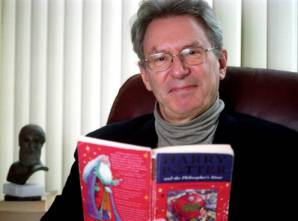
Harry Potter... in Ancient Greek

My intention was to recreate a version of the book which would make sense to a Greek from any era up to the 4th century AD who had managed by some magical process (such as would only be taught only to very advanced students at Hogwarts!) to reach the 21st century. Objects and ideas would be unfamiliar - but once he'd got used to his new surroundings, the book would make complete sense. So I thought it was very important to have this time-traveling Greek in mind at all times, and continually ask myself "would that have any meaning for him? what would he make of that?" In other words a cultural transposition is involved, not just finding the words.
Classicist Andrew Wilson discusses how he translated Harry Potter and the Philosopher's Stone into Ancient Greek, published last October. Check out his website.

Harry Potter is also available in Irish Gaelic, and I have the Latin translation sitting on my bookshelf. I'll get to it eventually when I feel more confident!

I am randomly reminded of that scene in Indiana Jones and the Last Crusade where, having escaped with the Jones Diary, Marcus Brody finds himself lost in Iskanderun trying desperately to communicate with the townsfolk:
Does anybody here speak English? Or even ancient Greek? No thank you sir, no water for me--fish make love in it. No thank you madam, no chicken I'm a vegetarian! Does anybody here understand a word I'm saying...?
Lost in his own museum.

Tuesday, February 01, 2005

In Full Compliance...

According to an independent audit:
The Archdiocese of Los Angeles has been found to be "in full compliance" with all aspects of the U.S. Bishops' "Charter for the Protection of Children and Young People".

LinkWithin

Related Posts with Thumbnails