Saturday, May 17, 2003

Healing the Culture

Fr. Robert Spitzer, S.J., Ph.D. of Gonzaga University, whom I had the priviledge of hearing at the Religious Education Congress in Los Angeles in February (see my earlier blog entry), now has his own series every wednesday this month (8pm PST) on EWTN: Healing the Culture - A Pro-Life Philosophy:
Fr. Robert Spitzer, president of Gonzaga University and deeply committed to engaging our culture in the pro-life message, unfolds a theme of developing health, happiness, and purpose within the individual and thus within society. His philosophical and theological discussions are couched in language the laity understands and appreciates, and, most importantly, will be motivated to put into practice.
The episode list is short but pretty comprehensive. As I mentioned in my earlier blog, Fr. Spitzer is co-founder for the Center For Life Principles and is a very engaging speaker. Tune him in!

Friday, May 16, 2003

How do we know?

Often times I encounter the age old argument, How else will you know _Y_ is good or bad unless you do _Y_? As though it were not possible for me to know _Y_ without doing it? And what if _Y_ is something harmful to us?

Archbishop Fulton Sheen, in his oration on Education from the TV series Life is Worth Living, had this to say about knowing:

We at times fail to distinguish between two ways of knowing anything. For example, typhoid fever can be known as we know it now, negatively; we do not have it. The evil is known by negation. There are some people who know typhoid fever experimentally; they suffer from it.. It is one thing to know intellectual errors, as the negation of truth; it is quite another thng to know evil by infection. The germ could ruin us. To know what dishonesty is one need not be a thief. To know what life is, one need not be an adulterer. Drunkenness can be known without being drunk. Education which emphasizes the necessity of living evil in order to know evil is in danger of making the mind captive to evil. Values and joys are associated with temperance, which the alcoholic does not know, and with innocence, which the sex addict can never experience. Let a drunken man become sober and he will see things as they are; let a skeptic turn to the Diety and he will begin to know truth.
So knowing evils by negation isn't necessarily a worse knowledge than knowing evils experimentally. I can see the effects of crack cocaine on the body to know that it is harmful without doing it. I can see the effects of jumping off a 10 storey building onto concrete to know that it is deadly. The same goes for spiritual evils, or sin. While I am a sinner, I know sin by the effects of it in my own life - yet I also know that by cooperating with grace and embracing the cross in faith, I can avoid sin. And because I also trust Our Lord when He tells us of how sin harms our soul, I know sin without indulging in it. Now, I don't dare boast that I have mastered this, but it is a daily walk, and were it not for God's grace, I could not do it. Hence we have the sacraments as tangible ways in which we are strengthened by His grace.

But what about the difference between knowledge by negation and knowledge by experimentation? Sometimes it is argued that to really live is to, at times, do less than moral or even harmful things. The implication is that we can never really know life without them. But is this really true? I would answer shortly that in the essence of it, it isn't true. - but perhaps there is a kernel of truth buried in there, but I think it has more to do with the reality of the human condition. Certainly one who engages in harmful activities will know them, while it is experimentally. This is because experimentation is much more concrete than knowing something by negation, which isn't as tangible to us. A young child, for example, will most realistically learn this way. The child has to touch the hot stove to know that it is hot, in spite of warnings. The child has to over indulge on sugar sweets, even if mom or dad puts the cookie jar up high. But are there degrees to which we might consider something less than moral? Has this changed in the course of time? Certainly I would hope that my child, if I had a child, wouldn't become convinced that one needs to go do crack to know what crack is all about.

But it seems to me that as one gets older, the more one realizes that one doesn't have to experiment to know the harmful effects of particular things. Therefore, I think it has more to do with the maturity of one's mind, just as the maturity of one's soul, to know and understand harmful things by negation. It is certainly true that there is considerable risk in attempting to know things experiementally, for as Sheen states,
Education which emphasizes the necessity of living evil in order to know evil is in danger of making the mind captive to evil.
We endanger our bodies to addiction and death by indulging in crack to know the effects of crack. We endanger our souls by indulging in sin to know the effects of sin.

Thursday, May 15, 2003

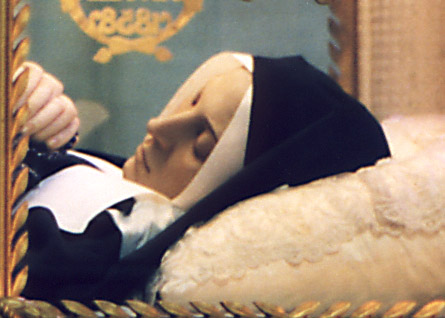
St. Bernadette Soubirous

Though I realize that this is merely the body of Bernadette,
I am struck by its restful peace just the same.


The incorrupt body of St. Bernadette (died April, 1879)


Fear and Trembling
Timor et tremor venerunt super me,
Fear and trembling have overcome me

et caligo cecidit super me.
and the shadows fall upon me

Miserere mei Domine miserere,
have mercy on me, Lord, have mercy

quoniam in te confidit anima mea.
for my soul confides in you.

Exaudi Deus deprecationem meam
Hear my plea, oh God

quia refugium meum es tu
for you are my refuge

et adjutor fortis Domine;
and you, O Lord, are my powerful aid

invocavi te non confundar.
I have called upon you, and I will not be confounded

in the garden of gethsemane...

Tristis est anima mea usque ad mortem:
my soul is sorrowful, even unto death

sustinete hic, et vigilate mecum:
remain here and watch with me

nunc videbitis turbam, quae circumdabit me.
soon you will see the crowd which will surround me

Vos fugam capietis, et ego vadam immolari pro vobis.
you will take flight, and I will go to be sacrificed for you

Ecce appropinquat hora et Filius hominis tradetur in manus peccatorum.
Behold the hour approaches when the Son of man will be handed over into the hand of sinners.

Wednesday, May 14, 2003

New Color of Money


The Department of the Treasury unveils some redesigns for American currency, with new background color!
The redesigned currency is safer, smarter and more secure: Safer because it is harder to fake and easier to check; Smarter to stay ahead of tech-savvy counterfeiters; and More Secure to protect the integrity of U.S. currency.

The most noticeable difference in the new design is the subtle introduction of background color, which makes it more burdensome for potential counterfeiters because it adds complexity to the note. The color will also make it easier to distinguish between denominations because different background colors will be used for each denomination.

However, despite the addition of color, the new note preserves the distinct size, look and feel of the traditional American “greenback” – the world’s most familiar and circulated currency.

Tuesday, May 13, 2003

Intercessions for Life

The Pro-Life Activities Division of the United States Conference of Catholic Bishops offers its June 2003 issue of "Word of Life", giving sample intercessions and bulletin announcements for Sunday Mass in both Spanish and English.

Particularly, among the fundamental rights of man, the Catholic Church claims for every human being the right to life as the primary right. She does it in the name of the truth about man and to protect his freedom that cannot be sustained without respect for the right to life. The Church affirms the right to life of every innocent human being and at every moment of his existence.

-- Pope John Paul II to the Pontifical Academy of Life (February 27, 2002)

Truth and solidarity are necessary if humanity is to succeed in building a culture of life, a civilization of love, a world of peace.

-- John Paul II, address to the Pontifical Council for Social Communications, March 25, 2003, in reference to World Communications Day, June 1, 2003 Judiciary Committee

The church respects and supports scientific research when it has a genuinely humanist orientation, avoiding any form of instrumentalization or destruction of the human being and keeping itself free from the slavery of political and economic interests.

-- John Paul II, address on Biomedical Research: Benefits, Limits of Science, February 24, 2003
The Angelus and Edgar Allan Poe

Popular culture sometimes inculturates the Catholic faith in interesting ways. For example, Edgar Allan Poe, in 1835, wondered why the bells would always toll at dawn, noon, and dusk at the nearby Fordham University. Asking the Jesuit priests there about the bells, they explained to him that the bells were tolled as they prayed the Angelus three times daily. Upon learning the Angelus, Poe, a non-Catholic, was so moved and inspired by this that he penned his famous poem, Hymn:
At morn- at noon- at twilight dim-
Maria! thou hast heard my hymn!
In joy and woe- in good and ill-
Mother of God, be with me still!
When the hours flew brightly by,
And not a cloud obscured the sky,
My soul, lest it should truant be,
Thy grace did guide to thine and thee;
Now, when storms of Fate o'ercast
Darkly my Present and my Past,
Let my Future radiant shine
With sweet hopes of thee and thine!
As you may know, the Angelus is a beautiful and powerful prayer to Mary that expresses four ideas of depth:
The annoucement to Mary via the angel Gabriel (God's Initiation)
Mary's Obedience to the Lord (Obedience)
Enfleshment of the Lord (the Incarnation)
Sharing in His Passion (daily conversion to Christ)

The Angelus

In Latin:
Angelus Domini nuntiavit Mariae.
Et concepit de Spiritu Sancto.

Ave Maria, gratia plena, dominus tecum. Benedicta tu in mulieribus, et benedictus fructus ventris tui, Jesus. Sancta Maria, Mater Dei, ora pro nobis, peccatoribus, nunc et in hora mortis nostrae. Amen.

Ecce ancilla Domini.
Fiat mihi secundum verbum tuum.

Ave Maria...

Et Verbum caro factum est.
Et habitavit in nobis.

Ave Maria...

Ora pro nobis, sancta Dei Genitrix.
Ut digni efficiamur promissionibus Christi.

Oremus.

Gratiam tuam, quaesumus, Domine, mentibus nostris infunde; ut, qui, angelo nuntiante, Christi Filii tui incarnationem cognovimus, per passionem ejus et crucem, ad resurrectionis gloriam perducamur. Per eumdem Christum Dominum nostrum.
Amen.
In English:
The angel of the Lord declared unto Mary.
And she conceived of the Holy Ghost.

Hail Mary, Full of Grace, the Lord is with you. Blessed are you among women, and blessed is the fruit of your womb, Jesus. Holy Mary, Mother of God, pray for us sinners, now, and at the hour of our death. Amen.

Behold the handmaid of the Lord.
Be it done unto me according to Thy word.

Hail Mary...

And the Word was made flesh.
And dwelt among us.

Hail Mary...

Pray for us, O holy Mother of God.
That we may be made worthy of the promises of Christ.

Let us pray

Pour forth, we beseech Thee, O Lord, Thy grace into our hearts, that we to whom the Incarnation of Christ, Thy Son, was made known by the message of an angel, may by His Passion and Cross be brought to the glory of His resurrection. Through the same Christ our Lord.
Amen.

Monday, May 12, 2003

What type of thinker are you?

You are an Intrapersonal thinker

Intrapersonal thinkers:
Spend a lot of time thinking about and trying to understand themselves
Reflect on their thoughts and moods, and work to improve them
You understand how your behaviour affects your relationships with others
Other Intrapersonal thinkers include
Sigmund Freud, Gandhi, Grahame Greene
Careers which suit Intrapersonal Thinkers include
Psychologist, Teacher, Pilot, Child care worker, Explorer, Drama therapist
What type of thinker are you?

Saturday, May 10, 2003

Beautiful Ride!

This afternoon, I biked to downtown Santa Barbara and back from where I live - total approx. 25 miles, which is quite a big deal for me! I hadn't done this ride in almost 4 years, so after a few weeks of mild preparation, I figured I was ready to give it a go. The ride there was beautiful. You take a coastal route from the university down along the beach, through the prestigious Hope Ranch community, down through a secluded beach, and then down a fun hill to the Santa Barbara Harbor and Stearn's Wharf. One of the last times I did this, I saw dolphins frolicking in the nearby sea. And today, it was a beautiful, sunny day.

However, I quickly found out that I was not in as great of shape as I initially figured, but that's okay. I gave myself opportunies to rest, kept well hydrated, and enjoyed downtown while I was there.

Have a great weekend!

Friday, May 09, 2003

The Unhealed Wound

Bishop Thomas Curry has some good criticisms of Eugene Kennedy's mindless diatribe, The Unhealed Wound: The Church, the Priesthood, and the Question of Sexuality. Kennedy gave this as a talk at the University here in Santa Barbara to plug his book. Bishop Curry writes:
In his book, Eugene Kennedy writes of "a once totally passive Catholic community conditioned to receive and accept as God's will whatever the official Church bade its members do" (p. 101).

Nineteenth century anti-Catholics would have concurred with him. As Philip Hamburger documents so thoroughly in his recent "Separation of Church and State" (Harvard U.P, 2002), that was precisely the stereotype they used to advocate the exclusion of Catholics from the franchise and political life.The very people Kennedy so denigrates faced constant and malignant prejudice, and by their courage, faith and resistance, they contributed enormously to the transformation of America into a pluralistic, open and diverse nation. In the church that they built for themselves, they found a refuge from their sufferings, and they created one of the most vibrant expressions of Catholicism ever.

... The depth of his confusion and lack of understanding of contemporary Catholicism appears in his astonishing and unsupported statement: "Distracted from or forgetting it, the church misses entirely the meaning of its central teaching that God took on our flesh in Jesus, sparing Himself none of our experiences, save sin, in order to heal our wounds and make us whole" (10).

... his view of history and life is based on crass conspiracy theory and reductionism. The Catholic people are seen as mindless sheep, manipulated by conspiring "hierarchs," or just long-suffering martyrs to the same. He reduces the whole tradition of celibacy in Catholicism to the desire of the 11th century pope Gregory VII to protect church lands (IX).
...
Reality always comes off second best when measured against an idealized future. Like a modern-day Gatsby, Kennedy believes in the "orgiastic future that year by year recedes before us." However, in his determination to present such a skewed and partisan version of Catholicism, he joins himself to an old tradition of American anti-Catholicism and is himself "borne back ceaselessly into the past."
Commencement Speakers

Graduation speakers: Issues and controversies

Interesting article by Michelle Gahee in the recent Tidings:
At Loyola Marymount University, the selection of actor-director Mel Gibson and film director William Friedkin as commencement speakers has generated much talk -- Gibson for his conservative (some would say traditional) views toward the Catholic Church (he likes the Tridentine Mass), Gibson and Friedkin for some of their films that have shown explicit violence.
Funny how she qualifies Gibson's "traditionalism" by saying he likes the Tridentine Mass. Is that all it takes?

But I'm not sure I can picture Mel Gibson at LMU. At the commencement ceremony for my B.S. degree in 2000, our speaker was the CEO of Honeywell corporation. He gave an excellent talk concerning ethics in engineering and how as engineers, we should always be asking questions about the effects of our work on the world. However, the speaker at the ceremony for my M.S. degree in 2001 gave what was largely a diatribe on the liberation of radical feminism. Sometimes it's hit and miss.

So I pose the question - what makes a truly beneficial or inspirational commencement speech?
Bridge Building

I just got back from an advisory board meeting on which I serve for the "Santa Barbara Bridge Building" program. Bridge Building is a regional young adult ministry program specifically intended for young adult Catholics ages 25-35 in the Santa Barbara Pastora Region of the Archdiocese of Los Angeles.

Young adults of this age range have a difficult time fitting into programs in this area - because most programs are either for much older Catholics, or if they are "young adult" events, they are typically for kids ages 16-24. Young adults 25+ are at a different area in life, spiritually and maturity speaking. So with the help of our regional bishop, Bishop Thomas Curry, and the Sisters of St. Joseph, Bridge Building was born.

The program proceeds in cycles. It starts with listening, then education and developing, and then service. We began the program with "conversation circles" in which we invite a bunch of young adults to come and talk about their spiritual lives, their experiences of being a young adult in the Church, and those things in their lives that prevent them from developing their spirituality as they'd like. It gives them a chance to meet one another and to gain other insights about what it means to be a young adult Catholic in Santa Barbara. Based on these things, we arrange lectures, retreats, prayer nights, and other education opportunities given by people who can speak to those needs for our age group.

Currenty, our next stage is our mission/service effort. We are arranging mission opportunities in the community to help young adults get involved, if they desire.

We then begin the cycle again. It may go an entirely different direction. Being on the advisory board to help plan these things has been a very insightful experience. It has helped me connect with other ministers in the region. What is really excellent is that I have really met a very diverse group of young adults, many of whom I number as good friends today.

Thursday, May 08, 2003

The Misplaced Infinite

A couple of weeks ago, I picked up a copy of a book of transcripts from Archbishop Fulton Sheen's Life is Worth Living (Second Series). Being a lover of Fulton Sheen's inspirational work, I figured it would be a good pick, and it was. So in addition to all the other things about which I would like to blog over the coming weeks, I'd like to occasionally blog about my impressions of a few chapters as they strike me.

In his oration, which is titled Misplaced Infinite, Sheen discusses the delineation between a normal human being and an abnormal one.

The normal human being is meant to have open relationships with the eternal or the infinite. Man has a body, a mind, and a relationship with things in the great world that constitutes his environment. The normal human being recognizes that his body gives him the capacity to experience sensual pleasure or carnal love. This love is to be seen as a spark from the great flame of love, which is God. Sex love was made not only to deepen the affection between husband and wife, not only to be a prolongation of God's creative power to creatures, but also to be a steppingstone to a higher love of God.
You can see how Sheen characterizes normal living. Our bodies, our minds, and those things which make up our environment are given to us to be oriented such that their purpose is to lift us up and direct us toward God. As Sheen illustrates with the example of the capacity of the body to feel, touch, and experience sensual pleasure - properly understood, such pleasure is intended not only to deepen the love between a married couple, but is, as Sheen puts it, a prolongation of God's creative power and to deepen our love of Him. When used, all of these faculties should always have an orientation toward God.

The mind by discovering the truths of science, history, and philosophy, gradually unifies them and sees them as a descent, refraction, and echo of the Great Omniscient Truth, which is God.
When we exercise the faculies of our mind with proper appreciation of their purpose, we are taken to the depths of deeper awareness of God. So even after reading this, one can already begin to see what Sheen believes to characterize the abnormal mind - a misguided sense of the orientation of our bodies, minds, and things in our environments.

[In] abnormal living, man [cuts] himself off from God and [proclaims] his own sufficiency. But man cannot live without a god, that is impossible. The infinite haunts him constantly. So he has to make his own gods. These gods are generally three. The first god is his own body. Sexual pleasure then becomes the supreme goal of life and ultimate happiness. He attempts to compensate for a want of eternal divine destiny by the intensity of his erotic experiences. Other men make a god of their minds through egotism and pride and the exaltation of the ego.

The body, made its own limit, becomes sex. The mind, made its own limit, becomes egotism. The things, denied an extraearthly relationship, become the source of greed. Civilization then becomes a conflict of individual egotisms, each one affirming his own will. From this result jealousies, bickerings, ... and war.

The third substitute god men make for the true God is the material: wealth, avarice, business, and greed. The true infinite is replaced by the false infinite of "more." Men attempt to cover their nudity by a vain display, thinking they are worth something because they have something.
I think that Sheen has a really good point here. Without a proper orientation of our bodies, minds, and relationship with the things in our environments, we are desparate to give them some purpose which falls short of God, which typically means they fall in on themselves. Thus they no longer lift us up in our relationship with God but leave us stranded on the dusty floors of life.

Sheen continues to note that there are two primary effects that flow from the abnormal living: Anxiety and Despair.

Anxiety, because man sees a disproportion between what he is and what he ought to be... Dispair, because living in a closed circle makes a man despair in that he cannot escape the desire for the infinite, and having made himself the infinite, he foresees there is nothing ahead of him but death, annihilation, and destruction
What he notes about despair is really interesting and perfectly correct. Man despairs when he is limited from the infinite. Man rejoices when he is free. The trouble is that the cause of man's limitation here is himself. Therefore I call this a self-perpetuating blindness, and a self-fulfilling prophecy in that, once in this rut, man gets what he pretty much expects to get.

But is hope lost on us? Of course not. If in normal living our faculties are properly oriented toward God, it cannot be because we have done this out of our own power! They are gifts of God to His Creation and we, as instruments, are empowered by His grace to use them. When we cooperate with God's freely given grace, we are created anew.

There are two things that are meant to go together. One is the misery of man: his worries, his trials, his difficulties, his sorrows. The other, the Mercy of God. Our modern world... has separated the misery of man from the mercy of God. As misery without mercy begets despair, so also, a sense of God's Mercy without a sense of sin can beget presumption, arrogance, and pride. Man has already one-half the condition of salvation - he is miserable. Then he has peace as he hears, coming from out of the darkness, the plea, "Come to Me, all ye who labor and are heavily burdened, and find rest for your souls."

Wednesday, May 07, 2003

Nuntii Latini - Recitatio Radiophonica

I want to blog briefly on a neat little resource if you are interested in hearing spoken Classical Latin. Nuntii Latini is a Finnish site where the news is broadcast each day in Classical Latin. Though Classical Latin is not what I am most familiar with simply because the Ecclesiastical Latin that I am studying tends to use some simplifications (like more use of prepositions, common to the romance languages to which classical latin gave birth), not to mention different pronunciations, I and others particularly like this site because it utilizes a rather neo-Latin vocabulary. What I mean by neo-Latin is that is a great source to hear modern terms and place names in Latin. For example, space shuttle is rendered navicula spatialis.

A transcript of the day's news is also available.

A fun time for the whole family.

Tuesday, May 06, 2003

Free Greek and Latin Study Aids

Download free books in PDF format at Textkit Greek and Latin Learning Tools:

Textkit is a language learning site which provides Greek and Latin grammars, reading material, classical e-books and other learning resources. Textkit is the Internet's leading source for free, fully downloadable, public domain Greek and Latin grammars. We also provide a wide range of classical e-books from Greek and Roman authors. With currently 119 free books to choose from, Greek and Latin learners have downloaded 52,972 grammars, readers and classical e-books.
Santa Barbara, CA

I managed to snap this photo in March of Santa Barbara on a Sunday Afternoon


Not bad for a disposable camera, isn't it?

Monday, May 05, 2003

The Eucharist in Poetry
THE HOLY EUCHARIST

by: Pedro Calderon de la Barca (1600-1681)

HONEY in the lion's mouth,
Emblem mystical, divine,
How the sweet and strong combine;
Cloven rock for Israel's drouth;
Treasure-house of golden grain
By our Joseph laid in store,
In his brethren's famine sore
Freely to dispense again;
Dew on Gideon's snowy fleece;
Well, from bitter turned to sweet;
Shew-bread laid in order meet,
Bread whose cost doth ne'er increase,
Though no rain in April fall;
Horeb's manna freely given
Showered in white dew from heaven,
Marvelous, angelical;
Weightiest bunch of Canaan's vine;
Cake to strengthen and sustain
Through long days of desert pain;
Salem's monarch's bread and wine;--
Thou the antidote shalt be
Of my sickness and my sin,
Consolation, medicine,
Life and Sacrament to me.
The Mass of the Second Vatican Council

The 1965 Missale Romanum in English

If you are a lover of liturgical history like me, you will find this interesting. The 1965 Roman Missal was published at the close of the Second Vatican Council and was apparently in use from 1965 until 1969/1970. It was superceded by the new missal of Pope Paul VI. According to the link, the 1965 missal reflects the intended fruit of Sacrosanctum Concilium. As I read through it, I could definitely see similarities to both the previously used 1962 Tridentine missal and the Novus Ordo. The link notes the following:

an option for use of the vernacular exists in the 1965. Furthermore, as in the Novus Ordo, it is at the discretion of the celebrant to either face the East ("ad orientem") or the people ("versus ad populum"). An option for concelebration was also introduced in the 1965 (this was formerly restricted to Ordination Masses). The required Mass vestments were also simplified (e.g., optionality of the maniple). In 1967, the cope was supressed in the Asperges (rite of aspersion at High Mass). The chasuble was worn in its stead. The Canon was still required to be read in Latin until 1967, when it was permitted in the vernacular. In the 1965 Missal, the priest, when administering Communion, says "the Body of Christ" (or "Corpus Christi") instead of "Corpus + Domini nostri Jesu Christi custodiat animam tuam ad vitam aeternam" (that is, "May the Body + of our Lord Jesus Christ bring thy soul unto life everlasting").

Options for congregational singing also exist in the 1965, exactly as they do in the Novus Ordo -- with places for processional, offertory, communion, and recessional hymns. The 1965 also allows for the Prayer of the Faithful after the Creed. The prayers at the foot of the altar, in addition to being made entirely optional, were shortened (as they would previously be prayed at Requiem Masses). The Last Gospel was suppressed. The calendar follows the Tridentine Ordo, consistent with that of the previous Missal (Missale Romanum 1962). Ironically enough, the New St. Joseph's Missal ends the Liturgical Calendar in 1970.

(Andrew, was this the missal that you were telling me you owned?)

Check it out!
Christ, the Medicine of Immortality

At the Pro Deo et Patria blog, Bill Cork blogs this about a bad editorial concerning the Holy Father's latest encyclical, Ecclesia de Eucharistia, by an ex-Catholic named Mark Marek, which aired on WLSH, a radio station in Lansford, Pennsylvania.

I have already now run into many people, many of them Catholics, who do not get the point of this encyclical. Their sole exposure to the encyclical is through secular media reports, and they always end up saying, "This isn't what the Church needs now!" as though the Church should no longer be willing to stand up for the Truth and the continuing call of the Gospel in spite of his human brokenness.

This is _exactly_ what the Church needs now! The problem of priestly sexual abuse is more than just a physical problem, it is a spiritual problem. And the effects are not just physical, they are also spiritual. In order to heal, we need to get our focus back on Christ. It must be back on living the Gospel. And for us Catholics, the Sacraments, particularly the Eucharist and the Sacrament of Reconciliation are ways in which God gives us the grace to answer His daily call and enhance our relationship with Him and with each other. As Bill correctly notes, the Eucharist is the "bread of life" and the "medicine of immortality" and we should never forget this.

The Holy Father knows this. And yet he also knows the terrible state that proper catechesis concerning the Eucharist and Reconciliation is in. Giving us the proper focus, allowing us to more fully understand the depth of the power and mystery of grace, the Holy Father is doing what a true shepherd does - he leads us back to Christ, the Good Shepherd. He leads us to forgiveness, reconciliation, and nourishment offered to us in the sacraments.

I ask those who feel that the time "isn't right" for the encyclical to first read the encyclical. Then I ask them, if not this, what is it time for? To toss aside the medicine of immortality for better PR? Christ never refuses someone without offering an invitation and a challenge for conversion. Our Holy Father invites those with grave sin in their life to experience and embrace the grace of forgiveness offered in Christ through the Sacrament of Reconciliation, so they can be disposed by grace to cooperate with that which Christ gives us in the gift of Himself in the Holy Eucharist.

And as members of the Body of Christ, let us not bow out at the challenge to stand up and keep running the good race, fighting the good fight, and witnessing to the world the power and beauty of the Gospel of Jesus Christ.

Friday, May 02, 2003

The Cycle of Nations

Some food for thought and discussion.

We Christians are living in a decidedly difficult time in the life of America. As abortion and general disrespect for human life rise, as the sense of absolute moral values declines, we are certainly in choppy waters. Some Christians, and indeed even some non-Christians, look to the state of our civilization and try to suggest that it is the beginning of the End Times, desparately trying to fit anything into an apocalyptic model, while justifying it by their own interpretation of Bible Prophecy. But if we study the halls of history, is it really true that what we are experiencing now is one-of-a-kind, never before experienced, event? Is this the beginning of an apocalyptic destruction, or is just simply part of the cycle of nations? After all, is it not true that later civilizations tend to make the same mistakes as former civilizations?

When the thirteen colonies were still a part of England, Professor Alexander Tyler wrote about the fall of the Athenian republic over two thousand years previous to that time:
A democracy cannot exist as a permanent form of government. It can only exist until the voters discover that they can vote themselves money from the public treasure. From that moment on the majority always votes for the candidates promising the most money from the public treasury, with the result that a democracy always collapses over loose fiscal policy followed by a dictatorship. The average age of the world's great civilizations has been two hundred years.
Alexander Tyler came up with a sequence of 10 stages that represents the cycle of nations. Kerby Anderson, in his article The Decline of a Nation states:
Each of the great civilizations in the world passed through a series of stages from their birth to their decline to their death. Historians have listed these in ten stages.

These nations have progressed through the following sequence:

     from bondage to spiritual faith,
     from spiritual faith to great courage,
     from courage to liberty,
     from liberty to abundance,
     from abundance to selfishness,
     from selfishness to complacency,
     from complacency to apathy,
     from apathy to moral decay,
     from moral decay to dependency,
     from dependency back to bondage.

Something interesting he notes is that the move from stage to stage is largely dependent upon the value associated with the family, because families are the foundation of a nation. Carl Wilson, in his book Our Dance Has Turned to Death notes a similar set of stages representing the pattern of family decline, based on a study of the Roman Empire and Ancient Greece. This is what he says:
In the first stage, men ceased to lead their families in worship. Spiritual and moral development became secondary. Their view of God became naturalistic, mathematical, and mechanical.

In the second stage, men selfishly neglected care of their wives and children to pursue material wealth, political and military power, and cultural development. Material values began to dominate thought, and the man began to exalt his own role as an individual.

The third stage involved a change in men's sexual values. Men who were preoccupied with business or war either neglected their wives sexually or became involved with lower-class women or with homosexuality. Ultimately, a double standard of morality developed.

The fourth stage affected women. The role of women at home and with children lost value and status. Women were neglected and their roles devalued. Soon they revolted to gain access to material wealth and also freedom for sex outside marriage. Women also began to minimize having sex relations to conceive children, and the emphasis became sex for pleasure. Marriage laws were changed to make divorce easy.

In the fifth stage, husbands and wives competed against each other for money, home leadership, and the affection of their children. This resulted in hostility and frustration and possible homosexuality in the children. Many marriages ended in separation and divorce. Many children were unwanted, aborted, abandoned, molested, and undisciplined. The more undisciplined children became, the more social pressure there was not to have children. The breakdown of the home produced anarchy.

In the sixth stage, selfish individualism grew and carried over into society, fragmenting it into smaller and smaller group loyalties. The nation was thus weakened by internal conflict. The decrease in the birthrate produced an older population that had less ability to defend itself and less will to do so, making the nation more vulnerable to its enemies.

Finally, unbelief in God became more complete, parental authority diminished, and ethical and moral principles disappeared, affecting the economy and government. Thus, by internal weakness and fragmentation the societies came apart. There was no way to save them except by a dictator who arose from within or by barbarians who invaded from without.

A nation will not be strong unless the family is strong. That was true in the ancient world and it is true today.

Interesting. Personally, I think that this model may be a tad over-generalized. But I ask you what you think about this model. What is the current stage of America according to this picture? And what does this say? One thing that one could use in the initial argument, that what we are experiencing now is unparalleled in history, is the fact that the world is so much more globalized than it has been at any other point. There is no longer the same extent of isolation between nations on opposite ends of the globe. Because media is now so ubiquitous, and the advent of the Internet has joined much of the world together, there is much more interaction between nations and global civilizations. Hence, we affect each other uniquely.

And then again, the Cycle of Nations may just be another world theory of doom and gloom. It certainly isn't necessary that we follow the path of some deterministic model.

Thursday, May 01, 2003

John 3:31-36 from today's readings


Qui de sursum venit, supra omnes est;
qui est de terra, de terra est et de terra loquitur.
Qui de caelo venit, supra omnes est;
et quod vidit et audivit, hoc testatur,
et testimonium eius nemo accipit.
Qui accipit eius testimonium, signavit quia Deus verax est.
Quem enim misit Deus, verba Dei loquitur;
non enim ad mensuram dat Spiritum.
Pater diligit Filium et omnia dedit in manu eius.
Qui credit in Filium, habet vitam aeternam;
qui autem incredulus est Filio, non videbit vitam,
sed ira Dei manet super eum.
Nova Vulgata


The one who comes from above is above all.
The one who is of the earth is earthly and speaks of earthly things.
But the one who comes from heaven is above all.
He testifies to what he has seen and heard,
but no one accepts his testimony.
Whoever does accept his testimony certifies that God is trustworthy.
For the one whom God sent speaks the words of God.
He does not ration his gift of the Spirit.
The Father loves the Son and has given everything over to him.
Whoever believes in the Son has eternal life,
but whoever disobeys the Son will not see life,
but the wrath of God remains upon him.
New American


Praise to you, Lord Jesus Christ

Wednesday, April 30, 2003

Vatican Ecumenical Conference on Catholic, Orthodox views on Papal Primacy

Catholic World News reports here about an ecumenical conference being organized under the auspices of the Holy See to engage Catholic and Orthodox scholars in a dialogue on the primacy of the Bishop of Rome.

The meeting will be a closed-door session, at which the participants will be scholars drawn from the Catholic and Orthodox traditions... representatives of the Russian Orthodox Church are expected to participate. Vatican officials have been pleased with the recent progress in relations with the Eastern churches. And many officials in Rome are convinced that-- as one official put it-- "the example of an eventual reconciliation with the Orthodox will certainly promote reconciliation with the other Christian denominations."

CWN summarizes the key issue at stake:

Pope John Paul II has made it clear that he has no desire to govern the Orthodox churches in the same way that he governs the Roman Catholic Church. Discussions about Church governance could boil down to questions about the respective powers of the Pope and the patriarchs of the Eastern churches. Before the schism of 1054, one Vatican official notes, the governance of the Church was divided among "the five great patriarchates, managed by five patriarchs who had full authority over their own churches." That historical example might furnish one possible model for the future, in which the Pope-- the Patriarch of Rome-- would be recognized as the "first among equals," with the power to curb the actions of any other patriarch who exceeded his own proper authority. "The question, then," the Vatican official concludes, "is which rights and duties are reserved for the Pope, and which can be left to the other patriarchs." ... Another key question is whether the Pope's primacy should be understood as a primary of honor or a primacy of jurisdiction. The noted French Orthodox theologian Olivier Clement, author of a key work on Catholic-Orthodox dialogue, points out that the two possibilities cannot be entirely separated. He observes: "The primacy of honor-- which, we should note, is granted to the Pope by all the Orthodox churches-- must inevitably convey to the Patriarch of Rome some measure of power as well, even if it is only the power of presiding."

In recent years, I have been priviledged to know many Eastern Catholics in union with Rome. In discussing the issue of papal primacy with them, they demonstrate to me that this issue is definitely not irreconcilable, even though historically this issue is probably one of the most difficult and most sensitive of issues to deal with. Unity among the apostolic churches is my solemn prayer.
Let's retrieve more of our Sacred Music heritage!

Thanks to Confessions of an Accidental Choir Director for this link.

The Choral Public Domain Library

The Choral Public Domain Library (CPDL) is an internet-based free sheet music which specializes in choral music. Most of the scores are in the public domain, but a growing number of scores are newly composed. The scores are contributed by volunteers, and the website is managed by Rafael Ornes (ornes@cpdl.org).

Check it out! A real treasure chest of our valuable sacred music heritage - sheet music for Haydn, Mozart, di Lasso, de Victoria, Byrd, Palestrina, and many, many others.
NOW and Connor Peterson's life

Susan Wills, associate director for education with the US Conference of Catholic Bishops' Secretariat for Pro-Life Activities, issued this statement five days ago with regard to the stubborn consistency of NOW and other pro-abortion groups who object to granting the status of "wanted, loved, living human being" to Laci Peterson's son, Connor, whose body washed ashore a couple of weeks ago. These groups vehemently object to charging Scott Peterson with double homicide because it might give "ammunition" to the pro-life cause (not because of "justice").

In the statement, Wills states that, those who work for the abortion industry react differently to such events. Human feelings are kept in check, while any event or policy that concerns a child before or near birth is minutely scrutinized for its potential to "undermine Roe v. Wade." Anything that threatens the shaky "constitutionality" of Roe must be stopped!

Better to pretend Connor's death was a non-event, reasoned the New Jersey chapter president of NOW who reacted indignantly to the double-murder charge: "If this is murder," she said, "well, then any time a late-term fetus is aborted, they could call it murder."

...

Today, their policy is becoming more philosophically consistent, but it's careening ever further from reality, justice and truth. Today the "wanted" child needing protection, assistance and healthcare is dismissed as a nonentity as well. Is there no bottom to Roe's slippery slope?


It doesn't matter that Laci and her family wanted and loved Connor and treated him as though he was a living child as they eagerly awaited his birth. Is this really respectful to Laci? Is this really what being "pro-woman" means to NOW?
Religious Education Congress, part 2

John Allen, Vatican Correspondent for the National Catholic Reporter, was on site to give another workshop concerning "The Next Pope." Now, I am not a big fan of the National Catholic Reporter, but I do enjoy reading Allen's "The Word From Rome," and I have a lot of respect for his insights. I can tell he has a great respect for the Holy Father as he is very much a part of the "goings on" in Rome. Because he has his ear in a lot of the talk on the streets of Rome with regard particular papal condidates in a future papacy, I figured his workshop would be interesting, and it was.

He prefaced his talk with the warning that "the garbage bins of Rome are filled with the corpses of journalists who have failed to predict the next pope." I was certainly prepared to hear his own personal, speculative opinion, but I was curious.

Allens feels that there are five primary issues considered important to the cardinals right now. These issues are:

1.) Collegiality - How much of a role will the pope have over the goings on in other dioceses?
2.) Ecumenism and dialogue - Will the pope engage ecumenical activities and dialogue with other churches and non-Catholic communities?
3.) Globalization - Will the pope be conscious to globalization?
4.) Bioethics - How will the pope engage such issues as abortion, embryonic stem-cell research, and euthanasia?
5.) Role of the laity - How will the pope involve laity in particular areas of leadership or decision making?

In addition to these, Allen outlined some particular character traits which he believes are seen by many of the cardinals as ideal in the next pope:

1.) The pope should have a charismatic appeal to the "world stage" (much like our current Holy Father)
2.) The pope should manifest a discernable holiness in his person. This is very improtant.
3.) An older candidate is preferable. A shorter pontificate would best follow a longer and fuller pontificate such as our current pope's.
4.) The pope should come from an area of the world with deep Catholic roots.
5.) The pope should understand the reality of injustice, suffering, and oppression and come from an area of the world, such as the third world, where that is a reality - just as our current pope came from behind the Iron Curtain.

Based on these issues, Allen perceives a "buzz" amongst the cardinals concerning particular papal possibilities, and he narrows them down to 3 candidates:

1.) Claudio Cardinal Hummes of Sao Paolo, Brazil. He is a Franciscan, an athlete, 68 years of age, considered "moderate", well respected by the people, big on social justice issues of the world. Not too charismatic - not able to "set the world on fire."
2.) Oscar Cardinal Rodriguez of Honduras - 60 years of age, very charismatic, speaks 7 languages, licensed pilot, pianist, big on social justice and traveling around the world to speak.
3.) Godfried Cardinal Danneels of Brussels - 68 years of age, one of the great "theological giants" of the Church. Not from the third world, but well respected amongst other Cardinals.

Incidentally, Oscar Rodriguez was a presenter at the Religious Education Congress and was celebrating the Spanish liturgy following the talk! I took the liberty of attending that, and I was impressed by what limited exposure I had of him. I'm not a Spanish speaker, but I was able to interpret some important points he preached about during his homily. He echoed the Holy Father's sentiment concerning war, and also spoke against the injustices of abortion and oppression in the world. He certainly has a "pope-able" demeanor, but what do *I* know about that?

Overall, an interesting analysis, though I should echo that be the next pope "good" or not by our standards, it is ultimately the responsibility of the Holy Spirit to guide the Church. I have no worries as long as I trust God who is in control, not us! I thank God for the long and very full pontificate of our current Holy Father, and I was priviledged to have been able to see him and hear him preach at World Youth Day in Toronto last July. I wish him many more years. He is very real about his humanity and is ever careful in his call to holiness and cooperation with God's grace in his life - and ever mindful of challenging the world to join him in living a full and engaging life as Christians in a world in ever desparate need of the Gospel.

What do y'all think about these possible candidates?

Tuesday, April 29, 2003

Life is Worth Living: Children

"How dull life would be if a musician were always picking up a violin and a bow, but never producing a melody; or a sculptor were always picking up a chisel, applying it to marble, but never creating a statue; or a poet were putting pen to paper, but never wrote a thoughtful line. Would not the farmer go mad if, each spring after he had planted the seed, he immediately dug it up, went on repeating the silly process, and never waited for fruits and harvests? What would happen to the mind and heart of a woman who, just as soon as the buds began to appear in her garden, cut each of them off, so that she never fondled a rose. Love, by its very nature, wants to bear some fruit; thus is saves itself from a duality that is death... Love is then discovered to be, not like the serpent that crawls on the same level, but rather like a bird that has an ascension of love and begins to taste its sweetest moments in the higher summits of flight."

-Archbishop Fulton J. Sheen, from his 1950's television series "Life is Worth Living"
Religious Education Congress, part 1

It's been about two months since I attended the annual Religious Education Congress in Anaheim, an event sponsored by the Office of Religious Education with the Archdiocese of Los Angeles. While some of the workshops didn't excite me too much, I did have the fortune of attending a few that I found to be really good. (I've actually been meaning to write about them for a while) I'll be blogging about them over the course of the next few days.

One talk I attended concerned Physician Assisted Suicide (PAS). It was given by Fr. Robert Spitzer, S.J., Ph.D., president of Gonzaga University in Spokane, WA and co-founder of the Center for Life Principles. He gave an excellent lecture refuting the four primary arguments often given to justify PAS. Much of what he said also applies to arguments in favor of abortion, which I will address. Fundamentally, our opposition to PAS, as well as our opposition to abortion, is rooted in our belief that all human beings are created in the Image of God, from which they derive an inherent dignity and value that is holy.

1.) Pain Protocols vs. "Aid in Dying"
One of the arguments used by the Hemlock Society and other supporters of PAS is that its purpose is to relieve the intense pain of terminal illness. What many people do not know is that approx. 90% of the pain in a terminal illness, such a cancer, can be controlled 100% of the time if physicians are only aware of the treatments available and know how to properly medicate their patients. Furthermore, most of the requests for suicide come from patients who also suffer from depression. According to Spitzer, 97% of all suicide requests are reversed when the pain and depression are treated properly. Spitzer did mention that many physicians often avoid certain pain protocols out of fear of a chemical dependency/addiction. But he notes that when you're dealing with a patient who has a terminal illness, this probably shouldn't be the #1 thing to worry about. If the effects of chemical dependency are not too debilitating or dangerous, depending on what those effects are and how the patient is treated, many rejected pain treatments should be frequently reevaluated. Is suicide therefore a necessity?

2.) Options vs. Duties.
Supports of PAS often argue that they are merely fighting to have PAS be another option that people may choose should they need it, and that opponents to PAS should calm down in that nobody is being forced to die. But is this really true? Spitzer brought up Montesquieu who is credited with having said, Frequently enough, one person's options are another person's duties. What this means is that many choices are treated often as duties by our society, depending on the values. This is certainly true in the case of abortion. Consider the poor, unwed mother who is told by society that having a baby will ruin her life, told by the university that she cannot attend school, and is told by employers that she cannot work in a career that she is qualified for and support a child. It is easy to see why abortion may not be seen as an option, but as a duty placed upon the mother. Many women often explain that they felt they had to have an abortion out of necessity - that they felt they had no choice. So it is with PAS. The option to die becomes the duty to die, particularly if you perceive that you may be a burden to your family, or to friends, or to society, especially when your own child or your own doctor is the one who suggests it. Also, insurance companies could offer a discount to those who, thinking they may never need it or use it, allow PAS. What choice does this give to the poor? The key here is to always work for social change. Are we creating a duty by allowing the option to die? Are we creating a duty by allowing abortion?

3.) Quality of Life
This is the argument I hear the most. The argument asserts that the last six months of life are not worth living because your autonomy is decreased, your ambulatory ability is limited, your verbal capacity is decreased, etc. This decrease in powers warrants PAS because your quality of life isn't significant enough to warrant living.

However, for many, especially the Christian, self-possession is not what makes the entirety of quality of life - but rather it is also love and self-transcendence (faith) that make quality of life. And it is true that these often increase significantly prior to death. To articulate this, Spitzer outlined the four levels of happiness (popularized by Life Principles):
    1.) Materialistic: how much money you have, the things that you own.
    2.) Self-possession: Ego-fulfillment, career, personal control,...
    3.) Self-communication: Love, agape, ability to impart wisdom, ability to forgive, reconcile, to make a positive difference, justice, community.
    4.) Self-transcendence: through faith, learn about truth, love, justice, and beauty. Learn about God.

In the last six months of life, the ability of acquiring levels 1 and 2 will decrease, but 3 and 4 can increase. This makes sense since levels 1 and 2 often have immediate and short-term effects, whereas the effects of 3 and 4 are more long term.

Our Catholic tradition also allows for the concept of redemptive suffering - that suffering has redemptive value - it is not always bad, it can be transformative of ourselves and of others. Spitzer notes that God can work even in the comatose and the most vulnerable. If quality of life is what you pay for in life, then the common good is merely a cultural property. This understanding destroys the notion of love of the other, which kills dignity, and eradicates inalienable rights. If you have loved ones suffering from terminal illness, or even loved ones in nursing homes, always let them know how much you value them in your life. Continue to learn from them, allow them to pray for you and with you. As we know from being at grandma's house, being in their very presence is often very empowering.

4.) Effects on culture
This argument asserts that PAS enables cultural advancement because we cannot afford to keep people alive beyond their productive years. But how is productivity defined here? Most supporters of PAS would argue that productivity is defined by self-possession (#2 in the levels of happiness above). But is there no productivity associated with ability to love? Who hasn't been empowered by the love of a grandparent, or by the love of children? This goes way beyond the work place and is not linked to money and economics.

But is PAS a cultural good?

Spitzer quoted Edmund Burke who stated that what you legally sanction becomes normative, and what becomes normative becomes moral. This means that a legal act is interpreted as being an act sanctioned by the government, and effectively, by society. "Everybody does it." But if you legalize/sanction suicide, what are you making moral? Is it not true that a society's youth often initially develops morality based upon what is normative in culture, but this is generally true of society - and the argument can be made that we have seen that effect regarding the issue of abortion.

More tomorrow.

Monday, April 28, 2003

Quasimodo Sunday / Divine Mercy Sunday/ First Sunday after Easter

Yesterday I took a trip down to Ventura for the weekly Tridentine Latin Mass indult at the beautiful San Buenaventura mission, where I heard the words that brought back a flood of memories. Yesterday. the first Sunday after Easter, is traditionally known, primarily in France and other parts of Europe, as "Quasimodo Sunday" because of the beginning words of the Introit which come from 1 Peter 2:2,3: Quasi modo geniti infantes, rationabile, sine dolo lac concupiscite ut in eo crescatis in salutem si gustastis quoniam dulcis Dominus, which in English is: As newborn babes, desire the rational milk without guile, that thereby you may grow unto salvation: If so be you have tasted that the Lord is sweet. It is used in the context of this particular Sunday to refer to the newly baptized at Easter as well as applying generally to all of us. But I learned about Quasimodo Sunday about four years before I became a Catholic, and about a year before I ever desired to study the Catholic Church! Though, at the time I did not fully understand the Easter connection as I do now.

Victor Hugo's The Hunchback of Notre Dame


    "Sixteen years previous to the epoch when this story takes place, one fine morning, on Quasimodo Sunday, a living creature had been deposited, after mass, in the church of Notre- Dame, on the wooden bed securely fixed in the vestibule on the left, opposite that great image of Saint Christopher, which the figure of Messire Antoine des Essarts, chevalier, carved in stone, had been gazing at on his knees since 1413, when they took it into their heads to overthrow the saint and the faithful follower. Upon this bed of wood it was customary to expose foundlings for public charity. Whoever cared to take them did so. In front of the wooden bed was a copper basin for alms. The sort of living being which lay upon that plank on the morning of Quasimodo, in the year of the Lord, 1467, appeared to excite to a high degree, the curiosity of the numerous group which had congregated about the wooden bed."
    -4th Book, Chapter 1.

I first read Hunchback in the 10th grade, and it has always been one of my favorite books, and now that I understand the Easter connection better, I can understand the figure of the Hunchback, named after the Sunday on which he was found, much better than I did then. Victor Hugo's story is a tale of redemption in the face of corruption, the sublime versus the grotesque. While the world prided itself on being beautiful on the outside, yet was bitter and ugly on the inside, only Quasimodo, the disfigured hunchback in Hugo's story, understood the value, and the pain, of being inwardly transformed in the innocent loving of others.

Saturday, April 26, 2003

Which Twentieth Century Pope are you?


John Paul II
You are Pope John Paul II. You are a force to be reckoned with.

Which Twentieth Century Pope Are You?
brought to you by Quizilla

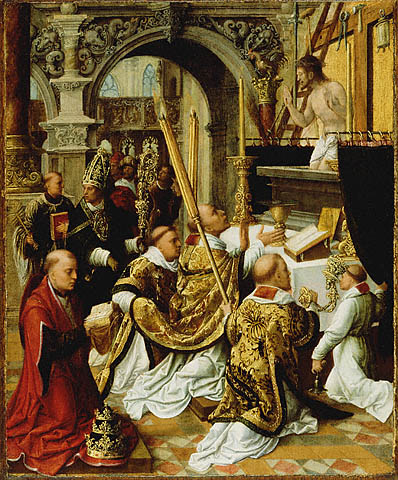
The Mass of St. Gregory the Great


Adrien Ysenbrandt
Netherlandish, 1510 - 1550

From the Getty Center Collection:
In an elaborately detailed Gothic cathedral, Pope Gregory the Great kneels before the crucified Christ, who has miraculously appeared before the congregation. While saying mass one day, Pope Gregory became aware of a disbeliever and began to pray for a sign that would leave no doubt about the real presence of Christ in the Mass. Showing his stigmata and surrounded by instruments of his Passion, Christ materialized before the Pope. Gregory sees the vision first, gazing intently above as he spreads his hands in amazement.


Adriaen Ysenbrandt used gold-colored paint liberally to describe decorative candlesticks, censers, goblets, and the fine liturgical vestments. The church's ornate interior was rendered in crisp detail. In contrast, the figure's faces were softly and loosely painted, giving their features a blurred effect.
Salvete!

Okay, I know what you might be thinking - but I'm not doing this _just_ to be part of the respectible growing blog crowd! Honest! But seriously. I'd like to use this space to flush out some really interesting thinking. Some humorous stuff, some spiritual stuff, some philosophical stuff, and all things ancient and modern. I'd love to give adventures in theology, philosophy, and many other venerable topics of discussion.

I'm a 24 year old Software Engineer and Roman Catholic convert from the Southern Baptist faith. I reside in beautiful Santa Barbara, CA. I'm not anything extreme - I just love Christ and His Church. I love the sacraments, and I especially enjoy the study of liturgical history (I even enjoy a traditional latin mass or eastern divine liturgy occasionally.) But I am at home wherever the mass is being celebrated. I'm big on Scripture and Apostolic Tradition, and I'm a lover of the French language, one of the most beautiful, and the Latin language, one of the great ancient and venerable tongues. I also love sacred art and music, though I am neither an artist nor a musician! But when something touches me, I'll share it.

Peace be with you.

LinkWithin

Related Posts with Thumbnails