Tuesday, April 19, 2005

HABEMUS PAPAM!


The Holy Father Pope Benedict XVI!

Sunday, April 17, 2005

The Good Shepherd
Surrexit pastor bonus, qui animam suam posuit pro ovibus suis, et pro grege suo mori dignatus est, alleluia.
Christ, the Good Shepherd, is an excellent image to keep in mind as we enter the period of the conclave in which the cardinals of the Church will, with the guidance of the Holy Spirit, choose the papal successor to our Holy Father Pope John Paul II.
[Jesus said to them,] I am the good shepherd. The good shepherd lays down his life for the sheep. He who is a hireling and not a shepherd, whose own the sheep are not, sees the wolf coming and leaves the sheep and flees; and the wolf snatches them and scatters them. He flees because he is a hireling and cares nothing for the sheep. I am the good shepherd; I know my own and my own know me, as the Father knows me and I know the Father; and I lay down my life for the sheep.
-The Gospel of John 10:11-15 (RSV)

Saturday, April 16, 2005

So.. what happens now?

Since the Holy Father's death, I have felt somewhat reluctant to write anything. I thought that perhaps after all of this time, I would have found something really eloquent to say, but it ain't comin'. What is there to say that hasn't already been said? So I've been offering prayer for the Holy Father... and Santo Subito!, as they say in Rome these days. I miss the Holy Father. Technically, I was born in the last months of the life of Pope Paul VI, yet of course, Pope John Paul II is the only pope I remember. For 26 years, I have grown up knowing only this pope. Even prior to my becoming Catholic, I knew of him. Granted, back then, I knew very little about who he was, but he was there. And now, we are preparing for a new pope, and for me and many of my generation, that is truly a strange prospect. I'm not sure quite how to act or think about it. Don't take it for granted - the young people of today's world have a special connection to Pope John Paul II, and it's going to be interesting moving into a new era of the Church with a new Holy Father. I guess it comes down to trusting the Holy Spirit.

He had a legacy...

People are arguing about this pope's legacy. Some traditionalists argue that it echoed an exceedingly progressive agenda with regard to ecumenism and social justice, while extreme progressives argue that the pope's legacy is a legacy of ideological oppression. I know that's an oversimplification - Personally, I'm not there. I admired this pope's ecumenical efforts and his stand for social justice, and I was not scandalized by his efforts to preach peace at Assisi. Yet, people missed that message, and as a result, there was confusion. On the same line, I admire this pope's commitment to the Gospel and to the teachings of the Church. I respect his authentic vision of the Second Vatican Council, and I respect him for standing firm on issues the Church does not have the authority to change (e.g. ordination of women to the presbyterate). Yet, people missed this message too, and again, there was confusion. We can critique every thing a pope does and ascertain certain effects present to us today, but it is incredibly difficult to judge them from the context of history, especially the actions of such a prophetic pope with such extraordinary vision. Personally, in the whirlwind of secularism that has devastated so much of the world during the last 40 years (or even the last 100 years), I think we are much better off than we could have been. Yes, there are problems.

The world respects John Paul II for the various roles he played on the world scene. Among other notable things, they see his contribution to the fall of communism and his opposition to war. They see his commitment to social justice and despise his opposition to the moral and physical dangers of artificial birth control. I see those things connected to the whole of the man, the pope, that was John Paul II.


What of young adults?

I don't speak for all young adults, but I do speak for many. This pope was our hero. He loved us. He rescued us from a troubled sea with the strong message of Christ's redemption. He reached out to us and challenged us with the Gospel and, in doing so, gave us an invitation to go even deeper. He told us that with God's grace, nothing was impossible for us. He made sure we knew that we were invited to share in the very divine life of God through our active participation in the sacramental life of the church. Were it not for this pope, I would not know Jesus as I know Him today.

This pope's extraordinary connection and contribution to the young people of the world has taken root, and while we can definitely see its effects today, we will see its greatest effects in the coming years. His encyclicals as well as his theology of the body demonstrated his ability to phrase the teachings of the church in ways that we, of this generation, could understand, embrace, and carry forward. And we will carry them forward. We will be studying these writings for centuries to come because they are prophetic, and they are radical. The Holy Father showed us that living the Christian life meant living a radical life with a powerful witness, set apart from the world's standards while still a part of the world.

What do I know?

I saw the Holy Father at World Youth Day 2002 in Toronto. Unlike some people, I never got to shake his hand or kiss his ring, but I did get to see him up close and attend one of his papal masses. Here is one of my pictures:


I didn't need a picture to commemorate it, but I succumbed to a desire for a tangible icon to remember the experience by. My humanness, I guess. But it wasn't just the Holy Father. It was the world's pilgrims gathered together there with me, the universal church with our universal shepherd - the complete image.


In the future...

This pope set an example of Christian holiness for me. That we as young adults can walk the fine line toward embracing true Christian holiness, and therefore true freedom, without falling into or getting carried away by the ebb and flow of various ideological fringe groups, "liberal" and "conservative", at war within the modern church. This has been the most difficult part of living the Catholic faith for me because it means embracing the challenge to be devout and orthodox in my beliefs together with the challenge to live those beliefs in an outward manner, calling attention to social justice, and speaking out on behalf of those whom society oppresses. I'm not completely there yet, but I see it as a goal. It can be done without being angry or giving in to the human lure of extreme progressivist indifference or extreme traditionalist rigidity. Our pope lived in the radical center of the tension, the locus of paradox, and that is where I want to be as well. I will stumble, but please God, let that be all.

I'm going to pull this to a close, but I hope that this illustrates one thing from my point of view: John Paul II was truly great, in the many senses of the word. At least, I can say that about his role in my life, and that is what I will pass on to future generations. And it is with a profound sadness that I let him go into the mercy of God.


As we, as a church, say goodbye to our Holy Father, Pope John Paul II, let us now look forward to the new man who will shepherd the universal church forward into the heights... and depths... of the third millennium.

Saturday, April 02, 2005

The See of Rome is Vacant

The Holy Father has died. Delivered into the arms of the Savior he adored, and the Mother he loved so much. May his legacy live on.
Subvénite, Sancti Dei; occúrrite, Angeli Domini: Suscipientes animam eius. Offerentes eam in conspectu Altissimi.
I have been informed that my cardinal archbishop, Roger Cardinal Mahony, is already making his way to Rome to meet with the other cardinals. He has left some guidelines for the archdiocese to follow in the coming days. May the Holy Spirit guide the cardinals and all the Church through the next few weeks and beyond.
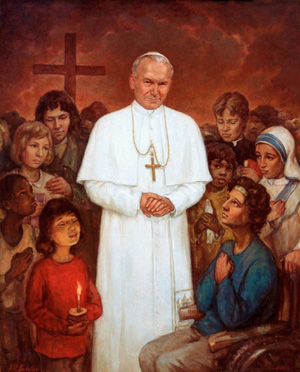
EWTN has a thorough website explaining what happens upon the death of a pope when the Holy See is vacant; a period referred to as the Interregnum.
The Holy Father

Easter came and went, and I have slacked off on posting anything. And so many events have happened... forgive me.

Please join me in praying for the Holy Father; It most likely isn't going to be too long before our Lord calls him home. An incredible figure of world history, and incredible pope for our universal church.


Friday, March 18, 2005

Speaking of Faith and Reason
Faith and reason are like two wings on which the human spirit rises to the contemplation of truth; and God has placed in the human heart a desire to know the truth - in a word, to know himself - so that, by knowing and loving God, men and women may also come to the fullness of truth about themselves.
Pope John Paul II from the opening of his encyclical letter, Fides et Ratio.
The Pope: Doctor Veritatis or Rock Star?

Another thing stuck out about John Allen's column; he discusses Archbishop Michael Miller, secretary of the Congregation for Catholic Education, who spoke March 9 in the "Theology on Tap" series in Rome, at the Nag's Head Pub, on the subject "The Pope is a Rock Star!: Legacy of a Living Legend."
Miller began by emphasizing that the title of his talk was assigned to him, and he doesn't think the pope is a rock star.

He then told two stories of John Paul II, one set in 1978 when Miller was a student at the Canadian College and Cardinal Karol Wojtyla was first elected pope. "He was a strong man, a robust man, who simply dominated St. Peter's Square from the beginning," Miller recalled. He contrasted that memory with seeing the pope in February/March 2005, now the Suffering Servant of Isaiah.

"We don't see God's athlete," Miller said. "We see a face frozen in this Parkinsonian mask. We see a man who has always been in touch with his own body slowly crumbling. ? He's letting it unfold before us, allowing himself to be a kind of spectacle to the world. He's demonstrating that life is still wonderful and beautiful, that there's nothing shameful in illness, suffering and approaching death."

Miller then presented what he conceded is inevitably a partial list of elements of John Paul's legacy.

First, Miller argued, John Paul has "recast the meaning of the papal ministry, and set an agenda for what it means for generations to come. He has done so, Miller believes, by regarding "the whole world as his parish." He is "the evangelizer par excellence," so that it is now unimaginable that a future pope would "withdraw behind the walls of the Vatican and have people come to him."

Second, John Paul is a world leader, "the single most authoritative voice on moral questions worldwide." In this regard, Miller observed, no one in the future will ever be able to complain about a "silence" of John Paul II on pressing social and ethical concerns.

Third, Miller noted, John Paul is a "true believer," a man for whom there are "no shortcuts and no compromises." He said that "in a world of doublespeak, you get clarity."

Fourth, Miller said that John Paul has created a body of teaching "which surpasses that of any other pope," certainly in quantity, and arguably in richness and depth. Miller said that today some call John Paul II the doctor veritatis, or "doctor of truth." On quantity, Miller observed that John Paul has turned out 30 pages a day of written material.

Fifth, Miller said that John Paul has helped to shape "a new Christian humanism." The pope believes that modern civilization is in crisis, Miller said, and that the way forward must revolve around three central truths about Christ, the human person and the church. "The pope has a radical sense of Christ as the center of the universe and of history," he said. "He's Christological to the core."

Sixth, Miller said that John Paul has worked out a theology of the body that is deeply sacramental. It arises, he said, from the pope's "rich vision" of the human person and what human dignity requires.
He's absolutely right about these points. Yet I don't think many people, including many Catholics my age, have a memory with regard to all that the Pope has done, nor do we appreciate just how much he has contributed to the world. What might explain some of this is the fact that all many Catholics my age know about the Pope is what we have seen on the television news or read in newspapers. To use a harsh term, we have allowed the secular media to spoon feed us for too long. We've lost our ability to engage and reflect.

I wish more young adults would spend time studying the pope's encyclicals - they contain so much depth and wisdom, and they are strikingly prophetic, particularly Fides et Ratio (Faith and Reason), Evangelium Vitae (The Gospel of Life), and Veritatis Splendor (The Splendor of Truth).

I also wish more young adults would spend time studying all that the Holy Father has put forth regarding the Theology of the Body and weigh it, honestly and sincerely, against what the world says about humanity, love, sex, human dignity, and responsibility. We also need leaders who are willing to teach these things and actually challenge us, knowing full well that we have brains!
Cardinal George on the New Missal

In John Allen's latest Word from Rome column, he recalls having a conversation with Cardinal Francis George of Chicago and discussing, among other things, the new English translation of the mass and the new Roman Missal:
On liturgical matters, George said that English-speaking Catholics will indeed one day be saying "and with your Spirit" rather than "and also with you" when the celebrant says "The Lord be with you" during Mass.... He conceded it may be tough for some Catholics to swallow.

"People possess the English texts in a way they never possessed the Latin," he said. "For some, it will be a difficult habit to break." For precisely that reason, George said, the preference among most bishops is to leave the rest of the "people's parts," meaning those phrases spoken aloud by the faithful, alone.
I myself have often wondered how difficult it will be to instruct the faithful on saying new things. I recall the chaos over the implementation of the 2000 GIRM, where some parishes spent a great deal on education, while others, like my own parish, did absolutely nothing to educate the faithful. Then there are others who will refuse to change or adapt. It will take time. Allen goes on:
Still, George predicted it will be at least another three years before work is completed on the new Roman Missal, the book containing the prayers for the Mass. He said roughly 40 percent of the work is done, and that the rest could be completed within that time "with a lot of hard work by a lot of people."

... Some liturgists, I noted, feel that what's happened is not so much about content as about power, specifically Rome's desire to take control of liturgical translation away from local churches.

"The challenge Rome put to the local bishops was to take possession of the process itself, to have bishops involved in every step," George said. "Maybe it's more accurate to say that control has been taken away from the experts and given back to the bishops."

"Canonically, I don't believe it's any more centralized than before," George said. "The structures are intact, but with a different cast of characters."
It will be interesting as it unfolds.
Pray for Terri

Pray for Terri Schaivo who is now being starved to death. Please also pray for Operation Rescue, a group of individuals who will risk arrest in civil disobedience by bringing food and water to Terri tomorrow. As Bill mentions, tomorrow is the feast of St. Joseph, and this is a corporal work of mercy.

Wednesday, March 16, 2005

Inactivity, with Bush in Heaven

Sorry for all of the inactivity lately; I've been busy with various things, including a major release at work, various events related to my ministry work here in Santa Barbara, and preparation to take the train (first time ever) down to the San Diego area for Holy Week.

But to add some relief, I found this posted over at textkit.com, so I couldn't resist posting it here:
George W. Bush mortuus erat et ad ianuam caeli stetit. Introire voluit et ianuam pulsavit. "Quis es?", Deus quaesivit. Bush dixit se Bush esse. "Proba te illum esse", dixit Deus. Dixit Bush, "Cur me Bush esse probare debeo?". "Omnes debent; Einstein debuit, Picasso debuit", Deus respondit. Bush miratus: "Quis Einstein est, quis Picasso est?". Suspiravit Deus, "introi".
I'll refrain from posting an English translation since you've no doubt heard a version of it before.

Sunday, March 13, 2005

John Allen, Opus Dei, and RE Congress

Last week, I received the tape of John Allen's talk concerning Opus Dei: Myth and Reality from last month's Religious Education Congress in Los Angeles. In my opinion, it was an excellent talk, as he addressed the various myths concerning the group that have been perpetuated in various Catholic circles and in pop-culture (such as from "The Da Vinci Code"). What Allen has presented is a very even handed presentation using his research done for his upcoming book concerning Opus Dei, which I will certainly make a point of reading. Claude Muncey has already written an excellent review of the talk. I agree with his points and refer you there for more information. :) I would also like to refer you to Opus Dei cooperator and fellow blogger Matthew Collins' Opus Dei FAQ.

The Religious Education Congress is a mixed bag. Though I didn't attend this year, I myself have attended four times in the past and have had occasion there to hear some really good speakers, such as John Allen, Fr. Robert Spitzer, S.J., and Fr. Virgilio Elizondo. I have also had occasion to hear some not-so-good speakers, such as Fr. John Gallen, S.J., and I know to avoid others whom I have heard before at other venues. I do have to be discerning when selecting certain speakers or attending certain liturgies, yet, I have never regretted attending, and I have always been challenged to learn something new.

The pictures of what you see during the liturgies are nothing new. But there have been, on occasion, some good liturgical treasures - such as when the Eastern Catholic communities of Los Angeles help put together the Byzantine Liturgy of St. John Chrysostom at the Congress, cantored by the Schola Cantorum of Annunciation Byzantine Catholic Church in Anaheim. And during the closing liturgy of the 2002 congress, with Cardinal Mahony as celebrant, I, myself, heard with my own ears a full choir sing Palestrina's Sicut Cervus during the Offertory. It was the only time I have ever heard polyphony during any liturgy of the current ordo missae.


For some pretty even handed opinions concerning the RECongress, please see Claude Muncey's commentary as well as the various commenters at Amy Welborn's blog. Most of you know me: I love a little Latin and masses celebrated ad orientem, so you can take my opinion for what it's worth or leave it :p

Thursday, March 03, 2005

Orate Pro Episcopis Vestris

Cathedralis ecclesia stabit; Spiritus Sanctus vivit.

Iacob (James) 1:19-21:
Scitis, fratres mei dilecti. Sit autem omnis homo velox ad audiendum, tardus autem ad loquendum et tardus ad iram; ira enim viri iustitiam Dei non operatur. Propter quod abicientes omnem immunditiam et abundantiam malitiae in mansuetudine suscipite insitum verbum, quod potest salvare animas vestras.
Quo magis mutat, eo magis perstat. Grrr...

Wednesday, March 02, 2005

Annual Credit Report

Get a free credit report annually:
This central site allows you to request a free credit file disclosure, commonly called a credit report, once every 12 months from each of the nationwide consumer credit reporting companies: Equifax, Experian and TransUnion.
Western States: Starts Dec. 1, 2004.
Midwestern States: Starts March 1, 2005
Southern States: Starts June 1, 2005
Eastern States: Starts September 1, 2005.

I got mine back in December, but starting today, you folks in the MidWest can take advantage of this.

Tuesday, March 01, 2005

CANFP Annual Conference

If you are in the Los Angeles area, the California Association of Natural Family Planning will be having its annual conference at the Cathedral in Los Angeles March 18-19. Speakers include Bill Simon and Fr. Frank Pavone of Priests for Life. The conference concludes Saturday with the Palm Sunday Vigil Mass celebrated by Cardinal Mahony at the Cathedral.

Tuesday, February 15, 2005

Medieval English Folk

Yesterday, I ran across a catchy little medieval folk song in Middle English, and I was trying to determine its actual title and the correct lyrics, but the more I looked around, the more variations I found. In some places that use a more modern translation, it's called "The Riddle Song", and in older variations, it's called "I have a yong suster". Here is the middle english version:
I have a yong suster
Fer biyonde the see;
Perry merry dictum, domine.
Manye be the druries
That she sente me.
Partum quartum pare dissentum Perry merry dictum, domine.

She sente me the cherye
Withouten any stoon,
Perry merry dictum, domine.
And so she dide the dove
Withouten any boon.
Partum quartum pare dissentum Perry merry dictum, domine.

She sente me the brere
Withouten any rinde;
Perry merry dictum, domine.
She bad me love my lemman
Withoute longinge.
Partum quartum pare dissentum Perry merry dictum, domine.

How sholde any cherye
Be withoute stoon?
Perry merry dictum, domine.
And how sholde any dove
Be withoute boon?
Partum quartum pare dissentum Perry merry dictum, domine.

How sholde any brere
Be withoute rinde?
Perry merry dictum, domine.
How sholde I love my lemman
Withoute longinge?
Partum quartum pare dissentum Perry merry dictum, domine.

Whan the cherye was a flowr,
Thanne hadde it no stoon;
Perry merry dictum, domine.
Whan the dove was an ey,
Thanne hadde it no boon.
Partum quartum pare dissentum Perry merry dictum, domine.

Whan the brere was unbred,
Thanne hadde it no rinde;
Perry merry dictum, domine.
Whan the maiden hath that she loveth,
She is withoute longinge.
Partum quartum pare dissentum Perry merry dictum, domine.
You can listen to the late musical artist John Fleagle sing this version with a reconstructed musical setting for free here here at Magnatune.com, and you'll see what I mean.

Here you can find a more modern rendition with some slightly changed lyrics. The catchy little "Latin" refrain seems to be more-or-less gibberish with a couple recognizable Latin words and sounds (like "dictum" and "domine"). It may have actually meant something significant at one time. But as folk songs do, especially among normal folk with no knowledge of Latin, they change and vary. Here's another variation of the "Latin":
para me, dixi, Domine
or even this:
Piri-miri-dictum Domini
I warn you, though - once it's in your head, it's stuck!

Thursday, February 10, 2005

In nomine patria et filia?

This evening, I worked through this 8th century letter from Pope St. Zachary to St. Boniface, who had organized the Church in Germany. It was a fun and interesting exercise. Here is the letter addressed to St. Boniface:
Virgilius et Sedonius, religiosi viri apud Baioariorum provinciam degentes, suis nos litteris usi sunt, per quas intimaverunt, quod tua reverenda fraternitas eis iniungeret, christianos denuo baptizare. Quod audientes, nimis sumus conturbati et in admirationem quandam incidimus; si habetur, ut dictum est. Retulerunt quippe, quod fuerit in eadem provincia sacerdos, qui Latinam linguam penitus ignorabat et, dum baptizaret, nesciens Latini eloquii, infringens linguam diceret: "Baptizo te in nomine patria et filia et spiritus sancti." Ac per hoc tua reverenda fraternitas consideravit rebaptizare. Sed, sanctissime frater, si ille qui baptizavit, non errorem introducens aut heresim, sed, pro sola ignorantia Romane locutionis infringendo linguam, ut supra fati sumus, baptizans dixisset, non possumus consentire, ut denuo baptizentur; quia, quod tua bene conpertum habet sancta fraternitas, quicumque baptizatus fuerit ab hereticis in nomine patris et filii et spiritus sancti, nullo modo rebaptizari debeatur, sed per sola manus inpositione purgari debeatur. Nam, sanctissime frater, si ita est ut nobis relatum est, non amplius a te illis predicetur huiusmodi, sed, ut sancti patres docent et predicant, tua sanctitas studeat conservare. Deus te incolomem custodiat, reverentissime frater.
Basically, Pope Zachary says that he received word that St. Boniface and priests in his company were presenting Christians to be re-baptized because the priest who had originally baptized them had seriously poor Latin skills and would say the baptismal formula incorrectly as, "baptizo te in nomine patria et filia et spiritus sancti", instead of "in nomine patris et filii et spiritus sancti" (in the name of the Father and of the Son and of the Holy Spirit). In the letter, Pope Zachary reproves this practice on the grounds that as long as the baptizing priest, while ignorant of proper Latin, did not intend to introduce error or heresy by deliberately messing up the Trinitarian formula, or by deliberately obscuring what the Church intended in the baptismal formula, then the baptism was perfectly valid and, consequently, these Christians should not be baptized again. To make his point more clear, Pope Zachary mentions that, in the Church's practice, even those baptized by heretics, while using the correct Trinitarian baptismal formula and intending to do what the Church does, are not to be rebaptized (they must, however, be cleansed with the imposition of the hand).

Pope Zachary clearly treats Boniface with great respect while correcting this illegitimate practice so as to eliminate confusion concerning baptism. But this destroys the notion some people have that all priests were supremely educated during this period, particularly with regard to use of the church's liturgical language. One wonders what their masses were like :)

Tuesday, February 08, 2005

Lingua Latina...

These articles about the nouns and verbs of the totally awesome (and undead) language of Latin are a couple years old, but they detail some pretty good points to help students, so I'll post them:

The Latin Noun
This is a brief tutorial about the Latin Noun which seeks to accommodate those fortunate visitors who would like to experience the beauty of this immortal language. At first sight the "inflection" of Latin nouns may seem a bit "awesome" but I bet you that English nouns are more difficult. What about English plurals! With a little patience when you read and re-read this tutorial you will find that the Latin Noun is easy to understand and encourages you to learn and read more Latin. It will become enjoyable. Lastly, to read and understand Latin, you must think straight - this is an important "maxim" in our life.
Formation of the Perfect Stems: Why are they so unusual?
When Latin students first encounter the perfect tense, the number of principal parts for verbs suddenly doubles. To add to this complication, these new parts appear to be formed at random... or are they? This tutorial is designed to explain why Latin developed these irregular verbal parts and hopefully to attune the reader to how verbs, and even words in general, are formed.
These aren't comprehensive, but they outline some good information!

Saturday, February 05, 2005

'Ignoto Deo'

It's so easy for me to picture Paul among the philosophers at Athens. The book of Acts records the scene at the Areopagus beautifully:
Then the brethren immediately sent Paul off on his way to the sea, but Silas and Timothy remained there. Those who conducted Paul brought him as far as Athens; and receiving a command for Silas and Timothy to come to him as soon as possible, they departed.

Now while Paul was waiting for them at Athens, his spirit was provoked within him as he saw that the city was full of idols. So he argued in the synagogue with the Jews and the devout persons, and in the market place every day with those who chanced to be there.

Some also of the Epicurean and Stoic philosophers met him. And some said, "What would this babbler say?" Others said, "He seems to be a preacher of foreign divinities" -- because he preached Jesus and the resurrection. And they took hold of him and brought him to the Areopagus, saying, "May we know what this new teaching is which you present? For you bring some strange things to our ears; we wish to know therefore what these things mean."

Now all the Athenians and the foreigners who lived there spent their time in nothing except telling or hearing something new. So Paul, standing in the middle of the Areopagus, said:

"Men of Athens, I perceive that in every way you are very religious. For as I passed along, and observed the objects of your worship, I found also an altar with this inscription, `To an unknown god.' ('Ignoto Deo') What therefore you worship as unknown, this I proclaim to you. The God who made the world and everything in it, being Lord of heaven and earth, does not live in shrines made by man, nor is he served by human hands, as though he needed anything, since he himself gives to all men life and breath and everything. And he made from one every nation of men to live on all the face of the earth, having determined allotted periods and the boundaries of their habitation, that they should seek God, in the hope that they might feel after him and find him. Yet he is not far from each one of us, for `In him we live and move and have our being'; as even some of your poets have said, `For we are indeed his offspring.' Being then God's offspring, we ought not to think that the Deity is like gold, or silver, or stone, a representation by the art and imagination of man. The times of ignorance God overlooked, but now he commands all men everywhere to repent, because he has fixed a day on which he will judge the world in righteousness by a man whom he has appointed, and of this he has given assurance to all men by raising him from the dead."

Now when they heard of the resurrection of the dead, some mocked; but others said, "We will hear you again about this." So Paul went out from among them. But some men joined him and believed, among them Dionysius the Areopagite and a woman named Damaris and others with them.


Acts 17:14-34 (RSV)
Wednesday, February 02, 2005

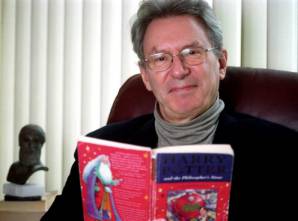
Harry Potter... in Ancient Greek

My intention was to recreate a version of the book which would make sense to a Greek from any era up to the 4th century AD who had managed by some magical process (such as would only be taught only to very advanced students at Hogwarts!) to reach the 21st century. Objects and ideas would be unfamiliar - but once he'd got used to his new surroundings, the book would make complete sense. So I thought it was very important to have this time-traveling Greek in mind at all times, and continually ask myself "would that have any meaning for him? what would he make of that?" In other words a cultural transposition is involved, not just finding the words.
Classicist Andrew Wilson discusses how he translated Harry Potter and the Philosopher's Stone into Ancient Greek, published last October. Check out his website.

Harry Potter is also available in Irish Gaelic, and I have the Latin translation sitting on my bookshelf. I'll get to it eventually when I feel more confident!

I am randomly reminded of that scene in Indiana Jones and the Last Crusade where, having escaped with the Jones Diary, Marcus Brody finds himself lost in Iskanderun trying desperately to communicate with the townsfolk:
Does anybody here speak English? Or even ancient Greek? No thank you sir, no water for me--fish make love in it. No thank you madam, no chicken I'm a vegetarian! Does anybody here understand a word I'm saying...?
Lost in his own museum.

Tuesday, February 01, 2005

In Full Compliance...

According to an independent audit:
The Archdiocese of Los Angeles has been found to be "in full compliance" with all aspects of the U.S. Bishops' "Charter for the Protection of Children and Young People".
Pray for JPII

According to Italian media, the Pope has come down with the flu and related respiratory problems and was taken to the hospital today.
L'enfer, c'est les autres

n'est-ce pas?

I promised I would comment on this. I like how my earlier post about la rue des Blancs-Manteaux immediately followed the one about Danny and Armi's music video. They kind of cancel each other out -- or maybe they compound each other, it depends. But that really wasn't the intention. It was more of a preparation for Lent.

Jean-Paul Sartre's classic Huis Clos was an attempt to illustrate his rather atheistic assertion that Hell (l'enfer) is other people (les autres). That is, Sartre's existentialism held that man can only define himself (or ascertain his image) according to how he is perceived by other people. However, what is fundamental to Sartre's beliefs is that man's existence has no universality: He is born, he lives, he dies; there is no second life, no afterlife, and no eternal life. Therefore, he has nothing to prepare for and no grand ideal to measure himself against, save what the others see. And so, he is therefore responsible for determining who he is to be.

According to Sartre, because man must gauge himself according to what the others perceive, he is doomed because other people only see the superficial -- they don't see what drives the man. Though man may strive to obtain heroic virtue, all it takes is one cowardly act for him to be branded a coward by the others for the rest of his life. And so man is trapped between the loneliness of himself and the judgments of the others. If he is to engage the world, he must contend with the others, and if he cares about their perceptions of himself, he abdicates his liberty.

In Sartre's world, man creates his own values. But Sartre's world is characteristically selfish. Man is focused on himself and his needs, he is subject to judgment by the others who care only about themselves, and there is a constant battle between what man keeps as his own liberty and what he sacrifices to the bondage of the others. Sartre's world can only exist if there is no grace, no love, no redemption, and no reconciliation. Sartre, being an atheist, would have no trouble admitting this, but when Christ enters Sartre's world, it ceases to exist.

I was reflecting on this recently because there are times when my observations about the world mirror Sartre's. A world that is morbid, dark, and weak. It is at those times that I find myself to be the most most selfish and the most superficial, even while I call myself a Christian, and I despair -- Thus, I enter Sartre's world. But, that is a lie. Sartre's world doesn't truly exist. It represents man's world at its worst, but there is a deeper, spiritual reality that is part of the physical world. And there is a grace that moves us beyond despair and into repentance and reconciliation. If we allow ourselves to be transformed by grace, which is unmerited favor granted to us by God, we can enter Christ's world. This is the world we encounter even at the height of our prayer in the Sacrifice of the Mass. It's a world that doesn't mask Sartre's world, but rather redeems it through self-sacrifice and the supreme self-sacrifice of Christ.
I have told you this so that my joy may be in you and your joy may be complete. This is my commandment: love one another as I love you. No one has greater love than this, to lay down one's life for one's friends. - John 15:11-13
Sartre observes a world without grace, unloved, and beyond redemption. Christ observes a world greatly loved and therefore, purely out of that love, worthy of grace and redemption. Sartre observed a selfish, physical world in which man is left to his own devices. Christ observes a spiritual world that is fundamentally transformed by the most unselfish act possible, where man is given everything he needs to know God, love God, and be with God forever. Christ obliterates the darkness forever because He has given us hope.
Santa Maria

Santa Maria, California, my home for about 10 years before coming to Santa Barbara, is back on the map again. I was there this past weekend to visit family, and yesterday, I drove past the courthouse to check out what had been setup. At that time, not many people had moved in, aside from some news crews.

Members of the community are renting out rooms in their homes at outrageous prices to die-hard Jackson fans who want to be near the courthouse. A local attorney, whose law office is right across the street from the courthouse and has the only nearby building with a flat roof, has rented out portions of the roof to 4 or 5 different news crews. And it was a little surreal to see a stand dedicated to CNN and Larry King Live. It's all a little too overwhelming for a modest town such as Santa Maria. Imagine the OJ Simpson trial in Mayberry... Okay, maybe Santa Maria is not that modest!

We'll see if I know anyone who ends up on the jury. :)

Sunday, January 23, 2005

In Latin, fetus means child...

The San Francisco March for Life was held today, and it looks like it drew a pretty sizeable crowd, in spite of counter-protests from local politicians and other abortion friends who yelled and threw condoms at the peaceful marchers.

Check out some photos of the march at FreeRepublic. Big this year, even bigger next year. (Stove-pipe hat tip to Bill Cork)

The marchers were able to use the Women Deserve Better slogan from Feminists For Life.

I wish I could've been able to make it down today to the Cathedral in Los Angeles for Cardinal Mahony's annual Requiem for the Unborn Respect Life Mass. They were expecting a full house. Hopefully, I'll hear about it soon.

Join me this weekend in offering prayer for the intention of the right to life for every human being.

Monday, January 17, 2005

La rue des Blancs-Manteaux
Dans la rue des Blancs-Manteaux
Ils ont élevé des tréteaux
Et mis du son dans un seau
Et c'était un échafaud
Dans la rue des Blancs-Manteaux

Dans la rue des Blancs-Manteaux
Le bourreau s'est levé tôt
C'est qu'il avait du boulot
Faut qu'il coupe des généraux
Des évêques, des amiraux,
Dans la rue des Blancs-Manteaux

Dans la rue des Blancs-Manteaux
Sont v'nues des dames comme il faut
Avec de beaux affûtiaux
Mais la tête leur f'sait défaut
Elle avait roulé de son haut
La tête avec le chapeau
Dans le ruisseau des Blancs-Manteaux
I encountered this rather macabre song back when I read Jean-Paul Sartre's infamous Huis Clos when I was at the university. A little poem about public execution, the blade up on a scaffold, and a street that, in the end, becomes a river of draining blood. L'Enfer, c'est les autres, and all of that. I'll reflect on that later.

Sunday, January 16, 2005

Danny and Armi

Fiat posts a link to the music video for I Wanna Love You Tender by Finnish pop stars Danny and Armi. Lots of fun to watch, and catchy lyrics; Obvious influence from Grease and Star Wars. Hmmm... My guess is that this was produced in 1978 when Danny and Armi were hugely popular (in Finland), and from what I understand, this song, sung in English, was one of their biggest hits. Here are the lyrics. Do people talk like this?
You love me, you wanna love me tender.
How can I be sure you're not pretender?
You want me today,
But what about tomorrow?

Oh, you're absolutely fine,
Your lips are taste of wine.
I'd like to think you're mine.
And if I could touch your hand,
This rock would turn to sand,
So this is where we stand.
Unfortunately, Armi died in 2002, but Danny is still alive and kickin'. Rock on!
Top 5 Vatican Myths

A speech by John Allen given at Marquette
Myth #1: Single-Mindedness
Myth #2: Absolute Control
Myth #3: Secrecy
Myth #4: Wealth
Myth #5: Careerism
Allen does a pretty decent job examining each of these from his point of view as an American observer in Rome. These are only the top 5 myths that abound, mind you. :)
Contraceptive dangers...

More news from Zenit on how the use of particular forms of artificial contraception are proving to be dangerous to women's health.

Saturday, January 08, 2005

Homo Adorans...

My parish here in Santa Barbara has begun 24-hr Exposition of the Blessed Sacrament on First Fridays. It's good to see more and more parishes start to offer something like this again. Up until this point, only the Poor Clares downtown had offered First Friday 24-hr adoration. To the north in Santa Maria, one parish has been offering it for a few years now, and another large parish up there opened up their own perpetual adoration chapel.

Thursday, January 06, 2005

So What's New?

* For information on how to donate and/or help relief efforts in Southeast Asia as millions of people recover from the tragic natural disaster and cope with the loss of hundreds of thousands of mothers, fathers, children, providers, and caretakers, check out Catholic Relief Services.

* Congratulations to the newly elevated Archdiocese of Galveston-Houston and to Archbishop Joseph Fiorenza. Also check out Bill Cork's excellent website dedicated to Young Adult and Campus Ministry.

* Congratulations to the Diocese of Saginaw on the appointment of Bishop Robert Carlson by the Holy Father, formerly of the Diocese of Sioux-Falls.

* Let's turn out those New Year's Resolutions.
A Meditation at Christmas

From Meditations on Christian Doctrine
By Cardinal John Henry Newman
1. God was all-complete, all-blessed in Himself; but it was His will to create a world for His glory. He is Almighty, and might have done all things Himself, but it has been His will to bring about His purposes by the beings He has created. We are all created to His glory - we are created to do His will. I am created to do something or to be something for which no one else is created; I have a place in God's counsels, in God's world, which no one else has; whether I be rich or poor, despised or esteemed by man, God knows me and calls me by my name.

2. God has created me to do Him some definite service; He has committed some work to me which He has not committed to another. I have my mission - I never may know it in this life, but I shall be told it in the next. Somehow, I am necessary for His purposes, as necessary in my place as an Archangel in his - if, indeed, I fail, He can raise another, as He could make the stones children of Abraham. Yet I have a part in this great work; I am a link in a chain, a bond of connection between persons. He has not created me for naught. I shall do good, I shall do His work; I shall be an angel of peace, a preacher of truth in my own place, while not intending it, if I do but keep His commandments and serve Him in my calling.

3. Therefore, I will trust Him. Whatever, wherever I am, I can never be thrown away. If I am in sickness, my sickness may serve Him; in perplexity, my perplexity may serve Him; if I am in sorrow, my sorrow may serve Him. My sickness, or perplexity, or sorrow may be necessary causes of some great end, which is quite beyond us. He does nothing in vain; he may prolong my life, he may shorten it; He knows what He is about. He may take away my friends, He may throw me among strangers, He may make me feel desolate, may make my spirits sink, and hide the future from me - still He knows what He is about.

O Adonai, O Ruler of Israel, Thou that guidest Joseph like a flock, O Emmanuel, O Sapientia, I give myself to Thee. I trust Thee wholly. Thou art wiser than I - more loving to me than I myself. Deign to fulfill Thy high purposes in me whatever they be - work in and through me. I am born to serve Thee, to be Thine, to be Thy instrument. Let me be Thy blind instrument. I ask not to see - I ask not to know - I ask simply to be used. Amen.

Saturday, December 25, 2004

Christmas 2004

Merry Christmas from Ad Altare Dei!

The most excellent gift that I have received over the past few days is a renewed appreciation and love for our dear Mother, the Church on Earth and in Heaven, and our precious Lord who left us the wondrous mystery that is our Church. In preserving Her in spite of the sinfulness of Her members, She continues to bring us His teachings and give us His graces, and we have Christ's word that He will never leave Her. I wish never to take Her for granted! Would that, some day, I might even have the courage to lay down my life in witness to Her and that Christ to whom she is wedded.

Today's feast is more than a mere birthday. Today, we celebrate an event - the Incarnation of God in human flesh. We celebrate God humbling Himself so as to be born a child from the womb of the Blessed Virgin. Oh, the minds that have tried for centuries to wrap themselves around that one! Fundamentally, what we learn is that you and I are worth so much to God that He might do this for us.
For God so loved the world that he gave his only Son, so that everyone who believes in him might not perish but might have eternal life. For God did not send his Son into the world to condemn the world, but that the world might be saved through him. -- The Gospel of John 3:16
We have value because God so loves us. Yes, even those who have no family or friends to love, those without a home, or without food, or without a steady job that they might earn a living and provide for themselves and their families.
Personent hodie Voces puerulae,
Laudantes iucunde Qui nobis est natus,
Summo Deo datus, Et de virgineo
Ventre procreatus.

In mundo nascitur; Pannis involvitur;
Praesepi ponitur Stabulo brutorum
Rector supernorum; Perdidit spolia
Princeps Infernorum.

Magi tres venerunt; Munera offerunt;
Parvulum inquirunt, Stellulam sequendo,
Ipsum adorando, Aurum, thus et myrrham
Ei offerendo.

Omnes clericuli, Pariter pueri,
Cantent ut angeli: 'Advenisti mundo:
Laudes tibi fundo Ideo: Gloria
In excelsis Deo'.
A marvelous mystery. Lord, I believe. Help me in my unbelief.

Saturday, December 11, 2004

"Preach My Gospel"

New Mormon Missionary Manual is online. I post this only as a resource for understanding where LDS missionaries are coming from when they approach you. Above all, be ready to give an account of your Catholic faith and know and live your faith well!

Monday, December 06, 2004

Our Lady of Guadalupe

Got back from the annual candlelight procession for Our Lady of Guadalupe along downtown State Street this evening. It had been raining all day, but the clouds parted for our procession, thanks be to God! Bishop Thomas Curry came out to lead the procession along with several local pastors. It was wonderful to see thousands of Santa Barbarans, primarily Hispanic, turn out to participate in this. It's a powerful witness to the Catholic faith in a city in dire need of grace and reconciliation. It's a humble witness that Our Lady can give for her Son, Our Lord, in obedience to God the Father.

The procession wound up at Our Lady of Sorrows Catholic Church where Bishop Curry led a standing-room-only crowd in prayer. By a merely random circumstance, I was asked to read the reading from Revelation 12 before the assembly. That was certainly a humbling experience.

Maria, Nuestra Señora de Guadalupe, Patrona de las Américas, ora por nosotros.

Sunday, December 05, 2004

The Tallis Scholars

Got back from a heavenly experience at the The Tallis Scholars concert this evening.

They performed renditions of the Magnificat by Hieronymus Praetorius and Orlando di Lasso, renditions of O Magnum Mysterium by Palestrina and Clemens non Papa, two Christmas pieces by William Byrd as well as Josquin des Prez's famous Ave Maria... virgo serena. Wonderful.

The concert was held at All Saints by the Sea Episcopal Church in Montecito, a cozy little church originally built in 1900 combining Gothic Revival and Shingle architectural styles, complete with wooden, hammer-beam roof. I missed the concert two years ago, which they held at Our Lady of Sorrows Catholic Church in Santa Barbara.

LinkWithin

Related Posts with Thumbnails