Friday, June 02, 2006

Guillaume DuFay and Weddings


The preparations for the big day are winding up. In the midst of buying a house and planning a wedding, it is so easy to get lost in various details. One of the more fun things about planning for the big day has been the nuptial mass.

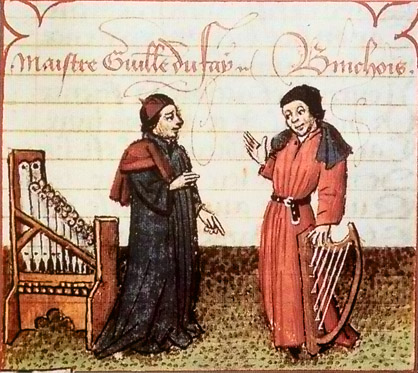
In particular, our friend, the inimitable Prof. Alejandro Enrique Planchart, has assembled a small choir, which he will direct, to sing for us a 15th century polyphonic mass setting, namely the Missa Sine Nomine, composed by Guillaume DuFay (the fellow on the left in the picture above). As I have learned, DuFay originally composed this mass for another wedding, that of Carlo Malatesta da Pesaro to Vittoria Colonna di Lorenzo (niece of Pope Martin V) at Rimini on July 24th, 1423. The musical setting itself is very short, about 15-16 minutes total. For the presentation of flowers to the Blessed Virgin, the choir will sing DuFay's very short Ave Regina Caelorum.

Since the mass falls coincidentally on the Feast of the Nativity of St. John the Baptist, we desired that our nuptials be celebrated within the context of this great feast, with its images of divine vocation, birth, and fruitfulness. Therefore, we will be using the proper for the day, and our choir will chant the Introit, etc. To quote the prophet Isaiah (Isaiah 49:1-6):
The LORD called me from birth, from my mother's womb he gave me my name.
Now let's just hope things go off without a hitch (yeah, right). Sacred polyphony has contributed a great deal to our spiritual growth, and it has rooted us in a very meaningful connection with our Roman Catholic heritage. Therefore, we had hoped to include it in our celebration, but without pretense or ostentation. We're hoping to have a great celebration of prayer and feasting with our family and friends on this day.

Monday, May 22, 2006

Moving to Houston

Wow, sorry it has been so long since my last posting spree. The truth is, to use the standard excuse, I haven't had any time. But I do have exciting news.

First of all, I want to announce that in less than two months, my soon-to-be wife and I will be moving to the Houston, TX area. I timed the blog announcement to correspond with the formal announcement of my job transfer within the company in which I work (TI). We also recently submitted an offer on a house in Sugar Land, and after some negotiation, our offer was accepted, and so now we enter the critical period. It's all very new for us, so we are doing what we can! Please pray for us!

We are very excited about the move. Speaking for myself, after having been a Californian for the last 19 years, I know that I will miss California. I know that I will miss being involved in ministry with my community and local church. I am looking forward to new career opportunities and opportunities for ministry, as God directs. Please pray that we are open to new challenges.

Moving to the South is somewhat of a homecoming for me -- I'm originally from Alabama and have family scattered throughout the South. However, it will be a huge change for my fiancee, Christina, because she is 100% California born-and-raised.

And we will not forget the Santa Maria tri-tip. Never, never ever ever!
Love One Another

From today's Gospel reading
This is my commandment: love one another as I love you.
There is so much that can be said about this -- 2000 years, and of course, our recent encyclical! But on the basic level, you know, being the human being that I am, I sometimes think about how much of a challenge it is even to love those who get on my nerves. Grrr... But now I think of the little reflection (#174) from The Way, written by St. Josemaría Escrivá, founder of Opus Dei:
Don't say: 'That person gets on my nerves.' Think: 'That person sanctifies me.'
And suddenly things come into focus. God works in our everyday lives and in our ordinary relationships with everybody we know. Each and every one of our relationships has meaning. This one is worth a million. Thanks.
Opus Dei and Corporal Mortification (and Poseidon)

Fr. Michael Barrett, a priest of Opus Dei and director of the Holy Cross Chapel and Catholic Resource Center in Houston, TX, responds to The Da Vinci Code's portrayal of Opus Dei and its views on Corporal Mortification:
The Da Vinci Code's bloody depictions of mortification are grotesque exaggerations that have nothing to do with reality. Obviously the movie makers were looking for shock value, and the real use of the cilice and discipline would have been too tame. In reality, they cause a fairly low level of discomfort comparable to fasting. There is no blood, no injury, nothing to harm a person's health, nothing traumatic. If it caused any harm, the Church would not allow it.
Fr. Barrett is a good man. When I first saw the trailer for The Da Vinci Code, I had to laugh - Particularly when it showed the Opus Dei Albino Monk literally ripping a cilice from his flesh and beating himself senseless with a discipline. Yeah, right.

Bill Cork offers some views on the film itself. I went to the movies too, but being a fan of large ships and disaster flicks, I couldn't resist the urge to see Poseidon. I liked the special effects and some decent action sequences, but I still prefer the 70's classic. :)

Wednesday, May 03, 2006

To Texas

Going to Houston, TX for the rest of the week. Will write more later!

St. Joseph, pray for us!

Tuesday, April 25, 2006

Well, it is actually true...

I grew up on grits, fried chicken, black-eyed peas, fried okra, turnip greens, and corn bread, but it's been going on 20 years since I last lived in the South.

Displaced Southerner
You are 79% true Southern!
You're pretty Southern, but something is keeping you from being a true Southern Belle or Gentleman. Maybe you've moved, or maybe your parents were Yankees and brought you up without ever taking you fishing or hunting or to Memaw's for chicken and black-eyed peas. You know your Southern facts and culture, but that literature still escapes you. And when you order tea at a restaurant, you expect it to come "unsweet." Yikes. Next time you have the chance, visit a classic Southern downtown area and spend an afternoon just soaking it in... Montgomery, Birmingham, Jackson, Natchez, Memphis, Charleston, Atlanta, or even New Orleans!
Link: The Southern-ness Test written by gwennykate. Thanks to DonJim.

Saturday, April 22, 2006

Television: NotSoClever tricks

I've seen all of these happen, and if you've been a fairly regular watcher of television over the last 10 or 20 years, you probably have too... If you really think about it, TV is ridiculous! (duh!) ;)

Chuck Cunningham syndrome
:
Chuck Cunningham syndrome is a term of criticism, applied when a regular character (ie: main character, supporting character, recurring character) in a television series is removed with little or no explanation.

The term derives from the Chuck Cunningham character in the American series Happy Days. Chuck, the oldest of the three children in the Cunningham family, initially appeared in the episode "Love and the Happy Days" (in the show Love, American Style), which served as the pilot for what became the Happy Days series. However, in Happy Days Chuck appeared as a superfluous character (usually on his way to basketball practice). He was written out of the series at the beginning of the second season with the explanation that he was going to college. After the second season, he was never mentioned again; subsequent episodes referred to the Cunninghams as having two, rather than three, children.
Jumping the shark:
Jumping the shark is a metaphor that has been used by US TV critics and fans since the 1990s to denote the tipping point at which a TV series is deemed to have passed its peak. Once a show has "jumped the shark," fans sense a noticeable decline in quality or feel the show has undergone too many changes to retain its original charm.

The phrase was popularized by Jon Hein on his website jumptheshark.com. It alludes to a scene in the TV series Happy Days when the popular character Fonzie, on water skis, literally jumps over a shark.
Cousin Oliver:
Cousin Oliver is a jargon used by TV critics when the creators of a TV show decide that the addition of a cute child actor to the cast will improve the ratings of the show, or as a replacement for child cast members that have grown up since the show started.
Fonzie Syndrome:
Fonzie syndrome is a phenomenon on TV programs in which a character that had originally been a one-off character or a supporting cast member becomes a/the central and/or most popular character on the show. The term comes from the American sitcom Happy Days, in which the character of Arthur "The Fonz" Fonzarelli (played by Henry Winkler) started out as a minor, fringe character but quickly evolved into the focal point of the series.
Retcon:
Retroactive continuity is the adding of new information to "historical" material, or deliberately changing previously established facts in a work of serial fiction. The change itself is referred to as a "retcon", and the act of writing and publishing a retcon is called "retconning".
Marriage as being caught up in God's Love

From the Pastoral Constitution on the Church in the Modern World (Gaudium et Spes) from the Second Vatican Council (paragraph 48)
Husband and wife, by the covenant of marriage, are no longer two, but one flesh. By their intimate union of persons and of actions they give mutual help and service to each other, experience the meaning of the unity, and gain an ever deeper understanding of it day by day. This intimate union in the mutual self-giving of two persons, as well as the good of the children, demands full fidelity from both, and an indissoluble unity between them. Christ the Lord has abundantly blessed this richly complex love, which springs from the divine source of love and is founded on the model of his union with the Church.

In earlier times God met his people in a covenant of love and fidelity. So now the Savior of mankind, the Bridegroom of the Church, meets Christian husbands and wives in the sacrament of matrimony. Further, he remains with them in order that, as he loved the Church and gave himself up for her, so husband and wife may, in mutual self-giving, love each other with perpetual fidelity.

True married love is caught up into God's love; it is guided and enriched by the redeeming power of Christ and the saving action of the Church, in order that the partners may be effectively led to God and receive help and strength in the sublime responsibility of parenthood. Christian partners are therefore strengthened, and as it were consecrated, by a special sacrament for the duties and the dignity of their state. By the power of this sacrament they fulfill their obligations to each other and to their family and are filled with the spirit of Christ. This spirit pervades their whole lives with faith, hope and love. Thus they promote their own perfection and each other's sanctification, and so contribute together to the greater glory of God.
So it is crucial and important that the Church recognizes in marriage a sacrament through which God bestows grace through the couple for their mutual sanctification and ultimate salvation. God, in freely sharing grace, invites us to participate in His very divine life, redeeming us and raising us out of the pit of our sinfulness. And we know that God is Love, and that through marriage, God's invitation also includes the unique opportunity to participate in His very nature which is His continual act of wanting to love, the result of which is the creation of new life. Thus, by His grace in marriage, we are given insight into the very Creation of the universe, and the Creator's will for you and for me. We are then, in a sense, made co-creators with God.

Friday, April 21, 2006

RIP Fr. Anthony

Fr. Anthony Peter Runtz, CJ
Funeral Mass was celebrated April 17 at St. Louis de Montfort Church, Santa Maria, for Josephite Father Anthony Peter Runtz, 78, who died April 11.

Born in New York City of English-Irish parents and educated in England, he served in the British Army signal corps before entering the seminary. He completed his seminary studies at College Melle in Belgium and was ordained in 1958 at Weybridge, Surrey, England. From 1960-64, he was housemaster of St. George College, Weybridge, and from 1964-67, he taught religion and industrial arts at Pius X-St. Matthias High School in Downey while obtaining a master's degree in teaching from Loyola University.

Father Runtz served as an associate pastor at several Santa Barbara Region parishes, including St. Mary of the Assumption and St. Louis de Montfort (Santa Maria), San Roque (Santa Barbara) and Sacred Heart (Ventura). While pastor of St. Louis de Montfort in the '70s, the parish doubled in size from 800 to 1,600 families.

A talented woodworker, he produced cabinetry and furniture for the St. Louis de Montfort rectory, parish hall and church as well as for the Sisquoc chapel, St. Anthony's Church in Los Alamos and St. Mary's in Santa Maria. Burial took place at the Josephite plot of Santa Maria Cemetery on April 18.
Requiescat in pace...

Wednesday, April 19, 2006

Universal Indult Confusion

I don't get it. If the Holy Father were to grant wider permission for the mass celebrated according to the 1962 Roman Missal without serious consensus among the bishops, it would really surprise me. Would the pope really want to circumvent the authority of the local bishop to regulate the liturgy in his own diocese? Okay, okay, before you cry, Bring on the circumvention!, let's examine the principle of doing this. We live in an era in which the prevailing belief in many circles about bishops still seems to be that they should function merely as papal administrators and nothing more. Both Benedict XVI and his predecessor, John Paul II, have often emphasized the teaching of the Second Vatican Council with respect to the proper role of bishops as a college to counteract this erroneous belief. While the pope certainly has the authority to grant wider permission, it doesn't seem likely that he believes it to be prudent at this juncture to do so without such a consensus among his brother bishops. So it also may be a while before Rome and the SSPX are really able to join hands and sing Kum Ba Yah.

But what about the confusion a move like this would cause in the larger church? With Sacrosanctum Concilium, the Second Vatican Council spoke rightly of liturgical reform. Can the church soundly educate the faithful around the world that giving every priest permission to celebrate the liturgy according to the 1962 Roman Missal does not mean that it wasn't actually in need of reform? Can it fight the perception that there would not be two coexisting missals, one previously in need of reform, and one that identifies itself as the fruit of that reform?

Of course, if you prefer the Tridentine mass, perhaps you don't care one way or the other. But I think you should. Yes, yes, I understand the need for true liturgical reform, and I am not necessarily an opponent of the Tridentine mass and can sometimes be seen at Cardinal Mahony's weekly indult in Ventura, CA. Yet how can I not see this through the lens of what the Second Vatican Council taught? Somehow I don't see a universal indult solving any of the real liturgical or ecclesiological problems we are faced with today. Or maybe I am all wrong..? It wouldn't be the first time.

Sunday, April 16, 2006

Bishop Ratko Peric on Medjugorje

John Allen also reports on the skepticism of Medjugorje within the Church, including an excerpt from an interview with Bishop Ratko Peric of Mostar-Duvno to his diocesan newspaper, Crkva na kamenu:
Some newspapers have written that this Pope visited Medjugorje incognito while he was a cardinal and that he is preparing to recognize Medjugorje as a shrine, etc. Did you touch upon this topic?

[Bishop Ratko Peric responds:]
We did, and I wrote to and spoke with the Holy Father on it. He only laughed surprisingly. Regarding the events of Medjugorje our position is well known: not a single proof exists that these events concern supernatural apparitions and revelations. Therefore from the church's perspective no pilgrimages are allowed which would attribute any authenticity to these alleged apparitions.

The Holy Father told me: "We at the Congregation [for the Doctrine of the Faith] always asked ourselves, how can any believer accept as authentic apparitions that occur every day and for so many years? Are they still occurring every day?"

I responded: "Every day, Holy Father, to one of the [visionaries] in Boston, to another near Milan and still another in Krehin Gradac (Herzegovina), and everything is done under the protocol of 'apparitions of Medjugorje'. Up till now there have been about 35,000 'apparitions' and there is no end in sight!"

... The numerous absurd messages, insincerities, falsehoods and disobedience associated with the events and "apparitions" of Medjugorje from the very outset, all disprove any claims of authenticity. Much pressure has been made to force the recognition of the authenticity of private revelations, yet not through convincing arguments based upon the truth, but through the self-praise of personal conversions and by statements such as one "feels good". How can this ever be taken as proof of the authenticity of apparitions?

... Finally the Holy Father said: "We at the congregation felt that priests should be of service to those faithful who seek Confession and Holy Communion, leaving out the question of the authenticity of the apparitions."
While I don't doubt that people can experience renewed faith and even miracles in their journeys to Medjugorje and other places around the world, I have been quite skeptical about the veracity of the alleged apparitions at Medjugorje. In 2004, Bishop Ratko Peric also published a full report of the history and recent goings-on at Medjugorje, reaffirming his opposition to the movement there:
The Church, from the local to supreme level, from the beginning to this very day, has clearly and constantly repeated: Non constat de supernaturalitate! No to pilgrimages that would ascribe a supernatural nature to the apparitions, no shrine of the Madonna, no authentic messages nor revelations, no true visions!
When one compares in greater detail Medjugorje to other approved apparitions, such as those that occurred at Fatima and Lourdes, many inconsistencies and problems arise.
Rethinking Opus Dei

An interesting story about Opus Dei in the world from John Allen's latest Word From Rome report:
A numerary of Opus Dei, meaning a celibate who lives full-time in an Opus Dei center, was elected to the [Italian] national Senate ... from the center-left.

As such, Senator-elect Paola Binetti, 63, defies the image of a monolithic hard-right political climate within Opus Dei.

To be sure, when it comes to "culture of life" issues, Binetti yields to no one in her defense of "Catholic" positions. A medical doctor, university professor, and former president of the "Association for Science and Life," Binetti helped spearhead last summer's campaign against the in-vitro fertilization referendum. She has also irritated fellow members of Prodi's coalition by her dogmatic opposition to changes to Italy's restrictive law on abortion.

Yet on most other issues, Binetti's agenda skews to the secular political left. She campaigned for policies favoring "the poorest and the most excluded," greater levels of social development, expanded health care for the most vulnerable families, the emergence of a strong Europe capable of defending peace in global affairs, and a clear option for the Third World, especially Africa, in favor of "reducing unacceptable inequalities."

Historically, Opus Dei has had a profile as conservative and male-dominated. Irony of ironies, Binetti's victory means that two of the most visible Opus Dei politicians in the world -- Binetti in Italy, and Ruth Kelly, the Minister of Education in England -- are now women who belong to center-left parties.
Pascha

Had a great Holy Week leading up to Easter. I attended the Easter Vigil in Santa Maria last night with my fiancee at the church at which I was baptized and confirmed 9 years ago -- the church where we'll also celebrate our marriage in a few months.

I wish I had been able to attend the Chrism mass at the Cathedral in Los Angeles this year. The Tidings has published some pictures.

Tuesday, April 11, 2006

Colonel Homer


Lurleen Lumpkin: [chuckles] Oh Homer, you're just a big sack of sugar.
Homer Simpson: Hey! [thinks on it] You did say 'sugar', right?

From Colonel Homer, episode #55.

Friday, April 07, 2006

Irenaeus and the Cainites

Just one more comment about the Gospel of Judas.

Kudos to those news organizations who have researched the early patristic witness of the Gospel of Judas and the heresy of Gnosticism. One of the best witnesses is 2nd century bishop, St. Irenaeus of Lyons, who devoted much of his writing to exposing the early Gnostic sects. In Book I, Chapter 31 of his work Against Heresies, Irenaeus explicitly discusses the Gnostic Cainites and specifically mentions their fictional Gospel of Judas:
1. Others again declare that Cain derived his being from the Power above, and acknowledge that Esau, Korah, the Sodomites, and all such persons, are related to themselves. On this account, they add, they have been assailed by the Creator, yet no one of them has suffered injury... They declare that Judas the traitor was thoroughly acquainted with these things, and that he alone, knowing the truth as no others did, accomplished the mystery of the betrayal; by him all things, both earthly and heavenly, were thus thrown into confusion. They produce a fictitious history of this kind, which they style the Gospel of Judas.
So it's old news. Perhaps it's not for those modern day Gnostics looking for some hidden, secret knowledge to believe in, which might explain the success of The DaVinci Code, Holy Blood, Holy Grail, etc...

For more information on Gnosticism, you could check out the Wikipedia article.
Gnostic Gospel of Judas

*giggle* Does the mainstream media really expect us to believe that a Gnostic text written over a century or more after the death of Christ is an authentic witness to the life of Judas, Christ, or anyone? *knocking on media's head* Hello, anybody home? Anybody remember the Gnostic heresy and its plethora of spurious documents that we've already known about for ages of ages??? In other words, it would benefit the media to learn a little about the history of the Scriptures and the early church! The only thing being suppressed here is foolishness, folks...

This is my favorite line showing the ridiculousness of the Gnostic "Gospel" of Thomas, a text which the media loves to rave about now and then as somehow threatening the teaching of the Church:
Simon Peter said to him, "Let Mary leave us, for women are not worthy of life." Jesus said, "I myself shall lead her in order to make her male, so that she too may become a living spirit resembling you males. For every woman who will make herself male will enter the kingdom of heaven."
Hello, McFly!! We should be grateful we have the New Testament Canon we have and the authority of the Church that recognized its inspiration.

That is all.

Wednesday, April 05, 2006

Tuesday, April 04, 2006

Wednesday: Day of Prayer and Fasting for Immigration Reform

Cardinal Mahony Designates Wednesday, April 5, As Special Day Of Prayer & Fasting For Just And Humane Immigration Reform
I encourage all Catholics to attend Mass this Wednesday to pray for just and humane immigration reform legislation. I will celebrate the 12:10 PM Mass at the Cathedral of Our Lady of the Angels on that day, and will also observe a special fast. Even if you cannot attend Mass in your parish, I invite you to spend some time in prayer for our legislators, for the achievement of just and human immigration reform, and for those among us who will be most affected by it.
I think that this is a cause worth praying about, whether you fully agree with Cardinal Mahony's thinking on this issue or not. I've seen people act as though the Cardinal is nuts for "making such a big deal" over this. Unlike other parts of the country, Southern California is a home for many, many, many immigrants, both documented and undocumented. It is right that the Cardinal should be concerned for their welfare and dignity. To assert, as some Catholics have (!!), that the Cardinal's interest is merely to secure support and a "few extra pesos in the collection basket" is, in my opinion, ridiculous and insulting.

Saturday, April 01, 2006

It's here

The Compendium of the Catechism of the Catholic Church, which I preordered last September, arrived today. :) Complete with beautiful art, Latin prayers, not to mention a summarization of our Catechism in Q&A format.
1. What is the plan of God for man?

God, infinitely perfect and blessed in himself, in a plan of sheer goodness freely created man to make him share in his own blessed life. In the fullness of time, God the Father sent his Son as the Redeemer and Savior of mankind, fallen into sin, thus calling all into his Church and, through the work of the Holy Spirit, making them adopted children and heirs of his eternal happiness.

Friday, March 31, 2006

Cardinal Mahony to Kids: Stay in school tomorrow!

News release
There have been further rumors that a possible school boycott would be held on Friday, March 31st. As one who is deeply engaged in the overall efforts to have Congress pass just and humane immigration reform legislation, I am urging all students in the greater Los Angeles area to stay in school tomorrow. I am urging all parents to speak with their sons and daughters this evening and in the morning impressing upon them the need for to remain in school and not on the streets.

Wednesday, March 29, 2006

Doctor Who

Has anyone been watching the new Doctor Who series on the Sci-Fi channel? I never followed the older series, but I find this one interesting... kinda creative...
RIP Dan Curtis

Dan Curtis, producer of America's first gothic television soap opera, Dark Shadows, died last Monday. I wasn't a fan of everything he produced, but I have been a fan of Dark Shadows for years -- both the 1960's series with Jonathan Frid and 1990's series with Ben Cross -- primarily for its creative storylines and its borrowing of themes present in a wide array of literature. In fact, my first online BBS nickname was Barnabas Collins.

May he rest in peace...
Sympto-Thermal neatness...

Last Sunday, my fiancee and I attended our class in Natural Family Planning (NFP) in Paso Robles offered by the Couple-to-Couple League (CCL). We started the day off on the way up with the Divine Liturgy at St. Anne's Byzantine Catholic (Ruthenian) Church in San Luis Obispo, which is always a treat. St. Anne's is an Eastern Catholic parish in full communion with the Bishop of Rome.

But this is really cool... A woman's natural fertility cycle is really something to behold. It is certainly counter-cultural to appreciate it as a man. It should really be required learning for any man, if only to be educated about how wonderfully and intricately made we human beings are, especially women.

The class we attended was actually a condensed, intensive course focusing on the Sympto-Thermal method of NFP, charting and chart interpretation, and other pertinent information to help couples get started with NFP. Couples can then approach other related topics, such how future pregnancy and menopause affect the fertility cycle, at their own pace. Being a part of CCL also means that we can get private consultation and help in interpreting our charts if we ever need it in the future. We knew a fair amount about NFP going into the course, but after walking through everything with other couples, charting no longer seems so daunting, and we are itching to get started charting this week! This'll give us a few months experience in charting before we are actually married. So cool! Thank goodness we have free long-distance on our cell phone plan.

Thursday, March 23, 2006

Music Meme

From Don Jim & Zadok the Roman:
Instructions: Go to your music player of choice and put it on shuffle. Say the following questions aloud, and press play. Use the song title as the answer to the question. NO CHEATING.

How does the world see you? Libera Me (Soundtrack Interview with the Vampire)

Will I have a happy life? Ave Verum Corpus (Mozart composition)

What do my friends really think of me? Nunc Dimittis (Geoffrey Burgon)

What do people secretly think of me? Don't you want me? (Human League)

How can I be happy? The Days of the Dancing (Maire Brennan)

What should I do with my life? Wild Mountain Thyme (Slainte)

Will I ever have children? Wishing You Were Somehow Here (Phantom of the Opera)

What is some good advice for me? Glory to God (Handel)

How will I be remembered? The Lord Ascendeth Up On High (Choir of King's College, Cambridge)

What is my signature dancing song? Dance of the Sugar Plums (Tchaikovsky)

What do I think my current theme song is? In A Dream (Rockell)

What does everyone else think my current theme song is? Love Will Never Do (Janet Jackson)

What song will play at my funeral? Angel of Music (Phantom of the Opera)

What type of men/women do you like? Te Deum Laudamus (Chant)

What is my day going to be like? Ring Of Fire (Johnny Cash)

Uhm.. Okay...
Patriarch of the West, Part 2

The Vatican Pontifical Council for Promoting Christian Unity recently issued a communiqué clarifying the recent action of the dropping of one of the pope's titles as Patriarch of the West:
Without attempting to consider the complex historical question of the title of patriarch in all its aspects, from the historical perspective it can be affirmed that the ancient patriarchs of the East, defined by the Councils of Constantinople (381) and of Chalcedon (451), covered a fairly demarcated territory. At the same time, the territory of the see of the Bishop of Rome remained somewhat vague.

In the East, under the ecclesiastical imperial system of Justinian (527-565), alongside the four Eastern patriarchates (Constantinople, Alexandria, Antioch and Jerusalem), the Pope was included as the Patriarch of the West. Rome, on the other hand, favored the idea of the three Petrine episcopal sees: Rome, Alexandria and Antioch. Without using the title "Patriarch of the West," the Fourth Council of Constantinople (869-870), the Fourth Lateran Council (1215) and the Council of Florence (1439) listed the Pope as the first of the then five Patriarchs.

The title "Patriarch of the West" was adopted in the year 642 by Pope Theodore. Thereafter it appeared only occasionally and did not have a clear meaning. It flourished in the 16th and 17th centuries, in the context of a general increase in the Pope's titles, and appeared for the first time in the "Annuario Pontificio" in 1863.

The term "West" currently refers to a cultural context not limited only to Western Europe but including North America, Australia and New Zealand, thus differentiating itself from other cultural contexts. Obviously, this meaning of the term "West" does not try to describe an ecclesiastical territory, and cannot be used as the definition of a patriarchal territory.

If we wish to give the term "West" a meaning applicable to ecclesiastical juridical language, it could be understood only in reference to the Latin Church. In this way, the title "Patriarch of the West" would describe the Bishop of Rome's special relationship with the Latin Church, and his special jurisdiction over her.

Therefore, the title "Patriarch of the West," never very clear, over history has become obsolete and practically unusable. It seems pointless, then, to insist on maintaining it. Even more so now that the Catholic Church, with the Second Vatican Council, has found, in the form of episcopal conferences and their international meetings, the canonical structure best suited to the needs of the Latin Church today.

Abandoning the title of "Patriarch of the West" clearly does not alter in any way the recognition of the ancient patriarchal Churches, so solemnly declared by the Second Vatican Council ("Lumen Gentium," No. 23). The renouncement of this title aims to express a historical and theological reality, and at the same time could prove useful to ecumenical dialogue.
Well, there it is. This still may afford opportunities for future western patriarchates, but time well tell.

Saturday, March 18, 2006

Pray for your bishop

Bill Cork posts a document from his Office of Young Adults and Campus Ministry in the Archdiocese of Galveston-Houston listing some ideas about encouraging more vocations among young adults to the priesthood and religious life. Among the points, I was glad to see this:
Develop love and respect for the archbishop and the local Church; campus ministries should involve him at the center as much as possible.
This is excellent. It's far to easy today to see ministers involved in campus ministry who openly and actively encourage rebellion against the bishop, mock him as not understanding their "way" of ministering, selectively interpret his instructions, and boast about how far away their campus ministry is from the bishop's cathedral. This is a horrible witness for young adults.

This is in a campus ministry, and young adults do pay attention -- and with ministers who encourage disrespect for the bishop of the local church, how do they expect to foster vocations to love and serve in such a church? It has given rise to erroneous ways of thinking among many young adults about the Church and its ecclesial expression, where it seems the most authentic expression of Catholic life includes complete autonomy from their local bishop. But that couldn't be further from the truth. I am often reminded of the words of one 1st/2nd century bishop, St. Ignatius of Antioch, and his statements concerning bishops in his letter to the Church at Smyrna, which could just as well have been written to some of these campus ministries today:
Follow the bishop as Jesus Christ follows the Father; and follow the presbytery as you would the apostles. Let no one do anything involving the church without the bishop. Let that eucharist be considered valid that occurs under the bishop or the one to whom he entrusts it [i.e. a presbyter (priest)]. Let the congregation be wherever the bishop is; just as wherever Jesus Christ is, there also is the catholic (universal) church... It is good to know both God and the bishop. The one who honors the bishop is honored by God; the one who does anything behind the bishop's back serves the devil.
Strong words! Especially the bit about serving the devil. But what Ignatius means by that is precisely that anyone who actively fosters disrespect for their local bishop is also fostering discord and division within the Church itself. The Church, while made up of human members, belongs to Christ, and divisive activity such as this does Christ no good service. Such activity seeks to cut the sheep themselves off from their shepherd and encourages others to do likewise. This is not the way to foster vocations of service in the Church -- a Church that is made up of sinful human beings, who, as St. Paul says, are also baptized into Christ and into His death so that as Christ was raised from the dead, we might also walk in newness of life, being sanctified by His grace unto salvation. So it is thus as I have said before - always pray for your bishop. One need not look past his own mistakes in ministry to do that.

Fortunately, the young adult ministry with which I have been involved over the past few years has fostered a healthy relationship with our local and regional bishops -- and, guess what, young adults are drawn to that! Yes, it helps to have a bishop who loves spending time with his flock.
What Now America?

Archbishop Fulton Sheen, from his 'What Now America?' talks:
When, I wonder, did we in America ever get into this idea that freedom means having no boundaries and no limits? You know I think it began on the 6th of August 1945 at 8:15 am when we dropped the bomb on Hiroshima. That blotted out boundaries. The boundary of America that was the aid of nations, and the nations that were helped. It blotted out the boundary between life and death for the victims of nuclear incineration. Among them even the living were dead. It blotted out the boundary between the civilian and the military. And somehow or other, from that day on in our American life, we say we want no limits and no boundaries.

Saturday, March 11, 2006

Ignatius Bible: RSV 2nd Catholic Edition

I recently purchased the 2nd edition of the Ignatius Bible (Revised Standard Version - Catholic Edition, paperback). The type setting for this one is excellent, and I love the fact that the scriptural notes are actually on the pages to which they apply, rather than in a section in the back. Not to mention that this is a very good translation that includes all of the canonical books of the Old Testament. For whatever it's worth, I give it the Ad Altare Dei stamp of approval!
Wedding Cake Blues

Saw this on snopes.com:
A young and nervous bride planning her wedding was increasingly terrified about her upcoming marriage. To calm her nerves, she decided to have a Bible verse which had always brought her comfort (1 John 4:18, "There is no fear in love; for perfect love casts out fear") engraved on her wedding cake. So she called the caterer and all arrangements were made.

About a week before the wedding, she received a call from the catering company. "Is this really the verse you want on your cake?" they asked. Yes, she confirmed, it was the one she wanted, and after a few more questions they said they would decorate the cake as requested.

The wedding day came, and everything was beautiful ... until the reception, when the bride walked in to find the cake emblazoned with John 4:18: "For you have had five husbands, and the one whom you now have is not your husband."
Of course, a responsible caterer would have also probably read the verse aloud to her to make sure that's what she wanted, but it's a story with a good note of caution, just the same...
Rev. Lovejoy


Reverend Lovejoy after he, Marge, and Ned Flanders kidnap Bart to keep him from becoming Catholic:
"Bart, we're here to bring you back to the one TRUE faith -- the Western Branch of American Reformed Presbylutheranism."
From Episode #356: The Father, The Son, and The Holy Guest Star

Tuesday, March 07, 2006

Patriarch of the West

It has been spreading around for a while now that our Holy Father, Pope Benedict XVI, has apparently decided to drop his papal title Patriarch of the West. Some have suggested that this is being done in an effort to bring into focus what is proper to the pope's role as Patriarch and bishop of Rome, rather than of the West. This would then allow us to focus on what is absolutely essential to our understanding of papal primacy with respect to the Petrine ministry and rest of the universal church, both East and West.

As whapster Andrew discusses, the pope doesn't have to concern himself with the administrative jurisdiction of other regions in, for example, appointing bishops and establishing liturgical laws and rites for certain regions. This move could make easier the construction of separate patriarchates in regions such as Asia and Africa that would be detached from the Latin church, while still in union with her and recognizing the Petrine primacy that truly belongs to the pope.

What this will exactly mean for the Eastern Orthodox remains to be seen. There are still many issues to consider, most certainly. Eastern Orthodox theologian Olivier Clement, in his book, You Are Peter: An Orthodox Reflection on the Exercise of Papal Primacy (written as a response to John Paul II's encyclical, Ut Unum Sint), puts forth very fair challenges to both the Eastern and Western churches with regard to the proper understanding of papal primacy in a potential unified church. He puts forth a very good argument, but among many things he brings up, one of Clement's primary concerns for the West is that its notions of primacy and jurisdiction have gotten too wrapped up in notions of power and administrative authority over that of individual bishops. Clement notes, however, that this may eventually be largely a thing of the past, as he praises efforts on the part of the Latin church in recent decades to refocus its understanding of papal primacy with respect to its understanding of collegiality among bishops and their true and proper authority -- efforts that stem, in particular, from the Second Vatican Council.

Prior to the council, it was not uncommon to speak of the pope alone as the true Vicar of Christ. Nevertheless, the council took great steps to broaden this focus by noting that every bishop is also, in a sense, a vicar of Christ for his local church and has an authority that is properly invested in him by Christ. Note paragraph 27 from Lumen Gentium:
Bishops, as vicars and ambassadors of Christ, govern the particular churches entrusted to them by their counsel, exhortations, example, and even by their authority and sacred power, which indeed they use only for the edification of their flock in truth and holiness... This power, which they personally exercise in Christ's name, is proper, ordinary and immediate, although its exercise is ultimately regulated by the supreme authority of the Church...
Several years ago, I mentioned this fact in a Catholic mailing list once, and it just about incited a riot. I was surprised at how many Catholics simply refused to accept it. Lumen Gentium continues:
The pastoral office or the habitual and daily care of their sheep is entrusted to [the bishops] completely; nor are they to be regarded as vicars of the Roman Pontiffs, for they exercise an authority that is proper to them, and are quite correctly called "prelates," heads of the people whom they govern. Their power, therefore, is not destroyed by the supreme and universal power, but on the contrary it is affirmed, strengthened and vindicated by it, since the Holy Spirit unfailingly preserves the form of government established by Christ the Lord in His Church.
Note this fact: The bishops are not to be thought of as vicars of the pope. They have an authority that belongs to them individually that is affirmed by the supreme authority of the Church by virtue of their unity with the See of Rome, not annulled by it. Pope John Paul II was also very keen to latch on and develop the importance of collegial ministry. In paragraph 95 of his encyclical, Ut Unum Sint, he underscores the Second Vatican Council's teaching:
When the Catholic Church affirms that the office of the Bishop of Rome corresponds to the will of Christ, she does not separate this office from the mission entrusted to the whole body of Bishops, who are also "vicars and ambassadors of Christ". The Bishop of Rome is a member of the "College", and the Bishops are his brothers in the ministry.
It is well that he should have had this in mind, for the encyclical does concern itself with the question of reunion with the East and the proper understanding of the primacy of the Bishop of Rome. All of this begins to make more sense when we consider these words of our current Holy Father, Pope Benedict XVI, from an essay written several years ago entitled Primacy and Episcopacy:
Rome must not require more from the East with respect to the doctrine of primacy than had been formulated and was lived in the first millennium. When the Patriarch Athenagoras, on July 25, 1967, on the occasion of the Pope's visit to Phanar, designated him as the successor of St. Peter, as the most esteemed among us, as one also presides in charity, this great Church leader was expressing the essential content of the doctrine of primacy as it was known in the first millennium. Rome need not ask for more. Reunion could take place in this context if, on the one hand, the East would cease to oppose as heretical the developments that took place in the West in the second millennium and would accept the Catholic Church as legitimate and orthodox in the form she had acquired in the course of that development, while, on the other hand, the West would recognize the Church of the East as orthodox and legitimate in the form she has always had... Finally, in the not too distant future one could consider whether the churches of Asia and Africa, like those of the East, should not present their own forms as autonomous 'patriarchates' or 'great churches' or whatever such ecclesiae in the Ecclesia might be called in the future.
So gradually things are coming into focus. There are still many issues to hammer out with our Eastern Orthodox brothers and sisters, but one day, we will be one.
Monday, March 06, 2006

What Lies Beneath

The Scavi of St. Peter's and the Grittiness of Catholicism


by George Weigel, from Chapter 2 of Letters to a Young Catholic:
The remarkable sites beneath St. Peter's are known today as the scavi (excavations). A walk through them is a walk into some important truths about what it means to be a Catholic...

Digging under the papal high altar of the basilica was something like peeling an onion or opening one of those nested Russian matrushka dolls. Eventually the excavators found a shrine, the Tropaion (the Greek word for trophy or victory monument): a classic structure with columns supporting what may have been an altar, surmounted by a pediment. The floor of the Tropaion, which has an opening delineating the boundaries of the grave over which the monument was built, defined the level of the floor of Constantine's basilica. At the back of the Tropaion was a red wall; exposed to the elements, it began to crack, necessitating the construction of a buttressing wall to support the whole structure. When archaeologists unearthed the buttressing wall, they found it covered with graffiti. And it contained a secret, marble-lined repository. One piece of graffiti, decoded, seemed to say, "Peter is [here!]"
I long to visit Rome and the Scavi one day...
Via Crucis: Good Lenten Practice


The Stations of the Cross from Rome, from Good Friday 2005, with meditations and prayers from Cardinal Ratzinger (now Pope Benedict XVI). If you're looking for healthy spiritual practices to engage in this Lent, check it out. For each station, click on the corresponding picture to display the corresponding reading from Scripture and the meditation.

Saturday, March 04, 2006

Even more bizarre than Chaucer's blog...

Godzilla - The Musical, courtesy of Trousered Ape. Amazing!
Scene 1:

Godzilla on Monster Island. He laments his solitude in a series of haiku.

Godzilla:
Here, I, Godzilla,
Monarch of Monster Island,
Sit, forlorn, alone.

Other denizens
Of this blessed Paradise
Have mates; I have none.

...
Go read the rest of it. Now that is truly of the most bizarre... thanks to Matthew for pointing it out!
The McPassion

I debated about whether to post this, but in the end I decided that I would. A lot of the controversy surrounding the release of Mel Gibson's The Passion of the Christ was how it was, in a way, taken over by a consumer culture mentality, even by pastors and churches, once it was seen that it was so well received. Thus, there are those who perhaps found it easy to make money off of the suffering of Christ, enough to make it marketable, in a way. At least that is what some assert. In contrast, other Christians objected to this, as this short video, The McPassion, written and produced by Christian Rik Swartzwelder, demonstrates

Watch the film

But beware, as Goleta pastor Billy Calderwood warns, This is biting satire with a capital "B". It may offend, but I suppose that is what satire does to make its point.

What do you think?

LinkWithin

Related Posts with Thumbnails