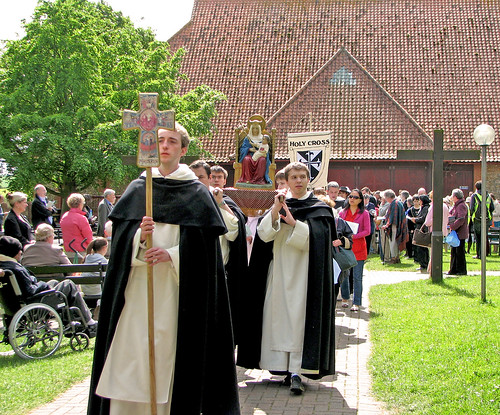
The English Dominican Studentate blog has pictures from their annual pilgrimage to the Shrine of Our Lady of Walsingham.
There’s an urban legend making the rounds about Pope Benedict’s visit to the United States. The story goes that Vice-President Cheney asked the pontiff what he’s been reading. The Holy Father replied that he’s been researching “the Arian heresy.” Cheney, thinking the pope meant “Aryan,” said, “That must be interesting for you, since you lived through it. And Benedict responded, “I’m old, but I’m not that old.”Visit Mike's blog to read the rest of the story.
It’s a funny story, and I’m told it appeared in the London Times. But I’m afraid I couldn’t find confirmation anywhere on the Web.
So I went over the head of the World Wide Web and sought out an expert: the political scientist Dr. Joseph Heim of California University of Pennsylvania. And Joe put me on to the likely source. Cheney wasn’t the political figure; it was Boris Johnson, the mayor of London. And Boris didn’t flub the historical facts quite as badly as the urban-legendary Cheney; the media did.

... I think there was a fruitful convergence between conversation partners on the fundamentally christological character of the analogia entis. Söhngen and Balthasar, in particular, give a more strongly christological reading of the analogy, placing it within the context of the analogia fidei, as explicating the logic of Nicaea and Chalcedon, a christological trend one might discern as well in the later Przywara.Matt, a former Wheaton and Princeton Seminary graduate, describes his interest in the analogia entis in an earlier post on his blog in which he looks at Bonaventure, Karl Barth, and Pope Benedict XVI:
... because of its heyday in the Medieval world, the analogia entis is best articulated by Medieval theologians such as Bonaventure:This is quite a fair treatment. As for myself, I am no theologian, and so my exposure to the depths of the analogia entis vs. analogia fidei discussion has been far more limited, though I agree with the general perception that there are strands of prejudice in some treatments of the subject I have read. While they were enjoying themselves at this conference, I was pondering the analogia while navigating through pages of generated assembly code. Now, who's up for some beer?"All created things of the sensible world lead the mind of the contemplator and wise man to eternal God... They are the shades, the resonances, the pictures of that efficient, exemplifying, and ordering art; they are the tracks, simulacra, and spectacles; they are divinely given signs set before us for the purpose of seeing God. They are exemplifications set before our still unrefined and sense-oriented minds, so that by the sensible things which they see they might be transferred to the intelligible which they cannot see, as if by signs to the signified" (Itinerarium mentis ad Deum, 2.11, as quoted p. 165).For those pleased by the preceding passage, it may surprise you that the analogia entis comes under severe Protestant attack. Why? Because of the dangers of abuse.
[20th century Protestant theologian Karl Barth] called the analogia entis the "invention of the antichrist". I imagine he did so because of its potential to obscure the mediating role that belongs to Christ alone. Instead Barth proposed the analogia fidei, (the "analogy of faith"), meaning the only link between ourselves and God is one of faith in Christ, recalling of course the Reformation's sola fide. In so doing, Barth burned all bridges but one, remembering that there is "one mediator" and "one foundation."
And in this Barth was right.
But consider the words of Pope Benedict in his recent Regensburg address, which, were they paying attention might have upset world Barthians as much as Muslims:"The faith of the Church has always insisted that between God and us, between his eternal Creator Spirit and our created reason, there exists a real analogy, in which - as the Fourth Lateran Council in 1215 stated - unlikeness remains infinitely greater than likeness, yet not to the point of abolishing analogy and its language. God does not become more divine when we push him away from us in a sheer, impenetrable voluntarism; rather, the truly divine God is the God who has revealed himself as logos and, as logos, has acted and continues to act lovingly on our behalf" (9/12/06).Benedict, speaking for the largest Christian tradition on the globe, makes three essential moves that when properly understood reasonably alleviates the fear of abusing the analogy of being:1. First, he recalls the words of the Fourth Lateran Council ("maior dissimulitudo in tanta similitudine"), explaining that the church has for quite some time been on record saying that the world's dissimilarity to God is somewhat greater than the similarity to God. Woops - did I say somewhat? I misquoted. Let me start again: He said "unlikeness remains infinitely greater than likeness." This is, after all, a fallen world. Anyone therefore fearing that the analogia entis obscures God's transcendence, or leaves no room for apophatic (negative) theology, needs to run by Benedict's statement again.So, who'll it be? Bonaventure, Barth or Benedict? I'll take 'em all, the Barthian insight being wonderfully framed by the wider perspectives of Bonaventure and Benedict. All shed important light on an enormous truth. What cannot be accepted is Barth's (or Luther's) hyperbolic desertions of large swaths of the tradition...
2. Secondly, in words that could be addressed directly to postmodern reductionists, Benedict shows that the analogia entis is important because it's easy to overdose on negative theology (a danger especially near to wounded ex-evangelicals on a positivist hangover who just discovered that negative theology exists). Benedict says that "God does not become more divine when we push him away from us in a sheer, impenetrable voluntarism," by which I take him to mean that the analogia entis safeguards us from the dangers of mysticism and subjectivism, thereby indirectly securing the essential benefits of both.
3. Finally, and most importantly, Benedict explains that the analogia entis is related to the logos - the ordering principle by which God created all that is. And this logos is none other than the Logos, Jesus Christ. The reason the analogy of being makes sense, even after God has definitively revealed himself in Jesus Christ, is because Christ is the one "through whom all things were made" and in whom "all things hold together." Therefore to contemplate an analogy between the being of the created world and the being of God is, properly understood, not something done independently of the Logos, Jesus Christ.
IN the matter of reforming things, as distinct from deforming them, there is one plain and simple principle; a principle which will probably be called a paradox. There exists in such a case a certain institution or law; let us say for the sake of simplicity, a fence or gate erected across a road. The more modern type of reformer goes gaily up to it and says, "I don't see the use of this; let us clear it away." To which the more intelligent type of reformer will do well to answer: "If you don't see the use of it, I certainly won't let you clear it away. Go away and think. Then, when you can come back and tell me that you do see the use of it, I may allow you to destroy it."From his essay, The Drift from Domesticity, available in The Thing.
This paradox rests on the most elementary common sense. The gate or fence did not grow there. It was not set up by somnambulists who built it in their sleep. It is highly improbable that it was put there by escaped lunatics who were for some reason loose in the street. Some person had some reason for thinking it would be a good thing for somebody. And until we know what the reason was, we really cannot judge whether the reason was reasonable. It is extremely probable that we have overlooked some whole aspect of the question, if something set up by human beings like ourselves seems to be entirely meaningless and mysterious.
There are reformers who get over this difficulty by assuming that all their fathers were fools; but if that be so, we can only say that folly appears to be a hereditary disease. But the truth is that nobody has any business to destroy a social institution until he has really seen it as an historical institution. If he knows how it arose, and what purposes it was supposed to serve, he may really be able to say that they were bad purposes, or that they have since become bad purposes, or that they are purposes which are no longer served. But if he simply stares at the thing as a senseless monstrosity that has somehow sprung up in his path, it is he and not the traditionalist who is suffering from an illusion. We might even say that he is seeing things in a nightmare. This principle applies to a thousand things, to trifles as well as true institutions, to convention as well as to conviction.
Al-Ghazali said that one does more harm to a doctrine by defending it with a method not suited to it, than by attacking it with a method suited to it. A perfect example of such a harmful defense is the ID movement, or any other movement that might try to find God or intelligence through science.
What we now call science is a method that deals with things insofar as they can be made proportionate to our intelligence. Science only accepts accounts that can be reduced to things we create: numerals, graphs, meters, grams, seconds, equation/variable-based mathematics. Because we are understanding the world in relation to things which owe their existence to our own will, it’s no surprise that we gain more and more power over things as science advances. If you understand something only so far as it conforms to something you control, then the extent of your understanding will stay close to the extent of your control.
So how well do you think God or intelligence can be understood by this method? The bare fact that both are free makes them impervious to the kind of reduction that science demands. So far as we expect understanding to be proportionate to control, can you “understand” anything about anyone? Well, yes, but only to the extent that they are not free- so to what extent does this apply to God?
One of the constantly recurring themes in perennial philosophy is that the eternal things are hard to know. The reason for this difficulty is always the same: eternal things are not proportionate to our intelligence. In Aristotle’s terms, we stand to God, the soul, and the angelic universe like the eye of a bat stands to the sun; in Plato’s terms, we are as a man who’s lived his whole life in a cave stands to the noonday sun. This is not to say we can’t know these things- everyone who knows how hard they are only says thisbecause he knows them- but it takes a while to acclamate oneself to the sight of the higher things. One can’t simply expect to drag people out of the cave in a day. For like reasons, a public debate with the cave-dwellers won’t get very far. How do you depict the sun with shadow-puppets?
In Plato’s terms, science is one of the most wonderful and edifying shows that the cave has ever put on. It has provided more corruptible (falsifible) knowledge than the world has ever known. It has provided more power and material comfort than human beings have found in anything else. Like church stained-glass, science is the closest that most people ever get to a sight of the eternal things.
Since 1645 selenographers had named at least 40 craters to honor Jesuits, but 5 have been renamed since then. Some of the craters are on the far side of the moon. When looking at the moon these craters can be located by eye when noting their position relative to the large Copernicus (O) crater with the distinctive "crater steaks" radiating from it like the stem of an orange.And why were their names used to identify the craters in the first place? MacDonnell continues:
At the entrance to the Smithsonian's Moon exhibit is a large copy of one of the earliest (1651) selenographs. This map, taken from a Jesuit book Almagestum novum, was composed by the Jesuit astronomers Riccioli and Grimaldi and across the top is written: "Neither do men inhabit the moon nor do souls migrate there".
It is the best known of all selenographs and has been used by most scholars for lunar nomenclature for three centuries. During these centuries astronomers took turns naming and renaming craters which resulted in conflicting lunar maps. In 1922 the International Astronomical Union (IAU) was formed, and eventually eliminated these conflicts and codified all lunar objects: 35 of the 40 Jesuit names survived to be listed in the National Air and Space Museum (NASM) catalog which identifies about 1600 points on the moon's surface.
It would be a mistake to think that the Jesuit names are on selenographs only because other Jesuits put them there. Rather it was a convergence of astronomers' opinions over three centuries: map makers before and after Riccioli confirmed the decisions again and again that these 40 men deserved this honor. This is not surprising. Recent histories emphasize the enormous influence Jesuits had not only on mathematics but on the other developing sciences such as astronomy. Historians of science always listed a surprisingly large number of Jesuits among the greatest scientists and mathematicians of all time. They were at the cutting edge of the sciences. For instance, by the time of the suppression in 1773, of the world's 130 astronomy observatories, 30 were operated by Jesuits. Furthermore Jesuit names are still being added to the list by the I. A. U.And just who are these Jesuits? Well, among them is the great Christopher Clavius, who was the main architect of the Gregorian Calendar and inspired mathematicians like Leibniz. Also among them is Matteo Ricci, and also Francesco Grimaldi, who inspired Isaac Newton in the study of optics.
Have confidence! You shall find the source of charity in the side of the crucified Christ. I wish you to establish yourselves there and make a dwelling there for yourselves. Rise up then with great and burning desire. Approach, enter and remain in this sweet dwelling. No demon or any other creature can take this grace from you or hinder you from reaching your end, namely, that you should come to see and taste God. I say no more. Abide in the holy and sweet love of God. Love, love one another.Holy Catherine, pray for me.
The Church, though dispersed through out the whole world, even to the ends of the earth, has received from the apostles and their disciples this faith: [She believes] in one God, the Father Almighty, Maker of heaven, and earth, and the sea, and all things that are in them; and in one Christ Jesus, the Son of God, who became incarnate for our salvation; and in the Holy Spirit, who proclaimed through the prophets the dispensations of God, and the advents, and the birth from a virgin, and the passion, and the resurrection from the dead, and the ascension into heaven in the flesh of the beloved Christ Jesus, our Lord, and His [future] manifestation from heaven in the glory of the Father "to gather all things in one," and to raise up anew all flesh of the whole human race, in order that to Christ Jesus, our Lord, and God, and Saviour, and King, according to the will of the invisible Father, "every knee should bow, of things in heaven, and things in earth, and things under the earth, and that every tongue should confess" to Him, and that He should execute just judgment towards all; that He may send "spiritual wickednesses," and the angels who transgressed and became apostates, together with the ungodly, and unrighteous, and wicked, and profane among men, into everlasting fire; but may, in the exercise of His grace, confer immortality on the righteous, and holy, and those who have kept His commandments, and have persevered in His love, some from the beginning [of their Christian course], and others from [the date of] their repentance, and may surround them with everlasting glory.
As I have already observed, the Church, having received this preaching and this faith, although scattered throughout the whole world, yet, as if occupying but one house, carefully preserves it. She also believes these points [of doctrine] just as if she had but one soul, and one and the same heart, and she proclaims them, and teaches them, and hands them down, with perfect harmony, as if she possessed only one mouth. For, although the languages of the world are dissimilar, yet the import of the tradition is one and the same.
For the Churches which have been planted in Germany do not believe or hand down anything different, nor do those in Spain, nor those in Gaul, nor those in the East, nor those in Egypt, nor those in Libya, nor those which have been established in the central regions of the world. But as the sun, that creature of God, is one and the same throughout the whole world, so also the preaching of the truth shines everywhere, and enlightens all men that are willing to come to a knowledge of the truth.
Mr. Copper: So Great Britain is part of Europea and just across the British Channel you've got Great France and Great Germany?Which proves that for even for the distant, alien race of the Time Lords, Britain is still the center of the known universe.
The Doctor: No, no it's just France and Germany; only Britain is Great.
Mr. Copper: And they're all at war with the continent of Hamerica.
The Doctor: No, well, not yet. Ah, you could argue that one.
True freedom blossoms when we turn away from the burden of sin, which clouds our perceptions and weakens our resolve, and find the source of our ultimate happiness in him who is infinite love, infinite freedom, infinite life. "In his will is our peace".He was also careful to underscore his role as Bishop of Rome, Successor to Peter the Apostle, with which visible unity is important. From his message at the ecumenical gathering:
Too often those who are not Christians, as they observe the splintering of Christian communities, are understandably confused about the Gospel message itself. Fundamental Christian beliefs and practices are sometimes changed within communities by so-called “prophetic actions” that are based on a hermeneutic not always consonant with the datum of Scripture and Tradition. Communities consequently give up the attempt to act as a unified body, choosing instead to function according to the idea of “local options”. Somewhere in this process the need for diachronic koinonia - communion with the Church in every age - is lost, just at the time when the world is losing its bearings and needs a persuasive common witness to the saving power of the Gospel (cf. Rom 1:18-23).
Faced with these difficulties, we must first recall that the unity of the Church flows from the perfect oneness of the Trinitarian God. In John’s Gospel, we are told that Jesus prayed to his Father that his disciples might be one, “just as you are in me and I am in you” (Jn 17:21). This passage reflects the unwavering conviction of the early Christian community that its unity was both caused by, and is reflective of, the unity of the Father, Son, and Holy Spirit. This, in turn, suggests that the internal cohesion of believers was based on the sound integrity of their doctrinal confession (cf. 1 Tim 1:3-11). Throughout the New Testament, we find that the Apostles were repeatedly called to give an account for their faith to both Gentiles (cf. Acts 17:16-34) and Jews (cf. Acts 4:5-22; 5:27-42). The core of their argument was always the historical fact of Jesus’s bodily resurrection from the tomb (Acts 2:24, 32; 3:15; 4:10; 5:30; 10:40; 13:30). The ultimate effectiveness of their preaching did not depend on “lofty words” or “human wisdom” (1 Cor 2:13), but rather on the work of the Spirit (Eph 3:5) who confirmed the authoritative witness of the Apostles (cf. 1 Cor 15:1-11). The nucleus of Paul’s preaching and that of the early Church was none other than Jesus Christ, and “him crucified” (1 Cor 2:2). But this proclamation had to be guaranteed by the purity of normative doctrine expressed in creedal formulae - symbola - which articulated the essence of the Christian faith and constituted the foundation for the unity of the baptized (cf. 1 Cor 15:3-5; Gal 1:6-9; Unitatis Redintegratio, 2).
My dear friends, the power of the kerygma has lost none of its internal dynamism. Yet we must ask ourselves whether its full force has not been attenuated by a relativistic approach to Christian doctrine similar to that found in secular ideologies, which, in alleging that science alone is “objective”, relegate religion entirely to the subjective sphere of individual feeling. Scientific discoveries, and their application through human ingenuity, undoubtedly offer new possibilities for the betterment of humankind. This does not mean, however, that the “knowable” is limited to the empirically verifiable, nor religion restricted to the shifting realm of “personal experience”.
For Christians to accept this faulty line of reasoning would lead to the notion that there is little need to emphasize objective truth in the presentation of the Christian faith, for one need but follow his or her own conscience and choose a community that best suits his or her individual tastes. The result is seen in the continual proliferation of communities which often eschew institutional structures and minimize the importance of doctrinal content for Christian living.
In May 2004, a composer named Nobuo Uematsu joined the Los Angeles Philharmonic for a single performance of his most famous work. The show sold out in three days. In fact, there was almost a riot at the box office when people couldn't get tickets.I would suggest listening to the story online. About 12 minutes.
What was the music? Uematsu's soundtrack for the popular video game Final Fantasy.
I do not issue orders to you, as if I were some great person. For though I am bound for the name [of Christ], I am not yet perfect in Jesus Christ. For now I begin to be a disciple, and I speak to you as fellow-disciples with me. For it was needful for me to have been stirred up by you in faith, exhortation, patience, and long-suffering. But inasmuch as love suffers me not to be silent in regard to you, I have therefore taken upon me first to exhort you that you would all run together in accordance with the will of God. For even Jesus Christ, our inseparable life, is the [manifested] will of the Father; as also bishops, settled everywhere to the utmost bounds [of the earth], are so by the will of Jesus Christ.Ignatius of Antioch was certainly not a Johnny Come Lately to the Christian scene, as one who might have sought to undermine the Gospel he received from the mouths of apostles themselves. In fact, Ignatius offered his life for the faith he received and lived and inspired countless others by his witness.
Wherefore it is fitting that you should run together in accordance with the will of your bishop, which thing also you do. For your justly renowned presbytery, worthy of God, is fitted as exactly to the bishop as the strings are to the harp. Therefore in your concord and harmonious love, Jesus Christ is sung. And do ye, man by man, become a choir, that being harmonious in love, and taking up the song of God in unison, you may with one voice sing to the Father through Jesus Christ, so that He may both hear you, and perceive by your works that you are indeed the members of His Son. It is profitable, therefore, that you should live in an unblameable unity, that thus you may always enjoy communion with God.
For if I in this brief space of time, have enjoyed such fellowship with your bishop — I mean not of a mere human, but of a spiritual nature — how much more do I reckon you happy who are so joined to him as the Church is to Jesus Christ, and as Jesus Christ is to the Father, that so all things may agree in unity! Let no man deceive himself: if any one be not within the altar, he is deprived of the bread of God. For if the prayer of one or two possesses such power, how much more that of the bishop and the whole Church! He, therefore, that does not assemble with the Church, has even by this manifested his pride, and condemned himself. For it is written, "God resists the proud." Let us be careful, then, not to set ourselves in opposition to the bishop, in order that we may be subject to God.
After thirteen continuous months in Lombardy, I went to Savoy, where I have been for five months. Prelates and several rulers of the area have asked for me and it is with great emotion that I have already visited four dioceses here, namely, Sion, Aosta, Tarantaise, Maurienne and Grenoble, all of which are important centers in Savoy. I am going around preaching in the towns, villages and castles to the extent that seems best. At the moment I am in the diocese of Geneva.The charism of St. Dominic is certainly evident in his writing, as earlier he observes:
Among other aberrations, I have found one very widespread error that has infected these parts: every year on the day after Corpus Christi, confraternities gather in solemn assembly under the title of "the holy rising sun." My confreres, the Friars Minor, other religious and even the parish priests have told me that they did not dare to preach or to say anything against this error out of fear, for they would be threatened with death and their offerings and alms would be taken away. I now address this error in particular by preaching daily, the Lord aiding and confirming what I say, and it has been effectively uprooted. These people, who now come to me, are overcome with sorrow when they learn how far they have wandered from the faith. When by the grace of God this error has been completely uprooted, I plan to go to the diocese of Lausanne, where they publicly worship the sun as a god -- especially the country folk -- by offering the sun their morning prayers and by reverencing it. The bishop of Lausanne himself made a journey of two or three days to see me and humbly beg that I would visit his diocese, where there are many valleys of heretics within Allemania and Savoy. This I promised to do. I have heard that the heretics of those valleys are very daring and bold, but I am confident in the accustomed mercy of God and I intend to go there and preach during the coming Lent. However, let it happen according to the heavenly plan.
I discovered that a principle reason for heresies and errors in these places was a lack of preaching. As I correctly perceived from the inhabitants there, thirty years had elapsed during which no one had preached to them but the Waldensian heretics, who would come to them twice a year from Apuleia.A solid witness is what our world most certainly needs today, to "preach the truth in love" according to our particular state in life, and to constantly remind ourselves of what we preach as well and live it out.
I have been maintaining that the Holy Father has a program, a vision for the Church. He is trying to revitalize our Catholic identity. I often refer to his "Marshall Plan", as I call it, for the Church. Just as Europe was devastated after the war and needed rebuilding, the Church and our identity as Catholics has been devastated over the last 40 or so years. We need rebuilding. For Benedict, liturgy is the key. It is the "tip of the spear" so to speak. Change our approach to liturgy and you change everything.Fr. Z is referring primarily, though not exclusively, to this section of the Holy Father's homily, which is particularly significant:
One of the most devastating changes after the Council was the widespread abandonment of ad orientem worship. Authors like Klaus Gamber, for whom Papa Ratzinger has such great respect, thought that changing our altars around was perhaps the most damaging change in the post-Conciliar reform. Sadly, the destruction of ad orientem worship was based on misuse of scholarship, surely, but most on ideological choices rooted in a hermeneutic of rupture and a ecclesiology which was little in harmony with our Catholic faith. The results for Catholic worship were viciously corrosive.
Pope Benedict has long written of the meaning and need for ad orientem worship. In practical terms he knows that we cannot force abrupt changes. We must be gentle in reintroducing it.
However, as we have been watching him during the last year or so reintroducing many traditional elements our Roman Rite into the full view of the world, including ad orientem worship in the Sistine Chapel, I think we can say that he thinks the time has come for more decisive moves.
In the early Church there was a custom whereby the Bishop or the priest, after the homily, would cry out to the faithful: “Conversi ad Dominum” – turn now towards the Lord. This meant in the first place that they would turn towards the East, towards the rising sun, the sign of Christ returning, whom we go to meet when we celebrate the Eucharist. Where this was not possible, for some reason, they would at least turn towards the image of Christ in the apse, or towards the Cross, so as to orient themselves inwardly towards the Lord. Fundamentally, this involved an interior event; "conversion", the turning of our soul towards Jesus Christ and thus towards the living God, towards the true light. Linked with this, then, was the other exclamation that still today, before the Eucharistic Prayer, is addressed to the community of the faithful: “Sursum corda” – “Lift up your hearts”, high above the tangled web of our concerns, desires, anxieties and thoughtlessness – “Lift up your hearts, your inner selves!” In both exclamations we are summoned, as it were, to a renewal of our Baptism: "Conversi ad Dominum" – we must distance ourselves ever anew from taking false paths, onto which we stray so often in our thoughts and actions. We must turn ever anew towards him who is the Way, the Truth and the Life. We must be converted ever anew, turning with our whole life towards the Lord. And ever anew we must allow our hearts to be withdrawn from the force of gravity, which pulls them down, and inwardly we must raise them high: in truth and love. At this hour, let us thank the Lord, because through the power of his word and of the holy Sacraments, he points us in the right direction and draws our heart upwards. Let us pray to him in these words: Yes, Lord, make us Easter people, men and women of light, filled with the fire of your love. Amen.Amen! But that said, be sure to read the homily in its entirety!
O certe necessarium Adae peccatum, quod Christi morte deletum est!The sublime contradiction, part of the Easter Exsultet - it strikes me now as it did when it was sung during the Easter Vigil in 1997 at which I was baptized and received into the Church. Only this year, hearing it sung in Latin was particularly haunting to me. How can I explain it?
O felix culpa, quae talem ac tantum meruit habere Redemptorem!
O truly necessary sin of Adam, which the death of Christ has blotted out!
O happy fault, that merited such and so great a Redeemer!
[Chesterton] examined various challenges to Christianity, noting, "It was attacked on all sides and for all contradictory reasons." His observations are just as illuminating today as they were one hundred years ago—perhaps even more so—for they outline the flawed nature of the biases of skeptics and scoffers, and are therefore of no small assistance to anyone defending Christianity in today's hostile public square.
The first contradictory criticism is that Christianity is "a thing of inhuman gloom" and "purely pessimistic and opposed to life". In contemporary terms: Christianity is allegedly repressive, dysfunctional, and depressing. In the words of Ted Turner, Christianity is a "religion for losers." Such is the mantra of the sexually "liberated," who see any restraint upon their libido as the work of a self-loathing and prudish Church. This portrayal of Christianity is such regular fare it hardly needs to be pointed out.
And yet, Chesterton continues, Christianity was also mocked because it "comforted men with a fictitious providence" and was " a fool's paradise." Don't you know, muses the enlightened "free thinker", that Christianity enslaves by promising heavenly bliss and eternal glory, when in fact life is a series of random biological accidents without any purpose, direction, or meaning? Ah, so who is really depressing and pessimistic? "The very man who denounced Christianity for pessimism," Chesterton notes, "was himself a pessimist." It is demeaning, say some critics, to speak of "sin"; far better to believe that man is an animal with little or no control over his lusts and passions, which are simply products of genetics and environment.

Planned Parenthood Peer Educators have become like the Underground Railroad of Sex Education [laughter]. They’re the front lines giving kids information they can’t get anywhere else.Which basically means he approves of PP's undermining of parents' authority, which we've basically known since it was shown that Planned Parenthood administrators will even cover up crimes in some cases of statutory rape. And let's give 'em more state funds! And Underground Railroad of Sex Education? Is he sure he wants to link abortion and teen sex to the plight of slaves seeking freedom from oppression?
In America today, almost as many African-American children are aborted as are born [3 out of 5 pregnancies]. A black baby is three times more likely to be murdered in the womb than a white baby. Since 1973, abortion has reduced the black population by over 25 percent. Twice as many African-Americans have died from abortion than have died from AIDS, accidents, violent crimes, cancer, and heart disease combined. Every three days, more African-Americans are killed by abortion than have been killed by the Ku Klux Klan in its entire history. Planned Parenthood operates the nation's largest chain of abortion clinics and almost 80 percent of its facilities are located in minority neighborhoods. About 13 percent of American women are black, but they submit to over 35 percent of the abortions.Abortion doesn't help minorities overcome oppression, and it doesn't help women today. As I've said before, the early American feminist movement didn't subscribe to this lie, and women shouldn't believe this lie today.
What kind of "change" will come about, what kind of "unity" can possibly occur under such a president who obstinately repudiates the very clear teachings of the Church on the sanctity of human life?

These opinions, Florinus, that I may speak in mild terms, are not of sound doctrine; these opinions are not consonant to the Church, and involve their votaries in the utmost impiety; these opinions, even the heretics beyond the Church’s pale have never ventured to broach; these opinions, those presbyters who preceded us, and who were conversant with the apostles, did not hand down to thee.Thanks be to God.
For, while I was yet a boy, I saw thee in Lower Asia with Polycarp, distinguishing thyself in the royal court, and endeavouring to gain his approbation. For I have a more vivid recollection of what occurred at that time than of recent events (inasmuch as the experiences of childhood, keeping pace with the growth of the soul, become incorporated with it); so that I can even describe the place where the blessed Polycarp used to sit and discourse— his going out, too, and his coming in—his general mode of life and personal appearance, together with the discourses which he delivered to the people; also how he would speak of his familiar intercourse with John, and with the rest of those who had seen the Lord; and how he would call their words to remembrance. Whatsoever things he had heard from them respecting the Lord, both with regard to His miracles and His teaching, Polycarp having thus received [information] from the eye-witnesses of the Word of life, would recount them all in harmony with the Scriptures. These things, through, God’s mercy which was upon me, I then listened to attentively, and treasured them up not on paper, but in my heart; and I am continually, by God’s grace, revolving these things accurately in my mind.
And I can bear witness before God, that if that blessed and apostolical presbyter had heard any such thing, he would have cried out, and stopped his ears, exclaiming as he was wont to do: “O good God, for what times hast Thou reserved me, that I should endure these things?” And he would have fled from the very spot where, sitting or standing, he had heard such words. This fact, too, can be made clear, from his Epistles which he dispatched, whether to the neighbouring Churches to confirm them, or to certain of the brethren, admonishing and exhorting them.
And that completes my final report until we reach touchdown. We're now on full automatic, in the hands of the computers. I've tucked my crew in for the long sleep and I'll be joining them soon.Hope you are having a solemn Lent!
In less than an hour we'll finish our sixth month out of Cape Kennedy. Six months in deep space. By our time, that is. According to Dr Hasslein's theory of time in a vehicle traveling nearly the speed of light, the Earth has aged nearly 700 years since we left it, while we've aged hardly at all.
It may be so.
This much is probably true. The men who sent us on this journey are long since dead and gone. You who are reading me now are a different breed. I hope a better one.
I leave the 20th century with no regrets, but... one more thing. If anybody's listening, that is. Nothing scientific. It's... purely personal. Seen from out here, everything seems different. Time bends. Space is... boundless. It squashes a man's ego. I feel lonely.
That's about it.
Tell me, though... Does man, that marvel of the universe, that glorious paradox who has sent me to the stars, still make war against his brother, keep his neighbor's children starving?
Inspiration is nice. But some folks seem to be getting out of hand.Joe Klein, from Time Magazine, notes some things about Obama's Super Tuesday speech:
It's as if Tom Daschle descended from on high saying, "Be not afraid; for behold I bring you good tidings of great joy which shall be to all the people: for there is born to you this day in the city of Chicago a Savior, who is Barack the Democrat."
Obama supporter Kathleen Geier writes that she's "getting increasingly weirded out" by some of Obama's supporters...
Describing various encounters with Obama supporters, she writes, "Excuse me, but this sounds more like a cult than a political campaign. The language used here is the language of evangelical Christianity – the Obama volunteers speak of 'coming to Obama' in the same way born-again Christians talk about 'coming to Jesus.'
And yet there was something just a wee bit creepy about the mass messianism — "We are the ones we've been waiting for" — of the Super Tuesday speech and the recent turn of the Obama campaign. "This time can be different because this campaign for the presidency of the United States of America is different. It's different not because of me. It's different because of you." That is not just maddeningly vague but also disingenuous: the campaign is entirely about Obama and his ability to inspire. Rather than focusing on any specific issue or cause — other than an amorphous desire for change — the message is becoming dangerously self-referential. The Obama campaign all too often is about how wonderful the Obama campaign is.The gift of the master of rhetoric.
... with conservatives one seat away from having a majority on the Supreme Court and the next president having the power to name up to three justices, do you actually think the folks who've fought two generations to re-take the Court actually want to see three Clinton jurists?I'm sure even the most conservative Republicans can make the best of a McCain nomination if only they use their brains. I think it was foolish to expect the perfect conservative to emerge who had any chance of appealing to independent voters and who could successfully trounce a Democrat in a national election -- not after the mess left behind by the Bush Administration. Now, issues do matter. But is committing suicide really the best option in this case? Perhaps the Republicans could've done better, but I'm quite certain they could've also done far worse.
From 1936 to 1976 the liberal side of the Republican party frequently won the national nomination with candidates such as Alf Landon, Wendell Willkie, Thomas E. Dewey, Dwight D. Eisenhower, and Richard Nixon, and Gerald Ford. Indeed, other terms for Liberal Republicans include Nixonian and Rockefeller Republican. The mainstream of the party was generally supportive of the New Deal, and the conservatives were the RINOs.Soon, Reagan came along and how many initially took him seriously?
After 1980 there were few if any open liberals in prominent positions in the GOP, except for numerous "moderates", such as George H. W. Bush, who had run for president on the stance that Reagan's Conservative platform was "voodoo economics".And then, when I think of RINO today, I think of folks along the lines of pro-choicers Giuliani, Bloomberg, etc... but then McCain doesn't quite fit that mold, at least not in the same way. And who else has held the RINO label? Romney, Huckabee, and Ron Paul.

