Business trips
I work for Texas Instruments, and as I've said, things have been very busy lately. And tomorrow, I leave for Dallas to the TI "mother-ship" for the week. I'll be back the following week, only to be flying out to Pittsburgh the week after that. :) I've never been as far East as Pittsburgh, so even if it's for business, it should still be fun.
I will blog when I return from Dallas and before the second trip.
Sunday, July 06, 2003

Thursday, July 03, 2003
Wednesday, July 02, 2003
Jesus Christ the Apple Tree
The tree of life my soul hath seen,
Laden with fruit and always green:
The trees of nature fruitless be
Compared with Christ the apple tree.
His beauty doth all things excel:
By faith I know, but ne'er can tell
The glory which I now can see
In Jesus Christ the apple tree.
For happiness I long have sought,
And pleasure dearly I have bought:
I missed of all; but now I see
'Tis found in Christ the apple tree.
I'm weary with my former toil,
Here I will sit and rest awhile:
Under the shadow I will be,
Of Jesus Christ the apple tree.
This fruit doth make my soul to thrive,
It keeps my dying faith alive;
Which makes my soul in haste to be
With Jesus Christ the apple tree.
-from the collection of Joshua Smith, 1784
Bring on the genetically engineered she-males?
This article is mind blowing:
This article is mind blowing:
Dr. Norbert Gleicher of the Foundation for Reproductive Medicine in Chicago and a colleague injected male cells into female embryos in research which they believe could lead to better treatments or cures for single gene disorders.Would something like this ever become accepted in our society? God help us.
...Their work also sparked outrage from abortion opponents who described it as run-away science. "This is gross manipulation of human life," said Nuala Scarisbrick of British anti-abortion charity Life.
To be or not to be Goth
I was reflecting a little on my experience in high school. Most kids tend to hover around a group mentality where fundamentally it is the group that sets the standards of what is popular, fashionable, or unpopular. Kids form cliques and go through phases and in the end, God willing, they become adults. As they grow, they learn to build a moral compass rooted in an informed conscience by which they can judge things for themselves instead of looking toward the group for all of their answers. The ways in which some kids accomplish this has always interested me. Particularly these phases. My half-sister went through a big KISS phase in the 80s. It was around everything she did. She wanted to look like them, act like them, and be them as she embraced their music. She eventually grew out of it as she matured. Other kids idolize zealots like Marylin Manson. And others find themselves embracing groups and behaviors that many of us might deem bizarre.
Depending on what they are, subcultures are an interesting study. Sometimes they aren't as obvious as we think. The Goth subculture is one in particular that has fascinated me. Right now I am not going to focus on the religious ramifications of Goths, per se, but the sociological. I knew a few growing up. Typically I guess its a phase, but I always wonder, what brings it on? I could characterize the Goths whom I knew as living in some sort of bottomless, communal depression. My friends tried to portray themselves as deep and unknowable. They rebelled against anything society deemed good or sacred. They wanted to be deep because they felt they were living in a shallow culture. And therefore whatever society said was good was no longer interesting - coupled with an overwhelming desire to be different. This brings me to my point. In knowing the Goths that I knew, it was the Goth attitude that seemed more shallow to me. In a way, it was a sort of fundamentalism. Instead of recognizing the many diverse and opposing elements that make up a human society where human beings live, they rejected everything and invented their own society in a way. But they could not escape the fact that anything they could invent would always have been fundamentally rooted in the very society they were trying to obscure. That's what makes Goth satires like Goth Talk on Saturday Night Life so hilarious.
So what about the religious ramifications? Many of the Goths I knew rejected religion - well, they rejected the image of it put forth by society, and they did so very often superficially. But didn't I say that sometimes subcultures aren't as obvious as we might think? Case in point is xnetgoth.com:
I was reflecting a little on my experience in high school. Most kids tend to hover around a group mentality where fundamentally it is the group that sets the standards of what is popular, fashionable, or unpopular. Kids form cliques and go through phases and in the end, God willing, they become adults. As they grow, they learn to build a moral compass rooted in an informed conscience by which they can judge things for themselves instead of looking toward the group for all of their answers. The ways in which some kids accomplish this has always interested me. Particularly these phases. My half-sister went through a big KISS phase in the 80s. It was around everything she did. She wanted to look like them, act like them, and be them as she embraced their music. She eventually grew out of it as she matured. Other kids idolize zealots like Marylin Manson. And others find themselves embracing groups and behaviors that many of us might deem bizarre.
Depending on what they are, subcultures are an interesting study. Sometimes they aren't as obvious as we think. The Goth subculture is one in particular that has fascinated me. Right now I am not going to focus on the religious ramifications of Goths, per se, but the sociological. I knew a few growing up. Typically I guess its a phase, but I always wonder, what brings it on? I could characterize the Goths whom I knew as living in some sort of bottomless, communal depression. My friends tried to portray themselves as deep and unknowable. They rebelled against anything society deemed good or sacred. They wanted to be deep because they felt they were living in a shallow culture. And therefore whatever society said was good was no longer interesting - coupled with an overwhelming desire to be different. This brings me to my point. In knowing the Goths that I knew, it was the Goth attitude that seemed more shallow to me. In a way, it was a sort of fundamentalism. Instead of recognizing the many diverse and opposing elements that make up a human society where human beings live, they rejected everything and invented their own society in a way. But they could not escape the fact that anything they could invent would always have been fundamentally rooted in the very society they were trying to obscure. That's what makes Goth satires like Goth Talk on Saturday Night Life so hilarious.
Our lair is located along a dark and sinister route, enshouded by weeping willows, a block and a half from the Pizza Hut. I am Circe Nightshade, and with me is Azrael Abyss, the Prince of Sorrow. Azrael had to work late last night at CinnaBuns, in the mall.It's also what makes it very juvenile, which explains why being Goth is a phase that a person usually outgrows.
So what about the religious ramifications? Many of the Goths I knew rejected religion - well, they rejected the image of it put forth by society, and they did so very often superficially. But didn't I say that sometimes subcultures aren't as obvious as we might think? Case in point is xnetgoth.com:
...you will encounter a worldwide community of Goths and other outcasts that have one thing in common: The Christian faith. This is no ordinary website, it is made up of those who walk in the shadows cast by the Light of the world.Yes you read it right - Christian Goths, walking in the shadows of the Light of the world. Yeah, it makes little sense, but hey. Reading through some of the discussions, I can see right away that this is a different type of Goth than those whom I knew growing up. Cynicism largely characterized those whom I knew, but what characterizes these Goths is optimism. They have come farther than the Goths that I knew. These Goths actually realize that sure, society can be shallow, but it is given a depth because it is redeemable. What, then, is the point? If it amounts to being different, okay - which shows that this, too, is a phase. I will not say that every person at that website is a Christian., but the mere existence of such a site is interesting, n'est-ce pas?
Wednesday, June 25, 2003
Vatican Museums
Vatican Museums is now online at the Vatican website, click here to enter.
Thanks to Dappled Things for the link.
Vatican Museums is now online at the Vatican website, click here to enter.
Thanks to Dappled Things for the link.
Sunday, June 22, 2003
The King's good servant, but God's First

Today is also typically the feast day of St. Thomas More, though as many bloggers have noted, it is superceded by the feast of Corpus Christi. Seeing as how Thomas More has become one of my dearest friends in Heaven, I thought I should mention something about him. I am of English descent myself, and so I enjoy reading about the history of England, particularly about the history of the Church of England, especially the pre-"Reformation" Church. Thomas More figures in that history significantly as an honorable statesman and lawyer as well as Lord Chancellor of England. When the Pope refused to grant Henry VIII a divorce from Catherine, which the Pope considered to be a valid marriage, in order that he could marry Anne Boleyn, Henry decided to assume authority for himself. More was imprisoned because he refused to swear to the Oath of Supremacy, which acknowledged the King's new title as Supreme Head of the Church in England, thereby contradicting the jurisdictional authority of the Bishop of Rome. More was later found guilty of high treason and lost his life, due largely to false testimony against him.
It should be noted that when most people, particularly textbooks, try to tell the story of why the Church would not grant Henry the divorce, they often paint the Church as some sort of monolithic structure which, on a whim of its own design, decided not to yield to Henry's desires. In truth, modern historians know precious little about Canon Law and what is meant by the validity or the invalidity of marriages. In truth, there were valid reasons for which the Church did not grant Henry a divorce. Henry had argued that his marriage to Catherine was null because he had married his brother's widow, which was a violation of the Levitical command (Leviticus 18:16), which would mean that his marriage was unlawful and therefore a divorce could be procured. However, historians often fail to note that the Pope proved that Henry's marriage to Catherine was indeed lawful because her marriage to Henry's brother was never consummated. Henry's brother was sickly and died early. There was also an exception to Leviticus given in Deuteronomy 25:5. That is why the Pope gave Henry the dispensation allowing him to marry Catherine in the first place. Therefore, a divorce could not be procured, evidence which Henry apparently chose to ignore.
St. Thomas More is my friend because I look to him as a role model and ask for his prayers for me. If you are interested in learning more about him and reading some of his short and long works, please visit the luminarium website, which is chock full of information.
St. Thomas More, pray for us.
Today is also typically the feast day of St. Thomas More, though as many bloggers have noted, it is superceded by the feast of Corpus Christi. Seeing as how Thomas More has become one of my dearest friends in Heaven, I thought I should mention something about him. I am of English descent myself, and so I enjoy reading about the history of England, particularly about the history of the Church of England, especially the pre-"Reformation" Church. Thomas More figures in that history significantly as an honorable statesman and lawyer as well as Lord Chancellor of England. When the Pope refused to grant Henry VIII a divorce from Catherine, which the Pope considered to be a valid marriage, in order that he could marry Anne Boleyn, Henry decided to assume authority for himself. More was imprisoned because he refused to swear to the Oath of Supremacy, which acknowledged the King's new title as Supreme Head of the Church in England, thereby contradicting the jurisdictional authority of the Bishop of Rome. More was later found guilty of high treason and lost his life, due largely to false testimony against him.
It should be noted that when most people, particularly textbooks, try to tell the story of why the Church would not grant Henry the divorce, they often paint the Church as some sort of monolithic structure which, on a whim of its own design, decided not to yield to Henry's desires. In truth, modern historians know precious little about Canon Law and what is meant by the validity or the invalidity of marriages. In truth, there were valid reasons for which the Church did not grant Henry a divorce. Henry had argued that his marriage to Catherine was null because he had married his brother's widow, which was a violation of the Levitical command (Leviticus 18:16), which would mean that his marriage was unlawful and therefore a divorce could be procured. However, historians often fail to note that the Pope proved that Henry's marriage to Catherine was indeed lawful because her marriage to Henry's brother was never consummated. Henry's brother was sickly and died early. There was also an exception to Leviticus given in Deuteronomy 25:5. That is why the Pope gave Henry the dispensation allowing him to marry Catherine in the first place. Therefore, a divorce could not be procured, evidence which Henry apparently chose to ignore.
St. Thomas More is my friend because I look to him as a role model and ask for his prayers for me. If you are interested in learning more about him and reading some of his short and long works, please visit the luminarium website, which is chock full of information.
St. Thomas More, pray for us.
Corpus Christi
John 6:56-59
In illo tempore: Dixit Iesus turbis Iudaeorum: Caro mea vere est cibus, et sanguis meus vere est potus. Qui manducat carnem, et bibit meum sanguinem, in me manet, et ego in illo. Sicut misit me vivens Pater, et ego vivo propter Patrem: et qui manducat me, et ipse vivet propter me. Hic est panis, qui de caelo descendit. Non sicut manducaverunt patres vestri manna, et mortui sunt. Qui manducat hunc panem, vivet in aeternum.
Saturday, June 21, 2003
What is the role of Campus Ministry?
Bill Cork has an interesting report concerning studies done on campus ministry. Overall, I agree with Bill's assessment, particularly this:
Bill Cork has an interesting report concerning studies done on campus ministry. Overall, I agree with Bill's assessment, particularly this:
Is [campus ministry] supported by finances, qualified and stable personnel, a diocesan-coordinated outreach, and collaboration with other diocesan offices? Or is it handed over to people who would prefer to work as "lone rangers," advancing their own agenda, with no oversight by the local bishop? The Code of Canon Law says (Can. 813):As many of you know, in my archdiocese (Los Angeles), we currently have no director or diocesan office for campus ministry, which is a sad shame, in my opinion, since campus ministry should be considered part of the Church's major mission, particularly the local Church, and I thought that it was. But interestingly, some campus ministries don't want to be seen that way. What bothered me about the Newman Center I was at for almost seven years was that our Cardinal, the Pope, or any figure of authority within the Church, was often looked upon with either apathy, distrust, or plain disdain anyway. The Newman center didn't care about being a part of the local Church, an extension of the Bishop's duties. Instead, they prided themselves on how individual they were and on how far away they were from the Cathedral in Los Angeles, ground zero as it were. It was an attitude that I increasingly found difficult to digest, among other things, so I eventually felt called to leave and join a nearby parish staffed by diocesan priests! I still lead the Eucharistic Adoration and Prayer Group with a friend of mine at the newman center, however, at least for a while.The diocesan bishop is to have earnest pastoral care for students, even by erecting a parish or at least by designating priests stably for this, and is to make provision that at universities, even non-Catholic ones, there are Catholic university centers which give assistance, especially spiritual assistance, to youth.As I look at this, it affirms that campus ministry is an extension of the bishop's pastoral office. Consequently, campus ministry needs to be a diocesan commitment. I think each bishop should appoint a diocesan director of campus ministry who can ensure that campus ministry truly represents the bishop's vision and is fully connected to the local Church.
Faire is the heaven
Faire is the heaven, where happy soules have place,
In full enjoyment of felicitie,
Whence they doe still behold the glorious face
Of the divine eternall Majestie.
Yet farre more faire be those bright Cherubins,
Which all with golden wings are overdight,
And those eternall burning Seraphins,
Which from their faces dart out fiery light:
Yet fairer than they both, and much more bright
Be th'Angels and Archangels, which attend
On Gods owne person, without rest or end.
These then in faire each other farre excelling,
As to the Highest they approach more neare,
Yet is that Highest farre beyond all telling,
Fairer than all the rest which there appeare,
Though all their beauties joynd together were;
How then can mortalle tongue hope to expresse
The image of such endlesse perfectnesse?
... from Edmund Spenser, from An Hymne of Heavenly Beautie, c1596.
Bad day for Roe
Looks like Norma McCorvey's request for a new trial was declined.
I hope this isn't the end of this. Sarah Weddington, who represented McCorvey in the original trial, apparently had this to say:
There is nothing stable or reliable when it comes to abortion. It's a shady business indeed.
Looks like Norma McCorvey's request for a new trial was declined.
I hope this isn't the end of this. Sarah Weddington, who represented McCorvey in the original trial, apparently had this to say:
Those who filed it got publicity, but the publicity actually has been very helpful for those of us who believe the government should not be involved.However, Weddington already got the government involved when she went to court, in the original case, to give national genocide legal protection. But when those in the abortion industry fight against "government involvement," they are fighting in particular to prevent the government from imposing medical regulations on abortion clinics, another reason why abortion clinics are some of the most medically unsafe and unregulated "medical" facilities in the nation.
There is nothing stable or reliable when it comes to abortion. It's a shady business indeed.
Friday, June 20, 2003
When does life begin?
An honest question, the answer to which many Americans give a variety of answers. Of course, most Christians like myself will say life begins at conception. Others will say it begins at birth. And still, some will argue that it begins sometime between the two. Various responses have been given throughout history. We often lacked scientific knowledge about what occurs during conception and gestation. Even the Church's understanding has deepend on the subject, often benefitting from the findings of the scientific community with regard to biology and human development at the embryonic and fetal levels.
Several years ago, I attended a pretty good lecture that attempted to show evidence for the contention that life begins at conception by tracing backward some of the common arguments given for when life began, beginning with birth. I found the same discussion outlined by Dr. Thomas Miller at this website, which I will quote below:
1.) Life Begins at Birth
An honest question, the answer to which many Americans give a variety of answers. Of course, most Christians like myself will say life begins at conception. Others will say it begins at birth. And still, some will argue that it begins sometime between the two. Various responses have been given throughout history. We often lacked scientific knowledge about what occurs during conception and gestation. Even the Church's understanding has deepend on the subject, often benefitting from the findings of the scientific community with regard to biology and human development at the embryonic and fetal levels.
Several years ago, I attended a pretty good lecture that attempted to show evidence for the contention that life begins at conception by tracing backward some of the common arguments given for when life began, beginning with birth. I found the same discussion outlined by Dr. Thomas Miller at this website, which I will quote below:
1.) Life Begins at Birth
To equate birth with the commencement of human life is to ignore totally a huge body of medical information that has been available for most of this century that concerns itself with what is happening to the child in the womb prior to birth. If labor is chemically induced a week before the mother would have gone into labor naturally, does the child become human a week sooner than it would have otherwise? ... Common scientific technology now records that activity and growth in detail. It is ludicrous to imply, as this definition does, that the activity in the womb is irrelevant and that there is no life until birth.2.) Life Begins at Viability
Further, if birth defines life, then the whole field of fetal surgery makes no sense. For over a decade fetal surgery has been used to treat various problems of unborn children. The child is taken out of the mother's womb, the defect is repaired, and the child is then returned to the womb to complete his or her development in preparation for birth. Operations on unborn children have been performed as early as twelve weeks. Inherent in these surgical procedures is the understanding that the unborn child is a full fledged human being. Birth has nothing to do with humanness or when a human life begins.
[Viability is] the term used to indicate when the unborn child potentially is capable of living outside the mother's womb, with or without life support technology. The time during a pregnancy at which a child reaches viability has changed dramatically over the past twenty years. The increasing sophistication of technology has been a significant factor in the change. But our enhanced understanding of fetal development and what is required to promote that development coupled with the capability of medical personnel to provide the necessary support services are also important factors which enable premature babies to develop to a point where they have a reasonable chance of living without support at earlier and earlier ages.3.) Life Begins at Quickening
Twenty years ago babies had a reasonable chance of survival by 30 weeks. Today, babies born at 20 weeks have survived. Thus viability is greatly influenced by the sophistication of medical support services available as well as by the ability to implement them. It has nothing to do with humanness or when a human life begins. [AP- in 20 years could a testtube child be able to develop ex-utero in a lab with everything it needs to develop? Would this then not be a human being?]
[Quickening is] a term which describes a woman's first sense of movement in her womb during her pregnancy. Some women have been known to sense such movement as early as three months into the pregnancy. Most women perceive movement sometime between four and four and one half months. But the perception of such movement by some women has been delayed as long as six to seven months. It is influenced by such factors as the sensitivity of the mother to her pregnant state, the activity of the unborn child (which can vary greatly from one child to another), the relative body weight of the pregnant mother and her own level of activity.4.) Life begins when the criteria of the Harvard Medical School are met
With the assistance of ultrasound a woman can observe the active child she may not yet be able to feel. Quickening is a matter of sensation and has nothing to do with defining humanness or when a human life begins.
The most important thing to be said about this definition is that the criteria have been taken out of the context in which they were originally intended. They were developed in an effort to define brain death in order to provide guidance in determining when a human being may be declared dead. They were not intended to define humanness.5.) Life begins at Conception
In the 1960s a committee at Harvard Medical School developed the four criteria to define when the brain was truly alive. The criteria consisted of:1. response to external stimuli, such as pinching to elicit pain;The presence of even one of the four criteria is sufficient to establish brain life. Reflex and response to external stimuli have been shown just a few weeks after conception. But the criteria assume the presence of a human being to whom they are being applied. The Harvard Criteria simply provide a gauge to ascertain the functioning of the brain. They do not determine humanness or when a life begins.
2. the presence of deep reflex action, such as what happens when a doctor takes a reflex hammer and taps the knee;
3. the ability to breathe and move spontaneously, and
4. the presence of brain wave activity as demonstrated on an electroencephalogram (EEG).
Conception is that moment when a woman's egg is fertilized by a man's sperm. The result of this union of two cells is one unique cell known as the zygote. This single cell contains all the ingredients necessary for growth, development, and differentiation into the organ systems of a human adult. The zygote of each human being is distinctly different from every other human being. ... The zygote... is totally self sufficient and independent in terms of its ability to develop into an adult human being. It needs no more than a proper environment of oxygen and nutrients to develop its recognizable human parts: head, arms, legs, and the various organs. The zygote is not potential human life, but actual human life. It will never develop into a dog, cat, or any other creature. Its destiny is to become an adult human being for human life is what it is.
Thursday, June 19, 2003
A hymn to the Virgin
I ran across a most beautiful piece composed by the late Benjamin Britten (1913-1976) entitled, A Hymn to the Virgin. He composed it at the age of 17. The composition is based on the ancient hymn, c. 1300, which is macaronic, partly in Latin and partly in English, like many of the carols of the medieval English Church. Britten's composition is written for two choirs, a large one singing the English verses, and a smaller one for the Latin:
I ran across a most beautiful piece composed by the late Benjamin Britten (1913-1976) entitled, A Hymn to the Virgin. He composed it at the age of 17. The composition is based on the ancient hymn, c. 1300, which is macaronic, partly in Latin and partly in English, like many of the carols of the medieval English Church. Britten's composition is written for two choirs, a large one singing the English verses, and a smaller one for the Latin:
A Hymn to the Virgin
Of one that is so fare and bright
Velut maris stella (like a star of the sea)
Brighter than the day is light,
Parens et puella: (mother and maiden)
I cry to thee, thou see to me,
Lady, pray thy Son for me,
Tam pia, (thou holy one)
That I may come to thee.
Maria! (Mary)
All this world was forlorn
Eva peccatrice, (through Eve the sinner)
Till our Lord was y-born
De te genetrice. (of thee, the mother)
With ave it went away
Darkest night, and comes the day
Salutis: (of salvation)
The well springeth out of thee
Virtutis. (of virtue)
Lady, flower of everything
Rosa sine spina (rose without a thorn)
Thou bare Jesu, heaven's King
Gratia divina: (by divine grace)
Of all thou bear'st the prize,
Lady, queen of paradise
Electa: (chosen one)
Maid mild, mother es
Effecta. (you are proved)
The Ossuary
I kinda figured the media jumped the gun on this one before much study could really be done. Now there looks to be solid evidence that the inscription on the ossuary is a forgery. Christians the world over looked to it as proof of Jesus' existence, and not a few fundamentalists used it to try to shoot down one of the oldest verifiable dogmas of our faith - that Mary was a perpetual virgin and did not have children, other than Jesus. Though I never really considered the ossuary to be a threat to that belief, and in fact, it turned into an excellent opportunity to learn more about the Eastern understanding of Mary's virginity.
I kinda figured the media jumped the gun on this one before much study could really be done. Now there looks to be solid evidence that the inscription on the ossuary is a forgery. Christians the world over looked to it as proof of Jesus' existence, and not a few fundamentalists used it to try to shoot down one of the oldest verifiable dogmas of our faith - that Mary was a perpetual virgin and did not have children, other than Jesus. Though I never really considered the ossuary to be a threat to that belief, and in fact, it turned into an excellent opportunity to learn more about the Eastern understanding of Mary's virginity.
Wednesday, June 18, 2003
Is the abortion tide swaying?
Word on the street is that Norma McCorvey (Jane Roe of the infamous Roe v. Wade decision), is now suing to have the decision reversed. In the years since the decision, McCorvey became pro-life, a Christian and, just a few years ago, entered the Catholic Church. About two years ago, she came out to Santa Barbara to give a lecture in Isla Vista, ground zero in partytown USA. I wasn't actually able to attend, but I heard mixed reviews from some of my Catholic friends who attended. But either way, if it is true that she is pushing this, then she has my prayerful support. Word also is that she has affidavits from as many as 1000 women who are willing to testify as to how they have been hurt, not helped, by abortions they've had, together with scientific evidence as to its harmful effects, 5400 total pages of evidence.
NOW and NARAL Pro-Choice America will probably try to pass McCorvey off as being "brainwashed by religious zealots." They don't even favor dialogue on the subject, as any attempt at dialogue means yielding power to "anti-choice special interest groups." But if they are so sure as to the positive effects of abortion, what are they so afraid of? I believe they are afraid of women actually being educated about the truly destructive force of abortion, and this is further evidence of how the modern feminist movement as perverted the true feminism of our American fore-mothers. Why can't there be continuing, open discussion on abortion? 30 years ago was a long time - why can't we open a new study, using all that we know today about fetology and health care, to determine not only how abortion affects women but also study the scientific evidence for when life actually begins. NOW and NARAL would never favor such a move. If they really cared about what's best for women, they should be in favor of such measures. But by opposing it they only show that their true motiviation is money, power, and control. Now I ask you - who is it that desires to keep women ignorant here?
Much of the abortion industry today is built upon the premise that "life begins at birth," and at no time prior should a baby be considered "living." But I certainly don't know of anyone today who honestly believes, or would admit to believing, that "life begins at birth." Such an argument has been shown by science to be utterly rediculous.
Word on the street is that Norma McCorvey (Jane Roe of the infamous Roe v. Wade decision), is now suing to have the decision reversed. In the years since the decision, McCorvey became pro-life, a Christian and, just a few years ago, entered the Catholic Church. About two years ago, she came out to Santa Barbara to give a lecture in Isla Vista, ground zero in partytown USA. I wasn't actually able to attend, but I heard mixed reviews from some of my Catholic friends who attended. But either way, if it is true that she is pushing this, then she has my prayerful support. Word also is that she has affidavits from as many as 1000 women who are willing to testify as to how they have been hurt, not helped, by abortions they've had, together with scientific evidence as to its harmful effects, 5400 total pages of evidence.
NOW and NARAL Pro-Choice America will probably try to pass McCorvey off as being "brainwashed by religious zealots." They don't even favor dialogue on the subject, as any attempt at dialogue means yielding power to "anti-choice special interest groups." But if they are so sure as to the positive effects of abortion, what are they so afraid of? I believe they are afraid of women actually being educated about the truly destructive force of abortion, and this is further evidence of how the modern feminist movement as perverted the true feminism of our American fore-mothers. Why can't there be continuing, open discussion on abortion? 30 years ago was a long time - why can't we open a new study, using all that we know today about fetology and health care, to determine not only how abortion affects women but also study the scientific evidence for when life actually begins. NOW and NARAL would never favor such a move. If they really cared about what's best for women, they should be in favor of such measures. But by opposing it they only show that their true motiviation is money, power, and control. Now I ask you - who is it that desires to keep women ignorant here?
Much of the abortion industry today is built upon the premise that "life begins at birth," and at no time prior should a baby be considered "living." But I certainly don't know of anyone today who honestly believes, or would admit to believing, that "life begins at birth." Such an argument has been shown by science to be utterly rediculous.
Monday, June 16, 2003
What X-Men character are you?

You are Professor X!
You are a very effective teacher, and you are very
committed to those who learn from you. You put
your all into everything you do, to some extent
because you fear failure more than anything
else. You are always seeking self-improvement,
even in areas where there is nothing you can do
to improve.
Which X-Men character are you most like?
brought to you by Quizilla
You are Professor X!
You are a very effective teacher, and you are very
committed to those who learn from you. You put
your all into everything you do, to some extent
because you fear failure more than anything
else. You are always seeking self-improvement,
even in areas where there is nothing you can do
to improve.
Which X-Men character are you most like?
brought to you by Quizilla
Saturday, June 14, 2003
French and Latin
Just the other day, I was thinking back to when I first got interested in studying Latin. I was sitting in my second year French class during my sophomore year in high school. Various members of the class had been complaining about how difficult it was to agree adjective endings with the nouns they modify. Mr. Miles, our illustrious French teacher, was quick to point out, "You know, you have it pretty good. You should be happy to study French! Be thankful you aren't learning Latin - you wouldn't survive!." Then, on the chalk board, he began to illustrate 1st and 2nd declension adjectives:
One of the things that puzzled me was how and when romance languages, which are derived from Latin, took on definite articles (like the word the in English). In French, definite articles include le and la, referring to masculine and feminine nouns, respectively - and similarly in Spanish, el and la. Strictly speaking, Latin lacks definite articles. But apparently these definite articles came out of the more common usage of the latin demonstrative pronouns ille (masculine), and illa (feminine), which mean that or this.
There were, of course, many other simplifications that we find in romance languages, such as a less advanced case system as well as an easier construction of complex tenses. The relaxed case system came as the result of grammar changes that were bsaically the result of phonetic changes. Ending consonants were less frequently used which blurred the distinction between the nominative, accusative, and ablative cases. The genitive case was completely replaced by usage of the preposition de, while the dative case was completely replaced by usage of the preposition ad.
Bof!
Just the other day, I was thinking back to when I first got interested in studying Latin. I was sitting in my second year French class during my sophomore year in high school. Various members of the class had been complaining about how difficult it was to agree adjective endings with the nouns they modify. Mr. Miles, our illustrious French teacher, was quick to point out, "You know, you have it pretty good. You should be happy to study French! Be thankful you aren't learning Latin - you wouldn't survive!." Then, on the chalk board, he began to illustrate 1st and 2nd declension adjectives:
There are three genders in Latin: masculine, feminine, and neuter, for both singular and plural number, and there are different case endings depending on what type of noun you want to use. If your noun is a subject (nominative), your adjective would have any one of these endings depending on the gender and number: -us, -a, -um, -i, -ae, -a. But if your noun is an indirect object (dative), the endings are different: -o, -ae, -o, -is, -is, -is. Yet, if your noun is a direct object (accusative), the endings become: -um, -am, -um, -os, -as, -a. Yes, that's right, the same ending for accusative masculine is used for the nominative neuter! What if your noun has a genitive case? -i, -ae, -i, -orum, -arum, -orum. And there aren't any silly rules to remember these endings - you just know them! And here you are learning French where the only ending agreement you have to know is gender and number!The class just sat there with their mouths hanging open, me included. My interest was sparked at that moment. Yet, I continued to study French throughout high school and at the university. I was always curious, though, why French and other romance languages were so much simpler than the original Latin. The evolution is very interesting.
One of the things that puzzled me was how and when romance languages, which are derived from Latin, took on definite articles (like the word the in English). In French, definite articles include le and la, referring to masculine and feminine nouns, respectively - and similarly in Spanish, el and la. Strictly speaking, Latin lacks definite articles. But apparently these definite articles came out of the more common usage of the latin demonstrative pronouns ille (masculine), and illa (feminine), which mean that or this.
There were, of course, many other simplifications that we find in romance languages, such as a less advanced case system as well as an easier construction of complex tenses. The relaxed case system came as the result of grammar changes that were bsaically the result of phonetic changes. Ending consonants were less frequently used which blurred the distinction between the nominative, accusative, and ablative cases. The genitive case was completely replaced by usage of the preposition de, while the dative case was completely replaced by usage of the preposition ad.
Bof!
Mystery of Nihil Obstat
Okay, so I took what I considered to be an educated guess about the true identity of the elusive Nihil Obstat, and as Kathryn Lively notes, I was mistaken. I'll keep my day job, but hey, it's fun ain't it? :)
Okay, so I took what I considered to be an educated guess about the true identity of the elusive Nihil Obstat, and as Kathryn Lively notes, I was mistaken. I'll keep my day job, but hey, it's fun ain't it? :)
Tuesday, June 10, 2003
The Miraculous Communion of St. Catherine of Siena
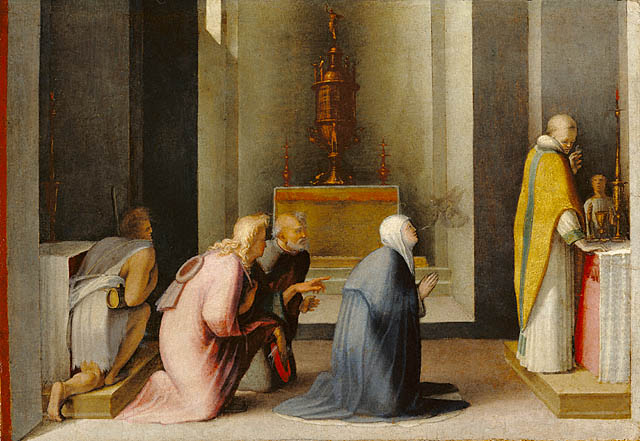
Artist: Domenico Beccafumi
Date: about 1513 - 1515
...from the Getty Center collection:
Artist: Domenico Beccafumi
Date: about 1513 - 1515
...from the Getty Center collection:
This small panel depicts an episode from the life of the Dominican tertiary and mystic, Saint Catherine of Siena. Upon arriving at church late one day because of her difficulty walking, Saint Catherine was dissuaded by her companions from taking communion because they knew her ensuing ecstasy would last for several hours. She concurred but prayed for God's help in receiving the Eucharist. Miraculously, an angel took a piece of the consecrated host and gave it to the saint. Celebrating Mass at a side altar, her confessor looked around with concern for the missing piece of the host. Neither he nor the others could see the miracle, so their expressions reflect bewilderment.
Sunday, June 08, 2003
Dominica Pentecostes
Sequentia
Veni, Sancte Spiritus, et emitte caelitus lucis tuae radium
Veni, pater pauperum, veni, dator munerum, veni, lumen cordium.
Consolator optime, dulcis hospes animae, dulce refrigerium.
In labore requies, in aestu temperies, in fletu solacium.
O lux beatissima, reple cordis intima turorum, fidelium.
Sine tuo numine, nihil est in homine, nihil est innoxium.
Lava quod est sordidum, riga quod est aridum, sana quod est saucium.
Flecte quod est rigidum, fove quod est frigidum, rege quod est devium.
Da tuis fidelibus, in te confidentibus, sacrum septenarium.
Da virtutis meritum, da salutis exitum, da perenne gaudium. Amen.
Alleluia.
Friday, June 06, 2003
Gregory VII and Muslims
Chris over at the Veritas blog has an interesting comment about a recent piece over at Catholic and Enjoying It concerning an excerpt from the letter of Pope Gregory VII, pope from 1073-1085 AD, to the Muslim King Al-Nasir of Mauretania, which is this:
Chris over at the Veritas blog has an interesting comment about a recent piece over at Catholic and Enjoying It concerning an excerpt from the letter of Pope Gregory VII, pope from 1073-1085 AD, to the Muslim King Al-Nasir of Mauretania, which is this:
We and you must show in a special way to the other nations an example of this charity, for we believe and confess one God, although in different ways. Many of the Roman nobility, informed by us of this grace granted to you by God, greatly admire your goodness and virtues.There are many who have, in recent years, accused our very own Pope John Paul II of indifferentism and universalism because of his friendly relations with Muslims, considering it more of a modern phenomenon. These individuals are simply mistaken. While understanding that the fullness of God's revelation was given in Jesus Christ, and the fullness of that revealed teaching subsisting within the Catholic Church, affirming all that is true and holy in non-Christian religions is, of course, consistent with Catholic teaching, as noted most specifically in the Vatican II document Nostra Aetate:
[The Church] regards with sincere reverence those ways of conduct and of life, those precepts and teachings which, though differing in many aspects from the ones she holds and sets forth, nonetheless often reflect a ray of that Truth which enlightens all men. Indeed, she proclaims, and ever must proclaim Christ "the way, the truth, and the life" (John 14:6), in whom men may find the fullness of religious life, in whom God has reconciled all things to Himself.Nostra Aetate also quotes Gregory's letter:
[Muslims] adore the one God, living and subsisting in Himself; merciful and all-powerful, the Creator of heaven and earth...Of course, as I am in most things that pertain to the historical teaching and practice of our faith, I am very interested in reading the whole of the letter from which this snip was taken, but I can't find it online right now.
Thursday, June 05, 2003
Wayback to the Past
For a cool trip, check out the Wayback Machine!
From Minute Particulars:
For a cool trip, check out the Wayback Machine!
From Minute Particulars:
If you haven't tried the Wayback Machine before, you're in for a treat. Like Google's cache feature, it can show you web pages as they were on a particular day in the past, a kind of snapshot of the Internet. Unlike Google's cache, the links on the page are also usually archived so it mimics what it would've have been like to visit the page and follow its links.I even found my old web page. Far out, man!
So, you can, for example, see a Yahoo News page from 1997, what Google looked like in 1998, or what the N.Y. Times webpage looked like on this date two years ago.
A Victory For Life?
The partial birth abortion ban [CNN] recently passed in the House by a 282-139 vote. President Bush has promised to sign this into law if it reaches his desk, which looks probable at this point. Yet those supporting this form of murder have already warned that they will challenge it in court.
Truly this is a nation with no memory. American Feminism has historically been very pro-life, seeing all abortion as the worst form of oppression of women. These were the same women who fought for equal opportunity and the right to vote. It was only within the past 50 years that our culture has bought into the lie that abortion is liberating.
Susan B. Anthony said this about abortion in her publication The Revolution:
The partial birth abortion ban [CNN] recently passed in the House by a 282-139 vote. President Bush has promised to sign this into law if it reaches his desk, which looks probable at this point. Yet those supporting this form of murder have already warned that they will challenge it in court.
Ken Connor, president of the anti-abortion Family Research Council, said passage was indicative of "a tide that is running against Roe v. Wade, which will eventually be dismantled."President Bush is right about this, though it will not happen overnight.
Bush hailed passage of the legislation, which he said "will help build a culture of life in America. I urge Congress to quickly resolve any differences and send me the final bill as soon as possible so that I can sign it into law."
The president -- unlike former President Clinton, who twice vetoed partial birth abortion bans -- had urged Congress in his State of the Union address in January to give him a bill he could sign.Reading this reminds me of someone I saw on CNN just the other night, arguing that this ban was anti-woman. The classic argument is given that keeping this procedure in place is pro-woman because it protects a woman's heath. First of all, abortion, by its very nature, is anti-woman, and this procedure even further demonstrates that. Secondly, this procedure is no better for a woman's health than actually giving birth. In fact, it is even more invasive and destructive, not just because of the fact that abortion clinics are some of the most medically unregulated facilities in the nation, but because partial-birth abortion involves partially giving birth to a late term, perfectly viable baby.
The administration strongly believes the bill "is both morally imperative and constitutionally permissible," the White House said in a statement.
Truly this is a nation with no memory. American Feminism has historically been very pro-life, seeing all abortion as the worst form of oppression of women. These were the same women who fought for equal opportunity and the right to vote. It was only within the past 50 years that our culture has bought into the lie that abortion is liberating.
Susan B. Anthony said this about abortion in her publication The Revolution:
Guilty? Yes. No matter what the motive, love of ease, or a desire to save from suffering the unborn innocent, the woman is awfully guilty who commits the deed. It will burden her conscience in life, it will burden her soul in death; But oh, thrice guilty is he who drove her to the desperation which impelled her to the crime!It is our culture that has blood on its hands because we have failed to provide opportunities to help women, faced with the choice, to not feel as though they have no choice.
Tuesday, June 03, 2003
Happy Blogversary
There have been many blogversaries lately, and I apologize for not recgonizing them all! Most recently is today's blogversary, Bill Cork at the Pro Deo et Patria blog. Last week it was Lane Core of the Blog from the Core.
And last Friday, Karen Marie Knapp's From the Anchor Hold.
Keep 'em bloggin!
There have been many blogversaries lately, and I apologize for not recgonizing them all! Most recently is today's blogversary, Bill Cork at the Pro Deo et Patria blog. Last week it was Lane Core of the Blog from the Core.
And last Friday, Karen Marie Knapp's From the Anchor Hold.
Keep 'em bloggin!
Monday, June 02, 2003
What Matrix Persona Are You?
Hmm...

You are Neo, from "The Matrix." You
display a perfect fusion of heroism and
compassion.
What Matrix Persona Are You?
brought to you by Quizilla
Hmm...
You are Neo, from "The Matrix." You
display a perfect fusion of heroism and
compassion.
What Matrix Persona Are You?
brought to you by Quizilla
Saturday, May 31, 2003
Pictures from World Youth Day 2002 - Toronto

I finally scanned some of the pictures I took at World Youth Day! They came out better than expected but they may still be a little dark in some areas - you be the judge!
Click here to check them out!
I finally scanned some of the pictures I took at World Youth Day! They came out better than expected but they may still be a little dark in some areas - you be the judge!
Click here to check them out!
Friday, May 30, 2003
Neo and the Architect
Some others asked about this, where here it is. The conversation between Neo and the Architect from Matrix: Reloaded. If you haven't yet seen the film, you may not want to read this! But in rereading it, I caught a lot of points that I missed in the film.
Some others asked about this, where here it is. The conversation between Neo and the Architect from Matrix: Reloaded. If you haven't yet seen the film, you may not want to read this! But in rereading it, I caught a lot of points that I missed in the film.
Unintended Call of Silence
I don't mean to bewilder you, but this is a warning to all cell phone owners. Please make sure that you turn on the auto-lock mechanism of your phone. This prevents the phone from reacting when random buttons are pressed when it's in your backpack, bag, or purse, . More specifically, it is a deterrent from what I have termed the Unintended Call of Silence, when the buttons on your cell phone are pressed in a certain way so as to dial a random person on your phone list. I have been the unfortunate recipient of several calls like this, I think because my name begins with the letter A and so I am at the top of most people's phone lists. I have overheard amazing things - beware! So this warning to all those who fail to use auto-lock, always beware that the walls really do have ears!
I don't mean to bewilder you, but this is a warning to all cell phone owners. Please make sure that you turn on the auto-lock mechanism of your phone. This prevents the phone from reacting when random buttons are pressed when it's in your backpack, bag, or purse, . More specifically, it is a deterrent from what I have termed the Unintended Call of Silence, when the buttons on your cell phone are pressed in a certain way so as to dial a random person on your phone list. I have been the unfortunate recipient of several calls like this, I think because my name begins with the letter A and so I am at the top of most people's phone lists. I have overheard amazing things - beware! So this warning to all those who fail to use auto-lock, always beware that the walls really do have ears!
Godly conceptions and their meanings
I was reflecting tonight on a discussion I recall having several years ago with an agnostic aquaintance of mine concerning this question:
Left to ourselves, it is impossible for us to know about God. But this ignores the idea of divine revelation - the idea that God would reveal to us whatever He would want us to know about Him and how to live in His presence. This revelation was given in the old law and testified to by all Creation, and is brought to its fulfillment by God in the person of Jesus Christ who then established a Church to hand on this His teaching in the form of oral and written Tradition, which is thereby found in Apostolic Tradition and in the Scriptures, respectively. So, by human reason alone, we can come to a knowledge of the Infinite God in observance of His creation, yet God also revealed Himself explicitly for our benefit, as Dei Verbum expresses:
My friend, somewhat satisfied with the response, further pressed me on the point of revelation.
My friend responded,
With a deep breath, our conversation drifted on to other wondrous ideas.
I was reflecting tonight on a discussion I recall having several years ago with an agnostic aquaintance of mine concerning this question:
If God is infinite, then how is it possible for any human being, finite in nature, to know anything about this concept? Would not any attempt at discovering the infinite be doomed to failure?My memory is faint, so I will reconstruct the conversation as cleanly as I can remember. My response was a resounding Of course it would be doomed to failure!. Satisfied yet confused, my friend could not accept my easy concession without concluding that he had been trapped. What is then the point? At best, one could live an agnostic existence, never being certain of God's existence or never having a satisfactory conception of the infinite that would have any effect over the tangible routine of daily life. Behold, I am no skilled manipulator of language, so I simply explained my response.
Left to ourselves, it is impossible for us to know about God. But this ignores the idea of divine revelation - the idea that God would reveal to us whatever He would want us to know about Him and how to live in His presence. This revelation was given in the old law and testified to by all Creation, and is brought to its fulfillment by God in the person of Jesus Christ who then established a Church to hand on this His teaching in the form of oral and written Tradition, which is thereby found in Apostolic Tradition and in the Scriptures, respectively. So, by human reason alone, we can come to a knowledge of the Infinite God in observance of His creation, yet God also revealed Himself explicitly for our benefit, as Dei Verbum expresses:
As a sacred synod has affirmed, God, the beginning and end of all things, can be known with certainty from created reality by the light of human reason (see Rom. 1:20); but teaches that it is through His revelation that those religious truths which are by their nature accessible to human reason can be known by all men with ease, with solid certitude and with no trace of error, even in this present state of the human race.Doing it all ourselves also ignores the idea of willful creation - the idea that God would create us with an orientation toward the infinite, manifested by an ever present desire to know more than what we perceive plainly. This concept is much more elusive, but certainly real. Another thing I believe it ignores is divine grace or assistance. That God would not only willfully create us, reveal Himself to us in a way that we can conceive, but would also provide us with grace that further enables us to live according to that revelation and achieve that which He has willed for us - unity with Him. This is the difference between knowing about Him and actually having a relationship with Him.
My friend, somewhat satisfied with the response, further pressed me on the point of revelation.
How can we trust this revelation as coming from God, the Infinite, which is transmitted to us through a book written by human authors and a tradition transmitted by human teachers - human teachers who are sinful and often times perform less than godly acts?Very good! Ay, there's the rub, I responded. My friend was attempting to catch me. How do we know without relying on ourselves? And we can't rely on ourselves alone. The final issue is then one of authority and faith. Again, left to ourselves, we are caught - but we remember that that is why we are given grace. We need grace to believe because faith is a grace. Again, Dei Verbum expresses this best:
"The obedience of faith" (Rom. 13:26; see 1:5; 2 Cor 10:5-6) "is to be given to God who reveals, an obedience by which man commits his whole self freely to God, offering the full submission of intellect and will to God who reveals," (4) and freely assenting to the truth revealed by Him. To make this act of faith, the grace of God and the interior help of the Holy Spirit must precede and assist, moving the heart and turning it to God, opening the eyes of the mind and giving "joy and ease to everyone in assenting to the truth and believing it." (5) To bring about an ever deeper understanding of revelation the same Holy Spirit constantly brings faith to completion by His gifts.Faith enables us to cooperate with God's grace and to understand God's revelation and the authority under which it was given and entrusted to the Church, the authority given by Christ to the Apostles, which is thus communicated to their successors and handed down to us today. That such a teaching authority, entrusted to human sinners, is free of corruption is ensured by the merits of Christ's death and resurrection, and Christ does this because He desires that all the world know of Him.
My friend responded,
I think I understand what you are saying. The agnostic assumes that the initiative belongs to human beings to know the Infinite, which they really cannot do, whereas you are saying that the initiative belongs to God. It starts with God and ends with God, not the other way around. The Infinite God chose to create us, He revealed Himself to us, and He gives us, finite as we are, what we need to know Him infinitely in time.I explained that it is important to remember that faith is not only the passive reception of a gift from God, but the active free response to God. Some people spend their whole lives fighting against it. But alas, it is a great mystery. Do you desire faith?, I asked. He responded,
Certainly.The desire to have it is already a sign of its work, and the continuing cooperation with grace is itself a work of grace. As the Catechism articulates,
"The preparation of man for the reception of grace is already a work of grace. This latter is needed to arouse and sustain our collaboration in justification through faith, and in sanctification through charity."As we cooperate with grace through faith, we are sanctified by grace and created anew to perform acts of charity which nourish faith. Without grace, it is impossible to please God. And that, said I, is only the beginning of an incredible journey into the Great Mystery, the heights and depths of glorious Truth.
With a deep breath, our conversation drifted on to other wondrous ideas.
Thursday, May 29, 2003
Newspeak for a future taken to extremes
This article at CNN predicts a pretty gloomy future!
This article at CNN predicts a pretty gloomy future!
She says a lot of people are having fun finding new titles for Ernest Hemingway's "The Old Man and the Sea" which presents problems with every word except "and" and "the." [Dianne] Ravitch said old is ageist, man is sexist and sea can't be used in case a student lives inland and doesn't grasp the concept of a large body of water.Granted - some words are explicitly offensive and have no place. But this is ridiculous. It seems to me that the cure for this has more to do with educating rather than erasing every words that is, could possibly be, or might remotely be offensive.
The New York Times recently reported that National Institute of Health researchers on AIDS are not only avoiding using words like gay and homosexuals in e-mails so as not to offend conservatives in the Bush administration, they are also inventing code words. Times journalist Erica Goode reported that one researcher was told to "cleanse" the abstract of his grant proposal of words like gay, homosexual and transgender even though his research was on HIV in gay men.Hmm. How is education helped by a standard taken to extremes? And just who is responsible for drawing the line?
"Everyone gets their pet causes incorporated in textbooks. The history texts are reluctant to criticize any dictator unless they are long dead. And even then, there are exceptions like Mao is praised in one text for modernizing China but his totalitarian rule is not mentioned," [Ravitch] said.
Voice of the Faithful
I followed the group from their beginnings. I read about them in the media. I even decided that I would see what they were about for myself, when a chapter began here in Santa Barbara, by attending a couple meetings. The question was always asked with surprise, Shouldn't there be more young adults in VOTF?. The implication here is that young adults should want to share their cause because we're young, right? We want to change the old Church, right? No - perhaps for the same reasons why there are not more young adults in groups like Call To Action which I will briefly address here.
After observing comments and presentations by a few of the members, I got a sense that for many VOTF members, the old Church was not just the Church that fostered an environment where sexual abuse could occur and be covered up, but it was also the Church that persists in antiquated modes of operating and thinking, particularly in the realm of sexuality, authority, women, and the involvement of the laity in doctrinal (not just disciplinary) matters. Certainly, this definition isn't explicity evident in the vague language often seen on the charter and the VOTF web page, but it is how I perceived many members interpret it. It is this attitude that I feel perpetuates an us versus them mentality. In misunderstanding doctrine and authority, it denies doctrinal truth, and in a spirit of rebellion, attempts to change whatever it can in the name of all lay Catholics. This, in spite of its longterm goals, is neither constructive nor healing for the Church as a whole.
It is wrong to assume that young adults will want to be part of a group such as this simply because we're young and are often judged to be anti-establishment or anti-hierarchy. We are not the hippies of the 21st century. While many of us do not oppose ensuring a lay voice in matters of Church governance, I think we have different ideas about what that means - that not only does it involve collaboration, but it also involves obedience. I have no problem with supporting pastoral and finance councils that include lay Catholics.
Generally speaking, I grow weary of those who like to think they're more catholic than the pope, and this is why the us versus them attitude really made me sick to my stomach. And just who them is often varies depending on who you are talking with. I'm not even fully convinced the individual members of VOTF are united in how to define the type of reform they seek. But such is the language of ambiguity. To one, a statement could appear perfectly orthodox, and to another, it could appear anything but orthodox. The goal for structural change is one that I find particularly vague. First, they state this:
There are other things, like in their FAQ:
I feel I speak for many young adults in saying that we don't want a group that is divisive - us versus them - and has an underlying agenda that presumes to be more catholic than the local diocesan bishop or the pope. And even if it isn't said explicitly, I perceive it as an agenda which would, given the opportunity, certainly include doctrinal change. We want to be a part of something that celebrates the Catholic Faith and has a more realistic and positive message about what true reform really is. A message that addresses the spiritual roots of reform. True reform comes in the person of Jesus Christ, and this is what the Church should be preaching, and is what our Holy Father is preaching right now.
I followed the group from their beginnings. I read about them in the media. I even decided that I would see what they were about for myself, when a chapter began here in Santa Barbara, by attending a couple meetings. The question was always asked with surprise, Shouldn't there be more young adults in VOTF?. The implication here is that young adults should want to share their cause because we're young, right? We want to change the old Church, right? No - perhaps for the same reasons why there are not more young adults in groups like Call To Action which I will briefly address here.
After observing comments and presentations by a few of the members, I got a sense that for many VOTF members, the old Church was not just the Church that fostered an environment where sexual abuse could occur and be covered up, but it was also the Church that persists in antiquated modes of operating and thinking, particularly in the realm of sexuality, authority, women, and the involvement of the laity in doctrinal (not just disciplinary) matters. Certainly, this definition isn't explicity evident in the vague language often seen on the charter and the VOTF web page, but it is how I perceived many members interpret it. It is this attitude that I feel perpetuates an us versus them mentality. In misunderstanding doctrine and authority, it denies doctrinal truth, and in a spirit of rebellion, attempts to change whatever it can in the name of all lay Catholics. This, in spite of its longterm goals, is neither constructive nor healing for the Church as a whole.
It is wrong to assume that young adults will want to be part of a group such as this simply because we're young and are often judged to be anti-establishment or anti-hierarchy. We are not the hippies of the 21st century. While many of us do not oppose ensuring a lay voice in matters of Church governance, I think we have different ideas about what that means - that not only does it involve collaboration, but it also involves obedience. I have no problem with supporting pastoral and finance councils that include lay Catholics.
Generally speaking, I grow weary of those who like to think they're more catholic than the pope, and this is why the us versus them attitude really made me sick to my stomach. And just who them is often varies depending on who you are talking with. I'm not even fully convinced the individual members of VOTF are united in how to define the type of reform they seek. But such is the language of ambiguity. To one, a statement could appear perfectly orthodox, and to another, it could appear anything but orthodox. The goal for structural change is one that I find particularly vague. First, they state this:
VOTF does not seek any change in church doctrine. The problems which have come to light in the present crisis are more truly cultural than structural in nature.They do not seek to change doctrine, but this statement is flimsy given how each person chooses to define what doctrine is and what it isn't. And how is it cultural? And not truly structural in nature? Then why the emphasis on structural change?They then go on to state this:
We respect the teaching authority of the Church and recognize the role that the hierarchy should exercise in discernment. It is essential, however, that all the people of God be involved in this process of discernment. We will, therefore, devote ourselves to advancing meaningful and active engagement of the laity in the life of the Church.What does this mean? How does this relate to what they previously stated? Discernment in what? They also state this:
In order to move toward the vision of the Second Vatican Council, we believe it is vitally important that the faithful of each parish engage in, and enthusiastically support, the formation and actions of Pastoral and Finance Councils and Safety Committees. We must empower the laity to protect our children and all the people of God.I do not agree that we have ignored the teachings of the Second Vatican Council. But what is this vision that they refer to? They never really explicitly define this. This is significant. Also, does this statement imply that lay Catholics will be more capable of protecting children? Last time I checked, we were all sinners, clergy and laity both. And sexual abuse is pretty widespread amongst non-ordained clergy - Approx. 90% occurs within families. No, this goal misses the point of reform.
There are other things, like in their FAQ:
Q. What does Voice of the Faithful feel will be the effect of bringing laity into the governance structure of the Church?This is just crying out for elaboration.
A. The Church hierarchy can learn much from the Catholic laity. We have intellectual, emotional and spiritual contributions to make and knowledge to impart on myriad real-life issues. These include, but are not limited to: human sexuality, women's rights, democratic processes, and the contextual roles of science and history in the healthy life of the Church.
I feel I speak for many young adults in saying that we don't want a group that is divisive - us versus them - and has an underlying agenda that presumes to be more catholic than the local diocesan bishop or the pope. And even if it isn't said explicitly, I perceive it as an agenda which would, given the opportunity, certainly include doctrinal change. We want to be a part of something that celebrates the Catholic Faith and has a more realistic and positive message about what true reform really is. A message that addresses the spiritual roots of reform. True reform comes in the person of Jesus Christ, and this is what the Church should be preaching, and is what our Holy Father is preaching right now.
Tuesday, May 27, 2003
Respect the Needs of Catholics!
Global Catholic News - Russian Orthodox Urged to Respect Catholics' Spiritual Needs
Global Catholic News - Russian Orthodox Urged to Respect Catholics' Spiritual Needs
The Vatican appealed to the Russian Orthodox Church to recognize the spiritual needs of the country's 500,000 Catholics, who numerically pose no threat to Orthodoxy.
Archbishop Jean-Louis Tauran, Vatican secretary for relations with states, made this appeal public in an interview Sunday with the Italian newspaper Il Corriere della Sera. He was commenting on the charges of "proselytism" leveled against Rome by the Moscow Orthodox Patriarchate.
...Archbishop Tauran believes, in part, that the present situation is due to the fact that Russian Orthodox Church leaders regard the Catholic Church as a "church of foreigners."
...Catholics in Russia "are Russian citizens -- not foreigners -- and, therefore, have a right to pastoral care, like all Catholics spread throughout the world and like all Orthodox Christians in Russia and in any other place," he explained.
"This would also help to overcome that psychological attitude of 'besieged fortress' that impedes the Orthodox Church, which suffered so much during the years of Communism, to offer Europe and the world the contribution of its great spiritual riches," Archbishop Tauran concluded.
In memoriam...
Being born and raised in a solid military family, I learned early on the remarkable role that our armed forces have played in our nation's history. So this memorial day I remembered those soldiers who have willingly sacrificed their lives in every war to defend our freedom so that we can, today, celebrate that freedom that we often take for granted. I flew the flag proudly and got to spend some time with a very good friend. Thanks Joe!
Being born and raised in a solid military family, I learned early on the remarkable role that our armed forces have played in our nation's history. So this memorial day I remembered those soldiers who have willingly sacrificed their lives in every war to defend our freedom so that we can, today, celebrate that freedom that we often take for granted. I flew the flag proudly and got to spend some time with a very good friend. Thanks Joe!
Monday, May 26, 2003
Busy Sunday
Spent the day in the cozy little town of San Luis Obispo with Christina. Started it off with the Divine Liturgy at St. Anne's Byzantine (Ruthenian) Catholic Church. Occasionally when I visit family in Santa Maria, I take a short trip up to St. Anne's, though it isn't often, and it had been several months since I had last been there. But I love the ancient Divine Liturgy of St. John Chrysostom! And being able to participate in the divine liturgy has really given me an appreciation for the Eastern heritage of our Church.

Main Altar at St. Anne's
After mass at St. Anne's, we went to lunch at the infamous Tortilla Flats in SLO followed by bookstore ransacking! We then finally went to see X-Men 2 which I did enjoy. I thought it was clever, and I really liked what they did with the character of Nightcrawler. Got home in the evening to rest! SLO is a cozy college town nestled within the foothills of the central coast of california. I applied and was strongly considering attending nearby Cal Poly, but I chose UC Santa Barbara at literally the last minute. I do not regret choosing to go to school in Santa Barbara!
Enjoy your memorial day holiday!
Spent the day in the cozy little town of San Luis Obispo with Christina. Started it off with the Divine Liturgy at St. Anne's Byzantine (Ruthenian) Catholic Church. Occasionally when I visit family in Santa Maria, I take a short trip up to St. Anne's, though it isn't often, and it had been several months since I had last been there. But I love the ancient Divine Liturgy of St. John Chrysostom! And being able to participate in the divine liturgy has really given me an appreciation for the Eastern heritage of our Church.
Main Altar at St. Anne's
After mass at St. Anne's, we went to lunch at the infamous Tortilla Flats in SLO followed by bookstore ransacking! We then finally went to see X-Men 2 which I did enjoy. I thought it was clever, and I really liked what they did with the character of Nightcrawler. Got home in the evening to rest! SLO is a cozy college town nestled within the foothills of the central coast of california. I applied and was strongly considering attending nearby Cal Poly, but I chose UC Santa Barbara at literally the last minute. I do not regret choosing to go to school in Santa Barbara!
Enjoy your memorial day holiday!
Subscribe to:
Posts (Atom)
LinkWithin
