Saw this (and many others like it) posted at church a few months ago from children...

I couldn't resist sharing it!
Bishop Samuel J. Aquila of Fargo has announced that engaged couples across the diocese will have to be instructed in the theology of the body and complete an approved course in natural family planning before they can marry in the Catholic Church... Bishop Aquila said the policy arose "out of a genuine concern for the right formation of conscience, the understanding of the truth, dignity and meaning of human sexuality and the responsibilities a couple accepts in married love."This is excellent news. This isn't yet a part of every diocese curriculum, but, in my opinion, it should be -- or at least something like it, and maybe this will begin a trend. My only concern is for couples who, for legitimate reasons, may be unable to able to complete a full course together during their marriage preparation. Bishop Aquila continues:
"Through my personal experience in preparing couples for marriage and through discussions with priests, I have seen a great need for this instruction to help couples fully live the sacrament of marriage," he said.Here is basically what the policy entails:
"Young adults are bombarded with negative images of sexuality, with attitudes that demean the marital commitment and with lies about the so-called 'freedom' contraception provides," he added. "They need to know and they deserve to know the plan that God has for them regarding their sexuality and the conjugal love they will share as husband and wife."
-- Couples preparing for marriage "shall receive an introduction to the church's teaching on conjugal love, modeled after (Pope) John Paul II's theology of the body during their interview with their parish priest, deacon or qualified married couple."Some couples may not like being forced to do this, but then it seems many couples come to the Church asking for marriage who only give lip-service to something the Church takes seriously. Other couples may have more legitimate reasons, like I said. We shall see. Perhaps the experience of the Fargo diocese over the next year or two will help other dioceses.
-- They will participate in a Marriage Preparation weekend that will include a presentation on natural family planning. It will also include at least a one-hour introduction to the theology of the body, which the late pope outlined in 129 general audience talks in the early years of his pontificate.
-- They must complete "a full course of instruction in a method of natural family planning" from an instructor approved by the diocese. A certificate of attendance is to be given to the parish priest, who is to place it in the couple's marriage file.
For couples entering a second marriage, past training and experience will be taken into account, the policy says. It says if they are still of childbearing years, the instruction in natural family planning is expected unless "previous equivalent training is already present."
Couples beyond childbearing years are to receive instruction in the theology of the body but need not learn natural family planning, it says.
- Art historian Elizabeth Lev explains why Dan Brown's assertion that it is Mary, not John, who is seated next to Christ in Leonardo da Vinci's famous Last Supper is silly to anyone who knows basic art history.Considering that more than a few Catholics base their understandings about the Catholic Church from books like "The Da Vinci Code" as well as the mainstream media alone, I can understand the significance. Personally, I am thankful for the many resources we have available where we can study the writings of the early church (both before and after Constantine). One such resource is the Christian Classics Ethereal Library. I can't count the number of hours I have spent reading this tome over the years.
- Catholic author Amy Welborn (also of the Open Book blog) explains why it is important for Catholics to educate themselves about church history and why Dan Brown's mischaracterizations shouldn't be taken lightly.
There be none of Beauty's daughtersGeorge Gordon Byron (1788 - 1824)
With a magic like Thee;
And like music on the waters
Is thy sweet voice to me:
When, as if its sound were causing
The charmèd ocean's pausing,
The waves lie still and gleaming,
And the lull'd winds seem dreaming:
And the midnight moon is weaving
Her bright chain o'er the deep,
Whose breast is gently heaving
As an infant's asleep:
So the spirit bows before thee
To listen and adore thee;
With a full but soft emotion,
Like the swell of Summer's ocean.
At least once a week, usually more often, I cringe with pain upon reading horribly elementary Latin errors in the learned pages of good Catholics who are quite knowledgeable about other things. I'm particularly amazed by clergy who do this. As Latin is again becoming the badge of a good and thinking Catholic, people are a bit too hasty in throwing the language around.... only because I plead guil-diddly-ilty to this myself. As my regular readers know, I like to use this blog to practice my rudimentary Latin skills from time to time, so I expect it to be bad, even though I am quite anal about trying to do it correctly. I don't want anybody to be embarrassed as a Catholic when I use Latin poorly. Rather, I want to try it out a bit in an open venue and be educated so that I don't continue to make the mistakes I make. I also appreciate those who engage me in Latin in the comments (I do read them! I don't often respond, though, but I will try!) And if any of my poorly constructed Latin causes you to cringe, then, by all means, let me know! I'm a student of the language, and I always want to be humble enough to learn from my mistakes.
Husbands, love your wives, as Christ loved the church and gave himself up for her, that he might sanctify her, having cleansed her by the washing of water with the word, that he might present the church to himself in splendor, without spot or wrinkle or any such thing, that she might be holy and without blemish. Even so husbands should love their wives as their own bodies. He who loves his wife loves himself. For no man ever hates his own flesh, but nourishes and cherishes it, as Christ does the church, because we are members of his body.Marriage is indeed a profound mystery, and what more challenge is there than to love your wife even as Christ loved the Church!"For this reason a man shall leave his father and mother and be joined to his wife, and the two shall become one flesh." (Genesis 2:24)This mystery is a profound one, and I am saying that it refers to Christ and the church.
In accordance with this design, Mary the Virgin is found obedient, saying, "Behold the handmaid of the Lord; be it unto me according to thy word." But Eve was disobedient; for she did not obey when as yet she was a virgin. And even as she, having indeed a husband, Adam, but being nevertheless as yet a virgin (for in Paradise "they were both naked, and were not ashamed," inasmuch as they, having been created a short time previously, had no understanding of the procreation of children: for it was necessary that they should first come to adult age, and then multiply from that time onward), having become disobedient, was made the cause of death, both to herself and to the entire human race; so also did Mary, having a man betrothed [to her], and being nevertheless a virgin, by yielding obedience, become the cause of salvation, both to herself and the whole human race. And on this account does the law term a woman betrothed to a man, the wife of him who had betrothed her, although she was as yet a virgin; thus indicating the back-reference from Mary to Eve, because what is joined together could not otherwise be put asunder than by inversion of the process by which these bonds of union had arisen; so that the former ties be cancelled by the latter, that the latter may set the former again at liberty...While Eve was made the cause of death to the entire human race, Mary became the cause of salvation to the whole human race. Through her obedience to God, she freely and willfully bore the Savior of the world in her womb.
And thus also it was that the knot of Eve's disobedience was loosed by the obedience of Mary. For what the virgin Eve had bound fast through unbelief, this did the virgin Mary set free through faith.
At night he beheld the foundation of the faith. Various thoughts troubled him, for certain people perverted true teaching and often obscured it through persuasive, clever attempts.Of course, the authenticity of the account is questionable, but I find it an interesting record nonetheless... a private revelation from God, given through the Blessed Mother and John the Evangelist, so that an essential truth, revealed by God in the person of Jesus Christ, might be articulated more fully.
As he laid awake, there appeared to him in a vision an aged person in human form adorned with solemn raiment and whose countenance was striking by great virtue and kindness in addition to the integrity his form... After quieting his fear, [the aged man] said in a soft voice that a divine order bade him to appear, the reasons of which were obscure to [Gregory], in order to reveal the truth of correct belief and to encourage him to speak while gazing upon him with both joy and respect. Then the old man suddenly extended his hand and with his finger pointed to something which appeared near him which was a splendid female form instead of a male one... Not only was [Gregory] revered with regard to true knowledge of faith but recognized the names of each man who appeared when they called each other by their respective names. It is claimed that this vision of a female form told [Gregory] that the evangelist John was exhorted to manifest the mystery of truth to a young man, saying that she was chosen to be the mother of the Lord whom she cherished. He also said that this fitting vision had vanished again from his sight. He was immediately ordered to write down this divine revelation and later proclaim it in the church. In this way it became for others a divinely given legacy through which the people might repulse any evil of heresy. The words of that revelation are as follows:There is One God, Father of the living Word (who consists of wisdom, power and who is the eternal pattern), perfect Begetter of who is perfect, Father of the Only Begotten Son....After that vision had filled him with confidence and courage, much like an athlete who competes in a contest after having acquired stamina from a trainer, he strips himself for the stadium and prepares for the struggle. In similar fashion, so does [Gregory] exercise himself and the assistance of grace which appeared to him anoints his soul and makes it worthy to undergo the contest... After leaving his solitude, [Gregory] at once hastened to the city where he felt obliged to establish a church for God.
There is One Lord alone from him who is alone, God from God, pattern and image of the divinity, mighty Word, wisdom which encompasses everything, true Son of true Father, unseen [Son] of the unseen [Father], immortal [Son] of the immortal [Father], and eternal [Son] of the eternal [Father].
There is One Holy Spirit whose life is from God and who was made manifest through the Son (as well as to men), perfect image of the perfect Son, living source of those who are alive, holy provider of sanctity in whom God the Father appeared who is above all and in all, and God the Son who is in all.
A Perfect Trinity to whom belongs glory, eternity and kingship which can never change. (Thus the Trinity is not created, has anything else which claims to be first, nor is there anything which exists that can be introduced later. Similarly, the Son neither lacks the Father nor does the Spirit lack the Son; rather, the Trinity forever remains immutable and constant.)

His invention of the monolithic integrated circuit - the microchip - some 45 years ago at Texas Instruments (TI) laid the conceptual and technical foundation for the entire field of modern microelectronics. It was this breakthrough that made possible the sophisticated high-speed computers and large-capacity semiconductor memories of today's information age.Requiescat in pace.

While pundits chatter on about the role of Catholic leaders in the stem-cell debate, the influence of Mormons (—members of the Church of Jesus Christ of Latter-day Saints) goes almost unnoticed. [Orrin] Hatch and [Gordon] Smith have become the leaders of a movement within the Republican Party to urge President Bush to fund embryonic stem-cell research. All five Mormon senators (the others are Sens. Robert Bennett, R-Utah; Mike Crapo, R-Idaho; and Harry Reid, D-Nev.) have come out for such funding. They have helped move the debate away from right-to-life absolutism without sacrificing pro-life theology. The LDS Church, not the Vatican, is playing the pivotal role in the struggle over stem cells.You'll see in a minute why this argument is absurd. Clark continues...
In an audience last week with Bush, Pope John Paul II restated the Catholic Church's opposition to abortion and "related evils" such as euthanasia, infanticide, and the destruction of human embryos through stem-cell research. That statement drew upon the pope's 1995 encyclical, Evangelium Vitae and his 1987 encyclical, Donum Vitae (Gift of Life). Both documents elaborate on the Catholic position that life begins at conception, equating abortion and [embryonic] stem-cell research with murder... Leaders of the LDS Church have been far more circumspect about both subjects. The church released a statement of neutrality on stem-cell research in July. What the LDS Church didn't issue, —and what its statements on abortion similarly avoid, is any statement about when life begins, and hence whether embryos constitute human life.It seems to me that without such a statement, the LDS Church is not able to engage the subject from a scholarly or theological level at all. As Clark goes on to note, the position is vague:
Rather than referring to the Biblical commandment "Thou shalt not kill," the church's 1991 statement on abortion cited a scripture from The Doctrine and Covenants, a collection of revelations received by Joseph Smith, whom the church regards as its first prophet. The scripture reads, "Thou shalt not steal; neither commit adultery, nor kill, nor do anything like unto it." The phrase "like unto it" suggests that while most abortions are sinful, they are not quite the same as murder.This is where it gets strange. Such a vague statement, which seems deliberate, of course, leaves the door open for a wide array of interpretation. And so we get into the theology proposed by Sen. Smith, buttressed by his understanding of Mormon teaching.
Mormon doctrine holds that each person lived as a spirit child of God prior to being born and receiving a physical body on Earth. From this point of view, it makes no sense to say that life begins at conception. Instead, Mormons would say that life on earth begins when the spirit and body are united.But why doesn't it make sense to say that? Of course, as Catholics, we reject the notion of the pre-existence of the soul, but why is it impossible to say that the soul, regardless of whether it pre-existed or whether it is created at that moment, joins the body at the moment of conception? Sen. Smith offers an alternative:
In his testimony, Sen. Smith made this very point. Without calling attention to his Mormon beliefs, he cited Genesis 2:7, "And the Lord God formed man of the dust of the ground, and breathed into his nostrils the breath of life; and man became a living soul." Smith went on to explain, "This allegory of creation describes a two-step process to life, one of the flesh, the other of the spirit." He compared stem cells to "the dust of the earth, —they are essential to life, but standing alone, will never constitute life." As Smith portrayed it, the onset of life, the union of spirit and body, takes place when the embryo is implanted in a womb.Aha! At last.... but wha..? I think what Sen. Smith means to say is that human embryos, from which stem-cells are harvested, do not constitute life by themselves. That's quite a bold statement. Sen. Smith goes from that to say that the union of spirit and body must occur, not at conception, but at implantation. This line of reasoning seems like a stretch. Of course, given that we know that an embryo, which is formed at the instant of conception, is a distinct human organism with everything within itself necessary to develop into an adult human being, it makes no scientific or theological sense to argue that it is nothing at all until implantation. Yes, at implantation, the embryo will begin to receive nourishment and shelter, fueling its development, but nourishment and shelter do not define what the embryo is, ontologically speaking. So, even if Sen. Smith doesn't want to concede life at conception, why pick implantation as that moment? One could extend his argument to assert that the spirit doesn't join the body until some other arbitrary time... how about at birth? How about one month after birth? But, with Sen. Smith's line of reasoning, what happens if an embryo develops ex utero? If, in some distant future, we are able to develop a child outside of the womb, would that child then not have a soul because implantation never occured? It seems inconsistent.
Richard Doerflinger, the associate director of pro-life activities for the U.S. Conference of Catholic Bishops, later described Smith's theory as "amateur theology."I have to agree. Sen. Smith's argument that life can only exist at implantation and never before, frankly, makes no sense to me, given what we know about embryonic development. It seems to me that the only consistent position is to argue that a distinct human life can only begin at conception... a human life that is in a constant stage of human development until its natural death.
But some one will say, perhaps, "Shall there, then, be no progress in Christ's Church?" Certainly; all possible progress. For what being is there, so envious of men, so full of hatred to God, who would seek to forbid it? Yet on condition that it be real progress, not alteration of the faith. For progress requires that the subject be enlarged in itself, alteration, that it be transformed into something else.A beautiful concept so essential in understanding the Church. St. Vincent goes on to summarize:
The intelligence, then, the knowledge, the wisdom, as well of individuals as of all, as well of one man as of the whole Church, ought, in the course of ages and centuries, to increase and make much and vigorous progress; but yet only in its own kind; that is to say, in the same doctrine, in the same sense, and in the same meaning.
The growth of religion in the soul must be analogous to the growth of the body, which, though in process of years it is developed and attains its full size, yet remains still the same. There is a wide difference between the flower of youth and the maturity of age; yet they who were once young are still the same now that they have become old, insomuch that though the stature and outward form of the individual are changed, yet his nature is one and the same, his person is one and the same. An infant's limbs are small, a young man's large, yet the infant and the young man are the same. Men when full grown have the same number of joints that they had when children; and if there be any to which maturer age has given birth these were already present in embryo, so that nothing new is produced in them when old which was not already latent in them when children. This, then, is undoubtedly the true and legitimate rule of progress, this the established and most beautiful order of growth, that mature age ever develops in the man those parts and forms which the wisdom of the Creator had already framed beforehand in the infant? In like manner, it behooves Christian doctrine to follow the same laws of progress, so as to be consolidated by years, enlarged by time, refined by age, and yet, withal, to continue uncorrupt and unadulterate, complete and perfect in all the measurement of its parts, and, so to speak, in all its proper members and senses, admitting no change, no waste of its distinctive property, no variation in its limits?
This rather should be the result,--there should be no discrepancy between the first and the last. From doctrine which was sown as wheat, we should reap, in the increase, doctrine of the same kind--wheat also; so that when in process of time any of the original seed is developed, and now flourishes under cultivation, no change may ensue in the character of the plant. There may supervene shape, form, variation in outward appearance, but the nature of each kind must remain the same. God forbid that those rose-beds of Catholic interpretation should be converted into thorns and thistles. God forbid that in that spiritual paradise from plants of cinnamon and balsam darnel and wolfsbane should of a sudden shoot forth...
But the Church of Christ, the careful and watchful guardian of the doctrines deposited in her charge, never changes anything in them, never diminishes, never adds, does not cut off what is necessary, does not add what is superfluous, does not lose her own, does not appropriate what is another's, but while dealing faithfully and judiciously with ancient doctrine, keeps this one object carefully in view,--if there be anything which antiquity has left shapeless and rudimentary, to fashion and polish it, if anything already reduced to shape and developed, to consolidate and strengthen it, if any already ratified and defined to keep and guard it. Finally, what other object have Councils ever aimed at in their decrees, than to provide that what was before believed in simplicity should in future be believed intelligently, that what was before preached coldly should in future be preached earnestly, that what was before practised negligently should thenceforward be practised with double solicitude? This, I say, is what the Catholic Church, roused by the novelties of heretics, has accomplished by the decrees of her Councils,--this, and nothing else,--she has thenceforward consigned to posterity in writing what she had received from those of olden times only by tradition, comprising a great amount of matter in a few words, and often, for the better understanding, designating an old article of the faith by the characteristic of a new name.Ever ancient, ever new.
O Trinity of blessed light,St. Ambrose of Milan (English translation: John Mason Neale, 1851)
O Unity of princely might,
the fiery sun now goes his way;
shed thou within our hearts thy ray.
To thee our morning song of praise,
to thee our evening prayer we raise;
O grant us with thy saints on high
to praise thee through eternity.
All laud to God the Father be;
all praise, eternal Son, to thee;
all glory, as is ever meet,
to God the holy Paraclete.

When a man steals to satisfy hunger, we may safely conclude that there is something wrong in society - so when a woman destroys the life of her unborn child, it is an evidence that either by education or circumstances she has been greatly wronged.One social reality that drives young women toward abortion is the lack of life-affirming options and support, particularly in places of employment as well as at schools and universities. Many high schools have day care programs and help for single mothers, but many universities do not(!). Many universities don't even provide opportunities for distance learning. That's why I'm glad to see some universities step in the right direction.
Mattie Brinkerhoff, published in The Revolution, 4(9):138-9 September 2, 1869

Salve Regina, Mater misericordiae,Pray for us, O Holy Mother of God
Vita dulcedo et spes nostra, salve.
Ad te clamamus exsules filii Hevae.
Ad te suspiramus gementes et flentes,
in hac lacrimarum valle.
Eia ergo advocata nostra,
illos tuos misericordes oculos ad nos converte.
Et Jesum benedictum fructum ventris tui
nobis post hoc exsilium ostende.
O clemens, o pia, o dulcis Virgo Maria.
My name is Gianna Jessen. I am 19 years of age. I am originally from California, but now reside in Franklin, Tennessee. I am adopted. I have cerebral palsy. My biological mother was 17 years old and seven and one-half months pregnant when she made the decision to have a saline abortion. I am the person she aborted. I lived instead of died.Gianna Jessen is now 28 years old... and is still glad that she is alive.
Fortunately for me the abortionist was not in the clinic when I arrived alive, instead of dead, at 6:00 a.m. on the morning of April 6, 1977... There were many witnesses to my entry into this world. My biological mother and other young girls in the clinic, who also awaited the death of their babies, were the first to greet me. I am told this was a hysterical moment. Next was a staff nurse who apparently called emergency medical services and had me transferred to a hospital.
While the Lagoon behind the UCen has no Loch Ness creature to its name, it has been known to have a monster smell... Since August 2002, employees and interns from the UCSB's Museum of Systematics and Ecology (MSE), which oversees management of the lagoon, have designed and constructed an organic system of "bioswells" to naturally filter surface water runoff before it deposits odor-causing chemicals in the lagoon.It might smell better, but I still wouldn't swim in it.
As I return to Los Angeles, filled with gratitude to God for this extraordinary spiritual experience, I plead with you, the Catholic People of Los Angeles, to join me in surrounding Pope Benedict XVI with our prayers, our love, our support, and our loving trust.For many years to come!
Yes, once again Peter is at the helm of the Church. We are not orphans, we are not alone. Peter is there to lead us forward in the next great chapter of the history of the Church, the Body of Christ.
Sive enim vivimus, Domino vivimus, sive morimur, Domino morimur. Sive ergo vivimus, sive morimur, Domini sumus.Therefore, let us act with courage and integrity if we truly profess Christ, crucified and risen. We are not our own; rather, we have been baptized into Christ. Therefore, we belong to Him, and we belong to Him together.
For if we live, we live to the Lord, and if we die, we die to the Lord; so then, whether we live or whether we die, we are the Lord's.
 Pope Benedict XVI |  Mosaic from Ravenna |  Pope Innocent III |
The pallium is a very interesting vestment, tying the archbishops metropolitan throughout the world directly to the See of Peter and the person of the Pope.As you can see in the images, the original pallium is worn around the neck and drapes down the pope's left side. Compare that with the pallium worn by Pope John Paul II, which is smaller and drapes down the middle:


Great! I wonder if I can make it down to the cathedral on that day!ARCHDIOCESAN MASS
CELEBRATING THE ELECTION OF
HIS HOLINESS
POPE BENEDICT XVI
Principal Celebrant:
His Eminence
Cardinal Roger Mahony
Archbishop of Los Angeles
Tuesday, April 26, 2005
12:10 p.m.
Cathedral of Our Lady of the Angels
555 West Temple Street
Los Angeles
All members of the Archdiocese of Los Angeles are encouraged to participate in this important Mass as we begin the Pontificate of the new Chief Shepherd of the Universal Church.
Today with joy and gratitude to God, in thanksgiving with the Cardinal electors including our own Cardinal Roger Mahony, we are pleased to share with you the news that Cardinal Joseph Ratzinger, taking the name of Pope Benedict XVI, was brought to the Chair of Peter.From the Archdiocesan website.
In the days and months ahead, the Pontificate of Pope Benedict XVI will unfold under the inspiration of the Holy Spirit and for the service of the Universal Church.
As we begin this new chapter in our Church's history, we encourage all of you to pray this special prayer:Lord,
source of eternal life and truth,
give to your shepherd Pope Benedict XVI
a spirit of courage and right judgment,
a spirit of knowledge and love.
By governing with fidelity those entrusted to his care
may he, as successor to the apostle Peter and the vicar of Christ,
build your Church into a sacrament of unity, love and peace
for all the world.
We ask this through our Lord Jesus Christ, your Son,
who lives and reigns with you and the Holy Spirit
one God, for ever and ever.
Amen.
Surrexit pastor bonus, qui animam suam posuit pro ovibus suis, et pro grege suo mori dignatus est, alleluia.Christ, the Good Shepherd, is an excellent image to keep in mind as we enter the period of the conclave in which the cardinals of the Church will, with the guidance of the Holy Spirit, choose the papal successor to our Holy Father Pope John Paul II.
[Jesus said to them,] I am the good shepherd. The good shepherd lays down his life for the sheep. He who is a hireling and not a shepherd, whose own the sheep are not, sees the wolf coming and leaves the sheep and flees; and the wolf snatches them and scatters them. He flees because he is a hireling and cares nothing for the sheep. I am the good shepherd; I know my own and my own know me, as the Father knows me and I know the Father; and I lay down my life for the sheep.-The Gospel of John 10:11-15 (RSV)


Subvénite, Sancti Dei; occúrrite, Angeli Domini: Suscipientes animam eius. Offerentes eam in conspectu Altissimi.I have been informed that my cardinal archbishop, Roger Cardinal Mahony, is already making his way to Rome to meet with the other cardinals. He has left some guidelines for the archdiocese to follow in the coming days. May the Holy Spirit guide the cardinals and all the Church through the next few weeks and beyond.
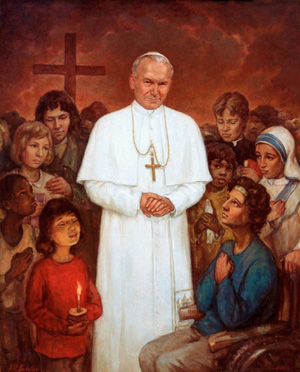
Faith and reason are like two wings on which the human spirit rises to the contemplation of truth; and God has placed in the human heart a desire to know the truth - in a word, to know himself - so that, by knowing and loving God, men and women may also come to the fullness of truth about themselves.Pope John Paul II from the opening of his encyclical letter, Fides et Ratio.
Miller began by emphasizing that the title of his talk was assigned to him, and he doesn't think the pope is a rock star.He's absolutely right about these points. Yet I don't think many people, including many Catholics my age, have a memory with regard to all that the Pope has done, nor do we appreciate just how much he has contributed to the world. What might explain some of this is the fact that all many Catholics my age know about the Pope is what we have seen on the television news or read in newspapers. To use a harsh term, we have allowed the secular media to spoon feed us for too long. We've lost our ability to engage and reflect.
He then told two stories of John Paul II, one set in 1978 when Miller was a student at the Canadian College and Cardinal Karol Wojtyla was first elected pope. "He was a strong man, a robust man, who simply dominated St. Peter's Square from the beginning," Miller recalled. He contrasted that memory with seeing the pope in February/March 2005, now the Suffering Servant of Isaiah.
"We don't see God's athlete," Miller said. "We see a face frozen in this Parkinsonian mask. We see a man who has always been in touch with his own body slowly crumbling. ? He's letting it unfold before us, allowing himself to be a kind of spectacle to the world. He's demonstrating that life is still wonderful and beautiful, that there's nothing shameful in illness, suffering and approaching death."
Miller then presented what he conceded is inevitably a partial list of elements of John Paul's legacy.
First, Miller argued, John Paul has "recast the meaning of the papal ministry, and set an agenda for what it means for generations to come. He has done so, Miller believes, by regarding "the whole world as his parish." He is "the evangelizer par excellence," so that it is now unimaginable that a future pope would "withdraw behind the walls of the Vatican and have people come to him."
Second, John Paul is a world leader, "the single most authoritative voice on moral questions worldwide." In this regard, Miller observed, no one in the future will ever be able to complain about a "silence" of John Paul II on pressing social and ethical concerns.
Third, Miller noted, John Paul is a "true believer," a man for whom there are "no shortcuts and no compromises." He said that "in a world of doublespeak, you get clarity."
Fourth, Miller said that John Paul has created a body of teaching "which surpasses that of any other pope," certainly in quantity, and arguably in richness and depth. Miller said that today some call John Paul II the doctor veritatis, or "doctor of truth." On quantity, Miller observed that John Paul has turned out 30 pages a day of written material.
Fifth, Miller said that John Paul has helped to shape "a new Christian humanism." The pope believes that modern civilization is in crisis, Miller said, and that the way forward must revolve around three central truths about Christ, the human person and the church. "The pope has a radical sense of Christ as the center of the universe and of history," he said. "He's Christological to the core."
Sixth, Miller said that John Paul has worked out a theology of the body that is deeply sacramental. It arises, he said, from the pope's "rich vision" of the human person and what human dignity requires.


