Thursday, November 11, 2010

The Ancient Law of Love

Suffering is the ancient law of love; there is no quest without pain, there is no lover who is not also a martyr. Hence it is inevitable that he who would love so high a thing as Wisdom should sometimes suffer hindrances and griefs.

-Blessed Henry Suso, O.P.

Sunday, November 07, 2010

To go on pilgrimage...

To go on pilgrimage is not simply to visit a place to admire its treasures of nature, art or history. To go on pilgrimage really means to step out of ourselves in order to encounter God where He has revealed Himself, where His grace has shone with particular splendour and produced rich fruits of conversion and holiness among those who believe.
Pope Benedict XVI at the cathedral of Santiago de Compostela in Spain.

Thursday, November 04, 2010

Norbertine Life

The Norbertines of St. Michael's Abbey in Orange County in Southern California produced this very nice video:


Hat Tip Anglican Patrimony blog.

Saturday, September 25, 2010

Perhaps, A Better Life

So my wife and I recently decided to cut the cable line (i.e. we canceled our cable service). We did this largely because we were concerned with how much control we gave to television over our daily lives -- not that we are opposed to TV, we aren't. In fact, with Internet streaming, Netflix (check out the 2nd generation Apple TV), and iTunes, we will still have access to movies and current (and classic) television shows. The only difference here is that we will have much more control over what we watch and when we watch it. Ultimately I had to face the reality that cable television, with its constant background chatter and inane selection of programming, simply could not be made to compete with more important things, like prayer and study.

Sunday, September 05, 2010

New Master of the Order of Preachers

Fr. Bruno Cadoré, O.P., of France has been elected the new Master of the Order of Preachers (Dominicans) and will serve this role for the next nine years. The previous Master was Carlos Azpiroz Costa of Argentina. The Friar blog has more information on him:
On Sunday, September 5, 2010, the Dominican friars gathered together in Chapter in the city of Rome elected Fr. Bruno Cadoré, OP, of the Province of France, as the new Master of the Order of Friars Preachers and the 86th successor to St. Dominic.

Fr. Cadoré was trained as a physician and has taught especially in the area of bio-medical ethics. Before becoming Provincial of the Province of France, he taught at the Catholic University of Lille. In 2008, the President of France appointed Fr. Cadoré to the French National AIDS Council as an advisor.

Please join the whole Dominican Order in praying for Fr. Cadoré, that by the intercession of the Blessed Virgin Mary and St. Dominic, he may serve the Order and the Church with wisdom and prudence.

Wednesday, September 01, 2010

Ancient Secrets for a Sharper Mind

A very excellent article written by Fr. Dominic Legge, O.P. of the Dominican Province of St. Joseph. Check it out.
How often have you, after a day of multi-tasking, felt scattered and dissipated? Man is supposed to be homo sapiens, but there is a difference between genuine knowledge and information, between the concentration of a true scholar and the bleary-eyed absorption of the chronic web surfer.

The ancients grasped this, even before the internet age, and recovering their secrets can sharpen your mind, and even help you better your grades.

The key, according to St. Thomas Aquinas, is not just a matter of study habits - and it certainly isn't a matter of having unlimited access to the internet. Rather, it is a matter of training your desire for knowledge, so that you develop the virtue of studiousness and not the vice of curiositas.

Aquinas takes his starting point from Aristotle: Everyone desires to know. Though knowledge can be put to a bad use (you can use it for evil purposes, like defrauding your neighbor, or even killing an unborn baby in the name of scientific research), all true knowledge, considered in itself, is good. The desire to know is a spiritual desire for a spiritual good, the truth, and it comes with its own pleasures (and true pleasures they are!)

... Still, as every high school freshman is acutely aware, even the delights of the spirit don't suppress our bodily desires, which often pull us in a different direction. "Because of his bodily nature, man avoids the labor involved in seeking knowledge," says Aquinas. Studiousness is the virtue that strengthens our perseverance in pursuing the higher but harder-to-reach pleasures of worthy knowledge.
Read the rest!

Saturday, August 28, 2010

On Waldensians and Dominicans

I rather liked this brief little tale written by Gerald de Frachet, an early Dominican friar, concerning Peter of Aubenas and his entrance to the Dominicans.  This story is also recorded in the Lives of the Brethren:
Brother Peter of Aubenas, who served as prior and as lector in Provence and who ran his course in the Order happily to its end, has described how he came to join the Order.  When he was practicing medicine in Genoa and had already made a promise to join the Order, the Poor Men of Lyons, also called the Waldensians, had such a disturbing effect on him that he was in great doubt which of the two he ought to follow.  He was rather more drawn to the Waldensians he found there, because he saw in them more outward signs of humility and of the virtues of piety, while he considered the friars too cheerful and showy.

So one evening, when he was brooding unhappily about this, not knowing what to do, he knelt down and asked God with all his heart, weeping profusely, to reveal to him, in his mercy, what he ought to do in this dilemma.  After his prayer he went to sleep, and shortly afterward he imagined that he was walking along a road with a dark wood on the left hand side of it, in which he saw the Waldensians all going their separate ways, with sad, solemn faces.  On the right side of the road was a very long, high wall, which was extremely beautiful.  He walked along it for some time and at last came to a gate.  Looking in, he saw an exquisite meadow, planted with trees and colorful with flowers.  In it he saw a crowd of Friars Preachers in a ring, with joyful faces raised towards heaven.  One of them was holding the Body of Christ in his upraised hands.  This sight delighted him and made him want to join them; but an angel who was guarding the gate blocked his way and said, "You will not enter in here now."  He started to weep bitterly.  Then he woke up and found himself bathed in tears and his heart joyful instead of his previous distress.  After some days, when he had dispatched some business he was obliged to do, he entered the Order. 

I heard this and a great deal more from his own lips.  He was a very contemplative man, and the Lord revealed many things to him in the Order and about the Order.

Fr. Rutler on Ad Orientem

Fr. George Rutler has a commentary concerning liturgical reform in First Things, brought to us courtesy of the New Liturgical Movement (and others).  Among his many points, he writes:
While I am glad for the new and more accurate translation of the Mass, which is not perfection but closer to it than one deserves in an imperfect world, a far more important reform would be the return of the ad orientem position of the celebrant as normative. It is the antidote to the tendency of clerisy to impose itself on the people. When a celebrant at Mass stops and says, “This is not about me,” you may be sure he thinks it may be about him. It would be harder for him to harbor that suspicion were he leading the people humbly to the east and the dawn of salvation.
My thoughts exactly.  Ad orientem, which refers to the posture of both the congregation and the celebrant facing East during the celebration of the Eucharist, was largely done away with in most parishes after the Second Vatican Council.  However, the council never called for this, and there is a growing awareness that doing away with it was a grave mistake.  It should once again be made normative, with, of course, proper catechesis so that the people understand what it means and why it is important.

Jordan of Saxony

Concerning Jordan of Saxony, I thought this was apropos.  From the Lives of the Brethren:
[Jordan] was asked once why arts men came thronging to join the Order [of Preachers, the Dominicans], while theologians and canon lawyers held back.  He answered, "Country people, who are used to drinking water, get drunk on good wine much more easily than noblemen and townspeople, who do not find wine very strong because they are used to it.  Arts men drink the plain water of Aristotle and other philosophers all week, so when they are offered the words of Christ or his disciples in a Sunday sermon or on a feast day, they fall victim at once to the intoxication of the Holy Spirit's wine, and hand over to God not only their goods but themselves.  But these theologians are always listening to the words of God, and they go the same way as the country sacristan who passes the altar so often that he loses his reverence for it and frequently turns his back on it, while outsiders bow reverently towards it."
Interesting...

When the Church Was Young

From an article written by Mike Aquilina concerning youth ministry in the early centuries of the Church.
... in all the documentary evidence from all the ancient patriarchates of the East and the West, there's not a single bulletin announcement for a single parish youth group.

Yet the Fathers had enormous success in youth and young-adult ministry. Many of the early martyrs were teens, as were many of the Christians who took to the desert for the solitary life. There's ample evidence that a disproportionate number of conversions, too, came from the young and youngish age groups.

How did the Fathers do it? They made wild promises.

They promised young people great things, like persecution, lower social status, public ridicule, severely limited employment opportunities, frequent fasting, a high risk of jail and torture, and maybe, just maybe, an early, violent death at the hands of their pagan rulers.

The Fathers looked young people in the eye and called them to live purely in the midst of a pornographic culture. They looked at some young men and women and boldly told them they had a calling to virginity. And it worked. Even the pagans noticed how well it worked.
I have often found that we are afraid to challenge youth.  Too often youth ministry and campus ministry are focused solely on social gatherings than they are about forming the soul and the conscience.  Yet, we can't be afraid to challenge youth and young adults, giving them an invitation to a truly radical way of life.  Embracing the Gospel is radical and counter-cultural.  They should be taught honestly the truths of the Faith by people who aren't ashamed of them, especially concerning matters in which the Church is indeed counter cultural, such as when it comes to artificial contraception, abortion, and same-sex marriage.  Yet, they also need to be challenged to be charitable and to live out their vocation with a truly compassionate concern for others: for the prisoner, for the poor, and for the salvation of souls.  Yes, the Gospel is radical!

Saturday, August 21, 2010

Stark Mad and Senseless: Fire and the Holy Spirit

Picking up from my post from last week, On Sacrifice and Holy Fire, I want to point out that the parallel between that blessed Fire of God that descended upon and consumed Elijah's sacrifice and the Holy Spirit that descends upon the Holy Sacrifice of the Altar at Mass was quite apparent to others.  St. John Chrysostom (4th century) writes in Book III of On The Priesthood:
Picture Elijah and the vast multitude standing around him (Kings 18:36-39), and the sacrifice laid upon the altar of stones, and all the rest of the people hushed into a deep silence while the prophet alone offers up prayer: then the sudden rush of fire from Heaven upon the sacrifice:— these are marvelous things, charged with terror. Now then pass from this scene to the rites which are celebrated in the present day; they are not only marvellous to behold, but transcendent in terror. There stands the priest, not bringing down fire from Heaven, but the Holy Spirit: and he makes prolonged supplication, not that some flame sent down from on high may consume the offerings, but that grace descending on the sacrifice may thereby enlighten the souls of all, and render them more refulgent than silver purified by fire. Who can despise this most awful mystery, unless he is stark mad and senseless? Or do you not know that no human soul could have endured that fire in the sacrifice, but all would have been utterly consumed, had not the assistance of God's grace been great.
Chrysostom is here writing about the awesome calling of priesthood, but what he writes here is striking.  By grace, we are purified as by fire and made partakers in God's own divine life.  He writes it better than I can: Who can despise this most awesome mystery, unless he is stark mad and senseless?

Sunday, August 15, 2010

On Sacrifice and Holy Fire

I have always been impressed by the image of sacrifice shown to us in the book of Kings (18:36-39):
And at the time of the offering of the oblation, Elijah the prophet came near and said, "O LORD, God of Abraham, Isaac, and Israel, let it be known this day that thou art God in Israel, and that I am thy servant, and that I have done all these things at thy word. Answer me, O LORD, answer me, that this people may know that thou, O LORD, art God, and that thou hast turned their hearts back." Then the fire of the LORD fell, and consumed the burnt offering, and the wood, and the stones, and the dust, and licked up the water that was in the trench. And when all the people saw it, they fell on their faces; and they said, "The LORD, he is God; the LORD, he is God."
I can picture this scene in my mind very vividly.  After witnessing this scene in which Elijah calls God down upon the sacrificial offering, perhaps we might expect that God would greet us in a similar fashion every time we experience the Holy Sacrifice of the Mass, the event in which we encounter, face to face, the One Sacrifice of Christ on the Cross. After all, God indeed descends upon our gifts in the divine fire of the Holy Spirit. And yet, what we see is not a display of magnificence, but rather a display of ultimate humility as God gives of Himself for us and shares with us the eternal Gift of Himself, inviting and making us by grace to be partakers of His own divine nature and life. And in the face of THAT, what else can we do but fall on our faces also, exclaiming, "The Lord, he is God!"

The Epiclesis and the West

Eastern Orthodox priest Fr. J. Guy Winfrey notes that there is something that just isn't right about the ancient Roman Liturgy of St. Gregory the Great as celebrated by the Western Rite Vicariate of the Antiochian Orthodox Church:
One of the strangest things that exists in the WRV Liturgy of St. Gregory is an epiclesis following the words of Institution. It simply does not belong. When the WR was first authorized by the Holy Synod of Moscow, they required the addition of the epiclesis in the Mass of St. Peter (the old Latin Canon of the Roman Rite) so as not to scandalize Orthodox who were ignorant of the WR and its authenticity. They made clear that it was not done for any theological cause at all and that the old Roman Canon stood as completely valid as it was.
I am very happy that that Fr. Winfrey posted this because the question of why the Orthodox would have tinkered with something they acknowledged as ancient and venerable disturbed me.

Saturday, July 17, 2010

On Embryonic Stem-Cells

Biologist Fr. Nicanor Pier Giorgio Austriaco, O.P., Ph.D., responds to Bill Tammeus' recent article in the National Catholic Reporter.
In his essay, Mr. Tammeus claims that the Catholic Church misrepresents the science behind somatic cell nuclear transfer (SCNT), which is the scientific procedure commonly called cloning. He claims: “The problem comes when people adopt the unwavering position that there’s no essential difference between a tiny ball of early stem cells produced by SCNT and a fully developed human being.” From his arguments, it appears that Mr. Tammeus is scientifically and philosophically confused.
Read the whole article.

Wednesday, July 14, 2010

Music in the Divine Liturgy

Good article from David Petras in Spero News.
For the Christians, the hymns had to have words. Liturgical hymns are not just hummed, they are absolutely not only a matter of melody, notes and meter. They are not just beautiful sounds, but they convey a truth and a concept. This is perhaps why the church early on accepted only the human voice in song and forbade musical instruments. Eusebius of Caesaria was to write, "more sweetly pleasing to God than any musical instrument would be the symphony of the people of God, by which, in every church of God, with kindred spirit and single disposition, with one mind and unanimity of faith and piety, we raise melody in unison in our psalmody" ("On Psalm 91, 4"). The Eastern Church accepted this principle as its tradition. The rejection of instruments, however, was not universal, for the Western Church later allowed their use in the church.
Read the whole article.

Saturday, June 19, 2010

New Orleans

Last weekend, my wife and I were presented with an opportunity to visit New Orleans for the first time. We thoroughly enjoyed our trip! In addition to visiting various historical locations, we also made several visits to antique and used book stores in the area. I was able to find a used edition of the Lewis and Short Latin Dictionary (second in fame and content only to the mammoth Oxford Latin Dictionary) for only $40.00. Of course, I snagged it, since the cheapest I could ever have found it used online was $125.00.

Visiting the place, one can't help but recall the hundreds of years worth of destruction and suffering that lingers in the area due to fires, hurricanes, poverty, and other things. Yet the city and its people seem simultaneously joyful and appreciative of life. It's an interesting juxtaposition, and the resiliency is contagious.

When you are there, particularly in the French Quarter, you can't help but feel a palpable connection to the Old World (Europe, most particularly France and Spain) while not losing sight of the fact that you are also in a modern American city. Culture, art, music, food, and good drink abound, and no, I am not referring to the excesses of Bourbon Street. The city's strong Catholic history is also ubiquitous and inescapable. I can't wait until we can return.

Tuesday, May 25, 2010

My apologies!

I got pretty carried away over the last month with work and various other projects that I haven't blogged even once.

Saturday, April 10, 2010

The Octave Day of New Birth


Tomorrow we celebrate Divine Mercy Sunday, which is also known by various names, including Whit Sunday, Dominica in albis, Quasimodo Sunday, and (recently) Divine Mercy Sunday. It is the Sunday of the Octave of Easter. The morning's Office of Readings presents to us words from St. Augustine's Eighth Sermon in octava Paschae given to the newly baptized:
I speak to you who have just been reborn in baptism, my little children in Christ... [Baptism] is a sacrament of new life which begins here and now with the forgiveness of all past sins, and will be brought to completion in the resurrection of the dead. You have been buried with Christ by baptism into death in order that, as Christ has risen from the dead, you also may walk in newness of life...

This is the octave day of your new birth. Today is fulfilled in you the sign of faith that was prefigured in the Old Testament by the circumcision of the flesh on the eight day after birth. When the Lord rose from the dead, he put off the mortality of the flesh; his risen body was still the same body, but it was no longer subject to death. By his resurrection he consecrated Sunday, or the Lord's day. Though the third after his passion, this day is the eighth after the Sabbath, and thus also the first day of the week.

And so your own hope of resurrection, though not yet realized, is sure and certain, because you have received the sacrament or sign of this reality, and have been given the pledge of the Spirit.
This is an octave. Augustine here demonstrates the great significance of the number eight as a sign of redemption and new life as well as resurrection, as our own resurrection is secured by Christ's, in whose body we are incorporated by way of our baptism by water and the Spirit. Baptism into Christ is baptism into his death and is intrinsically linked to his resurrection.

It is not uncommon to find baptismal fonts that are octagonal in shape for this very reason, as we find in the ancient baptistery in Milan where St. Augustine himself was likely baptized:


As Augustine also references, the number eight also applies to why the Church observes the Lord's Day, Sunday, as the eighth day, a day of new creation and birth in Christ, which, as Augustine writes, will be brought to completion in the resurrection of the dead. The work of Redemption is of greater significance and splendor than that of the first Creation, as the Catechism points out (CCC 349):
But for us a new day has dawned: the day of Christ's Resurrection. The seventh day completes the first creation. The eighth day begins the new creation. Thus, the work of creation culminates in the greater work of redemption. The first creation finds its meaning and its summit in the new creation in Christ, the splendour of which surpasses that of the first creation.
I hope that you are having a blessed Easter!

(originally posted in April, 2009)

Sunday, April 04, 2010

Resurrexit sicut dixit!

Today is Pascha Sunday of the Resurrection of the Lord!
Dominica Paschae in Resurrectione Domini


We spent the evening at our 4-hour Easter Vigil liturgy where we were privileged to join our parish community in welcoming 14 catechumens into the Church through the sacraments of Baptism, Confirmation, and Holy Communion. I could not help but recall my own reception into the church in 1997. The mystery of Christ's Church on Earth always moves me. The backdrop of human sin in the world and even in the Church cannot destroy us and cannot destroy our hope because we who seek Him belong to Him. The power and the glory of His suffering, death, and resurrection and Our Lord's victory over sin and death confirms that. How awesome that is! How awesome Christ is!

Last night's liturgy was awesome. Of course, every mass is inherently awesome. Our pastor preached a powerful sermon, touching on many points concerning baptism and justification, confirmation, and of course, the most intimate communion we share in the Holy Eucharist. What we share and live out in the sacraments is nothing less than God's own divine life at work in us. Peter assures us of this fact (2 Pet 1:3,4):
His divine power has granted to us all things that pertain to life and godliness, through the knowledge of him who called us to his own glory and excellence, by which he has granted to us his precious and very great promises, that through these you may escape from the corruption that is in the world because of passion, and become partakers of the divine nature.
And, in response, I can only echo Paul's assertion to the Galatians (Gal 2:20):
I have been crucified with Christ; it is no longer I who live, but Christ who lives in me; and the life I now live in the flesh I live by faith in the Son of God, who loved me and gave himself for me.
Peace be with you.

Friday, April 02, 2010

Good Friday in Houston


Good Friday at St. George Antiochian Orthodox Church in Houston


The photo above is provided courtesy of Fr. Joseph Huneycutt. We are fortunate this year in that the dates of Catholic and Orthodox Easter from both calendars coincide.

A reading from St. John Chrysostom from today's Office of Readings:
If we wish to understand the power of Christ’s blood, we should go back to the ancient account of its prefiguration in Egypt. Sacrifice a lamb without blemish, commanded Moses, and sprinkle its blood on your doors. If we were to ask him what he meant, and how the blood of an irrational beast could possibly save men endowed with reason, his answer would be that the saving power lies not in the blood itself, but in the fact that it is a sign of the Lord’s blood. In those days, when the destroying angel saw the blood on the doors he did not dare to enter, so how much less will the devil approach now when he sees, not that figurative blood on the doors, but the true blood on the lips of believers, the doors of the temple of Christ.

If you desire further proof of the power of this blood, remember where it came from, how it ran down from the cross, flowing from the Master’s side. The gospel records that when Christ was dead, but still hung on the cross, a soldier came and pierced his side with a lance and immediately there poured out water and blood. Now the water was a symbol of baptism and the blood, of the holy eucharist. The soldier pierced the Lord’s side, he breached the wall of the sacred temple, and I have found the treasure and made it my own. So also with the lamb: the Jews sacrificed the victim and I have been saved by it.

There flowed from his side water and blood. Beloved, do not pass over this mystery without thought; it has yet another hidden meaning, which I will explain to you. I said that water and blood symbolized baptism and the holy eucharist. From these two sacraments the Church is born: from baptism, the cleansing water that gives rebirth and renewal through the Holy Spirit, and from the holy eucharist. Since the symbols of baptism and the eucharist flowed from his side, it was from his side that Christ fashioned the Church, as he had fashioned Eve from the side of Adam. Moses gives a hint of this when he tells the story of the first man and makes him exclaim: Bone from my bones and flesh from my flesh! As God then took a rib from Adam’s side to fashion a woman, so Christ has given us blood and water from his side to fashion the Church. God took the rib when Adam was in a deep sleep, and in the same way Christ gave us the blood and the water after his own death.

Do you understand, then, how Christ has united his bride to himself and what food he gives us all to eat? By one and the same food we are both brought into being and nourished. As a woman nourishes her child with her own blood and milk, so does Christ unceasingly nourish with his own blood those to whom he himself has given life.

Wednesday, March 31, 2010

Holy "Maundy" Thursday

Tomorrow is Holy Thursday, also known as "Maundy Thursday". First and foremost, Holy Thursday is the feast at which we commemorate the institution of the Holy Eucharist. In Church Latin, which numbers weekdays from Sunday (the 1st day of the week), Holy Thursday is actually Feria Quinta in Caena Domini, or Thursday (5th day) of the Lord's Supper. It is also the feast on which we commemorate Our Lord's washing of the Apostles' feet.

But why "Maundy"? Its use is common among traditionalist Catholics as well as Christians of other liturgical churches (e.g. Lutheran, Anglican). I actually haven't heard a complete explanation for the name. There are a few competing theories as to its derivation. The most common explanation seems to be that it derives from the first word of the Latin antiphon from John's Gospel that is sung during the washing of the feet: Mandatum novum do vobis ut diligatis invicem sicut dilexi vos. In English: I give to you a new commandment: that you love one another as I have loved you.

However, the Lutheran Church-Missouri Synod disagrees:
The explanation usually given for the word "Maundy" is popular, even in most dictionaries. But, it is incorrect. According to the popular notion, the term "Maundy" is from the Latin, "mandatum," which means "commandment." Most dictionaries say the same thing, thus proving that there is only one book without errors, and, as you shall shortly see, that one inerrant book isn’t one of most dictionaries.

If the name of this night were to have come from the "mandatum," it would Mandy Thursday, or Mandate Thursday, or even Mandatum Thursday. But, the term comes to us from the Medieval English royal practice of given alms to the poor on this Thursday. There is an English term from the Middle Ages, maund. It is both a noun and a verb. The verb, to maund, comes from the Old French, mendier, which in terms comes from the Latin, mendicare, to beg. To "maund" is to beg. And the noun, maund, refers to a small basket, held out by maunders as they would maund. On Holy Thursday, the extended Royal Family of Great Britain would give alms to the poor prior to attending Holy Thursday mass. These alms were presented to each of the gathered poor in a small velvet bag called the "maundy purse." You see, term Maundy Thursday refers to this practice, and we get this name from the Anglicans, not the Romans, who also now call this day Maundy Thursday as well as Holy Thursday because of the influence of English-speaking Roman churches!
Either way, it's coming!

Tuesday, March 30, 2010

RIP Jaime Escalante

Jaime Escalante of "Stand and Deliver" fame died Tuesday after a battle with cancer. Requiescat in pace.

The Pope and the New York Times

It now appears to be clear that recent attempts on the part of the New York Times to link Pope Benedict with the horror of what has happened to children under the influence of priest-abusers have been woefully misdirected. I think Jimmy Akin has the clearest portrayal of the facts of the situation involving the horrible Fr. Murphy in Wisconsin, including the actions of the archdiocese, the local authorities, Rome, and what role Benedict (then Cardinal Ratzinger) actually had. Read Jimmy here. What the New York Times has attempted to do is capitalize on abuse cases in order to launch a smear campaign. How can this possibly be considered honest journalism?

And one more thing: Just yesterday, Fr. Thomas Brundage, JLC, who was Judicial Vicar for the Archdiocese of Milwaukee and who presided over the case of Fr. Murphy, has now spoken out to clear things up with the facts of this case that have been completely distorted by the New York Times. Smear campaigns do nothing to bring justice to abuse victims:
The fact that I presided over this trial and have never once been contacted by any news organization for comment speaks for itself.

My intent in the following paragraphs is to accomplish the following:

-To tell the back-story of what actually happened in the Father Murphy case on the local level;

-To outline the sloppy and inaccurate reporting on the Father Murphy case by the New York Times and other media outlets;

-To assert that Pope Benedict XVI has done more than any other pope or bishop in history to rid the Catholic Church of the scourge of child sexual abuse and provide for those who have been injured;

-To set the record straight with regards to the efforts made by the church to heal the wounds caused by clergy sexual misconduct. The Catholic Church is probably the safest place for children at this point in history.
And there is still much work to do.

Monday, March 29, 2010

Scientific Study, a Hymn of Praise to God


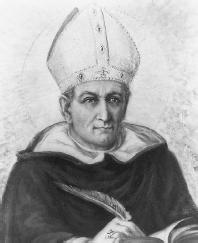
Last week, Pope Benedict spoke about St. Albert the Great, Dominican scholar and bishop. St. Albert is one of my influences as a Dominican involved in science. Benedict said:
Above all, St. Albert shows that between faith and science there is no opposition, notwithstanding some episodes of misunderstanding recorded in history. A man of faith and prayer, as St. Albert the Great was, can cultivate serenely the study of the natural sciences and progress in the knowledge of the micro and macro cosmos, discovering the laws proper of matter, because all this concurs to feed the thirst for and love of God. The Bible speaks to us of creation as the first language through which God — who is supreme intelligence, who is Logos — reveals to us something of himself. The Book of Wisdom, for example, states that the phenomena of nature, gifted with grandeur and beauty, are as the works of an artist, through which, by analogy, we can know the Author of creation (cf. Wisdom 13:5). With a classic similarity in the Medieval Age and the Renaissance one can compare the natural world with a book written by God, which we read on the basis of several approaches of the sciences (cf. Address to the participants in the Plenary Assembly of the Pontifical Academy of Sciences, Oct. 31, 2008).

How many scientists, in fact, in the wake of St. Albert the Great, have carried forward their research inspired by wonder and gratitude before a world that, in the eyes of scholars and believers, seemed and seems the good work of a wise and loving Creator! Scientific study is transformed then into a hymn of praise. It was well understood by a great astrophysicist of our times, whose cause of beatification has been introduced, Enrico Medi, who wrote:
Oh, you mysterious galaxies ... I see you, I calculate you, I understand you, I study you and discover you, I penetrate you and I am immersed in you. From you I take the light and I do science, I take the motion and do science, I take the sparkling of colors and make poetry; I take you stars in my hands, and trembling in the unity of my being I raise you beyond yourselves, and in prayer I hand you to the Creator, that only through me you stars can adore (The Works. Hymn to Creation).
St. Albert the Great reminds us that between science and faith there is friendship, and that the men [and women] of science can undertake, through their vocation to the study of nature, a genuine and fascinating journey of sanctity.

Deus, fons et origo totius sapientiae, qui in illam exquirendam sanctum Albertum effecit magnum, gratiam vobis concedat, benedictionis suae largitatem infundat, atque suae tribuat sapientiae abundantiam.

Blueberry Wine


Last weekend, we were given a bottle of blueberry wine from Teixeira Ranch winery in the Santa Maria Valley of California where we grew up. They call it Heavenly Blue. Let me say right up front: this wine is good, friends. An excellent dessert wine. Great with ice cream. Ok, so it was a tiny splurge before Holy Week. I reasoned that this dark blue wine was appropriately close to the penitential purple of the Lenten season, and since I was still in a mood after observing the Solemnity of the Annunciation last Thursday, I also reasoned that this pleasant blue wine called forth meditation on the Blessed Mother and her beautiful Fiat. Of course, you believe me, right?

Wednesday, March 24, 2010

Solemnity of the Annunciation


Tomorrow (Thursday) is the great Solemnity of the Annunciation. There is no end to the meditation on the profound mystery of the Incarnation: God becoming man, taking on human flesh. It is rich in its profundity, yet it is also as simple as is expressed in the ancient antiphon used for the Magnificat today in the Proprium Ordinis Praedicatorum for the Liturgy of the Hours:
Oriétur sicut sol Salvátor mundi, et descéndet in úterum Vírginis, sicut imber super gramen.
The Saviour of the world shall arise like the sun, and He shall descend into the womb of the Virgin as rain upon the grass.

On that note, Fr. Brian Mullady, O.P., will be celebrating mass at 7:30pm Thursday at my parish, St. Theresa's in Sugar Land, in honor of this great feast day. He will also be wrapping up the Lenten parish mission. Come and join us!

The Dominican Rite Liturgy

The Eastern Dominican Province has produced a most excellent website providing a tutorial and a history of our beautiful liturgy of the Dominican Rite.
The ancient Dominican liturgy, largely unchanged since 1256, beautifully expresses the distinctive charism of the primitive Dominican Order. This site, a project of the Liturgical Commission of the Dominican Province of St. Joseph, makes accessible the riches of the ancient Dominican liturgy – not as a rival to the Novus Ordo, which remains the Ordinary Form of the Mass, but as a supplement to enrich our liturgical life with the treasures of our tradition, consistent with the express wishes of the Second Vatican Council (Sacrosanctum Concilium 4).
Hat tip Fr. Augustine Thompson, O.P.

Tuesday, March 23, 2010

Fasting in the East and in the West

I think that Eric Sammons makes a good point over at his blog regarding the differences in "Fasting regulations" between Eastern and Western Christianity:
Some people might know about the vast difference in the fasting regulations between the two great churches. In the West, we are told to fast on Ash Wednesday and Good Friday (which means one normal meal and two small meals not to equal that one normal meal) and abstain from meat on the Fridays of Lent and Ash Wednesday. In the East, on the other hand, a common tradition is that every day of Lent is a day of fasting and abstinence, and abstinence applies not only to meat, but also includes items such as fish, wine and oil. Why such a difference in these practices? Is it because the East is just more holy or more serious about Lent? I think the reason is due more to the underlying attitudes towards rules and regulations in the East and the West.

- In the West, a regulation is seen as the minimum requirement and failing to follow it is perceived as a serious failure, perhaps even a sin.

- In the East, a regulation is seen as an ideal to strive for and failing to follow it is perceived as an opportunity to do better in the future.

So in the West, the regulations for fasting are much less stringent than in the East, because a failure to follow them is seen as a more egregious action. In the East, the regulations are much more strict, but failing to live up to them is not seen as serious of a failure.
Of course, for those of us in the West, the minimum requirement had been a bit more stringent. But this point still holds. I see the benefits of both mindsets, and I share Eric's opinion that each attitude has its advantages and disadvantages:
The advantage of the Western attitude is that regulations are always taken seriously, but the disadvantage is that one can become legalistic or even prideful if he follows the law. The advantage of the Eastern attitude is that one always sees the ideal as something to strive for and this keeps you humble, but the disadvantage is that the wide gap between practice and regulation might be so wide as to seem insurmountable or make the regulation appear unrealistic.

All Christians should work, with the help of God’s grace and a good spiritual director, to make sacrifices that are in keeping with their state of life. The worst thing to do, at any time, is to compare one’s own sacrifices with anyone else’s.
Amen to that. In fact, I believe that as we practice whatever disciplines are proper to our spiritual tradition, be it Eastern or Western, our particular attitude can nevertheless be informed and nourished by that of the other. East and West can certainly learn from each other and work together in such a way. As a Western Christian, I am inspired by the practice of the East to attempt to exceed what is for me the minimum requirement imposed by the Church. In fact, the Church doesn't fail in encouraging us to do precisely this.

Sunday, March 21, 2010

Passiontide


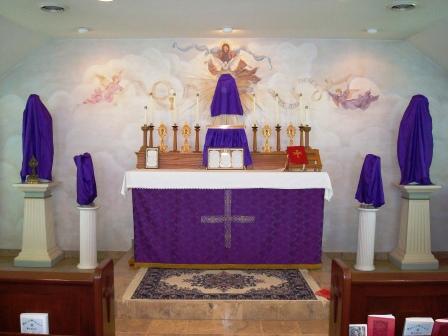
On the 5th Sunday of Lent we begin the period of the final two weeks of the season traditionally referred to as Passiontide. Crucifixes and other sacred images and statues are traditionally veiled during this time. We had never encountered this practice before until we moved to Texas. Other liturgical churches (e.g. Anglicans, Lutherans) also maintain this practice, although I understand that even there it isn't universal. What is the point of veiling? It is admittedly a good question - after all, why wouldn't one earnestly desire to gaze upon the Crucifix during this time? According to the 1917 Catholic Encyclopedia:
The crosses are veiled because Christ during this time no longer walked openly among the people, but hid himself. Hence in the papal chapel the veiling formerly took place at the words of the Gospel: "Jesus autem abscondebat se." Another reason is added by Durandus, namely that Christ's divinity was hidden when he arrived at the time of His suffering and death. The images of the saints also are covered because it would seem improper for the servants to appear when the Master himself is hidden.
The crucifix is typically unveiled after the Lord's Passion is observed on Good Friday. Fr. Z reflects on this more:
We lose things during Lent. We are being pruned through the liturgy. Holy Church experiences liturgical death before the feast of the Resurrection. The Alleluia goes on Septuagesima. Music and flowers go on Ash Wednesday. Today, statues and images are draped in purple. That is why today is sometimes called Repus Sunday, from repositus analogous to absconditus or “hidden”, because this is the day when Crosses and other images in churches are veiled. The universal Church’s Ordo published by the Holy See has an indication that images can be veiled from this Sunday, the 5th of Lent. Traditionally Crosses may be covered until the end of the celebration of the Lord’s Passion on Good Friday and images, such as statues may be covered until the beginning of the Easter Vigil. At my home parish of St. Agnes in St. Paul, MN, the large statue of the Pietà is appropriately unveiled at the Good Friday service...

The pruning cuts more deeply as we march into the Triduum. After the Mass on Holy Thursday the Blessed Sacrament is removed from the main altar, which itself is stripped and bells are replaced with wooden noise makers. On Good Friday there isn’t even a Mass. At the beginning of the Vigil we are deprived of light itself! It is as if the Church herself were completely dead with the Lord in His tomb. This liturgical death of the Church reveals how Christ emptied Himself of His glory in order to save us from our sins and to teach us who we are.

The Church then gloriously springs to life again at the Vigil of Easter. In ancient times, the Vigil was celebrated in the depth of night. In the darkness a single spark would be struck from flint and spread into the flames. The flames spread through the whole Church.

If we can connect ourselves in heart and mind with the Church’s liturgy in which these sacred mysteries are re-presented, then by our active receptivity we become participants in the saving mysteries of Christ’s life, death and resurrection.
Amen.

Stabat Mater dolorosa iuxta Crucem lacrimosa, dum pendebat Filius.
Cuius animam gementem, contristatam et dolentem pertransivit gladius.

Monday, March 15, 2010

Christopher Lee and Metal Music

I'm not sure I get this. Melissa Snell of the About.com Medieval history blog brings us news that the infamous Christopher Lee (Dracula, Count Dooku, Saruman the White) has produced a "symphonic metal music" album entitled Charlemagne: By the Sword and the Cross. Apparently it tells the story of Charlemagne looking back at his life on his deathbed. Melissa notes:
Far and away the best thing about the album is Lee's performance. Now that he's in his 80s, his voice doesn't have the clarity it once had, but it still has extraordinary power and depth. The narration by his daughter, Christina, is quite good. The music is listenable, although there isn't a single track I felt compelled to listen to again, and some of the melodies stay with you. And, miracle of miracles, the content is historically accurate. I don't want Mr. Lee thinking I doubted his and his associates' ability to pull together an accurate portrayal of a medieval figure; it's just that I'm so used to popular culture falling short that it's a delightful surprise when somebody gets it right.

Unfortunately, although the lyrics were interesting as well as factual, they lacked poetry; and while the music was enjoyable, it wasn't as exciting as I'd anticipated. Of course, this is only my own personal opinion; music critics who know more about these things will probably think differently. I'm simply an extreme history enthusiast, and as such I can only tell you that, yes, Charlemagne did have trouble with his brother Carloman in the early years of his reign; and yes, according to Einhard he was betrayed by the Gascons on his Spanish expedition; and yes, he did have more than 4000 Saxons brutally executed when they refused to convert to Christianity.
A taste over at Christopher Lee's website:


It is interesting. But clearly not my thing. ;)

Saturday, March 13, 2010

SXSW & The Big Deal Down South

What do a bunch of livestock, Alan Jackson, Kenny Chesney, Mary J. Blige, the Jonas Brothers, Tim McGraw, Darius Rucker, Rascal Flatts, Brad Paisley, Toby Keith, Lady Antebellum, Keith Urban, the Black Eyed Peas, Brooks & Dunn, and Selena Gomez have in common? They are all featured at this year's Houston Livestock Show and Rodeo. And which local band is notably missing from this list for the first time in I don't know how long? ZZ Top. What's up, guys? The Eliminator must be in the shop. We've been here almost four years now, and we still have only made it to one Rodeo event: the 2007 opening BBQ cook-off.

And what's the other big deal down south? The annual South by Southwest (SXSW) live music festival in Austin. It's not too far away from here.

Wednesday, March 10, 2010

Faith and Reason Lecture Series (#2)


Our monthly Faith and Reason lecture series at St. Theresa's in Sugar Land continues next Tuesday, March 16th. Our last lecture with Fr. Jeff Reed was quite excellent and well attended. In our next lecture, Joseph Magee, Ph.D., will explore the rational limits and requirements of faith with regard to the individual and the community. Can we believe anything we want to believe? If you are in the Houston area, come on down Tuesday evening to Sugar Land (705 St. Theresa Blvd.) and check it out! Everyone is invited and bring a friend!

The lecture begins at 7pm and will take place in the new school library of the St. Theresa Catholic School building (upstairs and at the end of the hallway through the double doors). I look forward to seeing you there!

Also, by way of a preview, Fr. Brian Mullady, O.P., will be at St. Theresa's on Monday, March 22nd, to give our annual Lenten parish mission. Details to come, everyone invited.

Sunday, March 07, 2010

The Anglican Church in America

Last week, the big news was that the House of Bishops of the Anglican Church in America (ANA - belonging to the worldwide Traditional Anglican Communion) voted to implement the provisions of Anglicanorum Coetibus, which means they will join many others worldwide who have elected to enter full communion with the Roman Catholic Church. This group looks to include about 3000 members in 120 or so parishes. As they report on their website:
We, the House of Bishops of the Anglican Church in America of the Traditional Anglican Communion have met in Orlando, Florida, together with our Primate and the Reverend Christopher Phillips of the "Anglican Use" Parish of Our Lady of the Atonement (San Antonio, Texas) and others.

At this meeting, the decision was made formally to request the implementation of the provisions of the Apostolic Constitution Anglicanorum coetibus in the United States of America by the Congregation for the Doctrine of the Faith.
The National Catholic Register has more:
The bishops of the Anglican Church in America have voted to accept Pope Benedict XVI’s invitation to bring their 3,000 members into the Catholic Church.

The unanimous vote of eight members of the House of Bishops, who met in Orlando, Fla., brings 120 parishes in four dioceses across the country into the Church.

Also present at the March 3 vote and in support of it were representatives of “Anglican use” parishes admitted on a one-by-one basis to the Catholic Church in accordance with the Pastoral Provision of Pope John Paul II in 1980.

The move is seen as significant for both the “AngloCatholics” in the Anglican Church in America and the worldwide Traditional Anglican Communion — and the Catholic Church.

“We are returning to the Roman Catholic Church as community with a common past and a common future,” commented Christian Campbell, a Florida lay member of the Anglican Church in America and coordinator of a blog called theanglocatholic.com.
There are those who have ignorantly sought to downplay the significance of Anglicanorum Coetibus, describing it as merely "an extension" of the pastoral provision already in existence. It's certainly rooted in that effort, but this is proof that what the pope has done here is truly something new, as we now have the means to implement meaningful structures to allow for significantly large groups of Anglicans to become Catholic. But I'm just glad that it looks like the Anglican Church of St. Mary of the Angels in Los Feliz, CA, will finally be Catholic. Several years back, it looked like the community was ready to join via the pastoral provision as an Anglican Use parish, but for several reasons (some trivial, some not), that fell through. Ut unum sint.

UPDATE: I just want to correct a point here. It is now my understanding that even though the Anglican Church in America has voted to implement Anglicanorum Coetibus, it is still the responsibility of each parish to vote on whether it will join the movement or not. Thus, it is not a fait accompli that all 120 or so parishes will automatically join the Anglican ordinariate that is set up.

Thursday, March 04, 2010

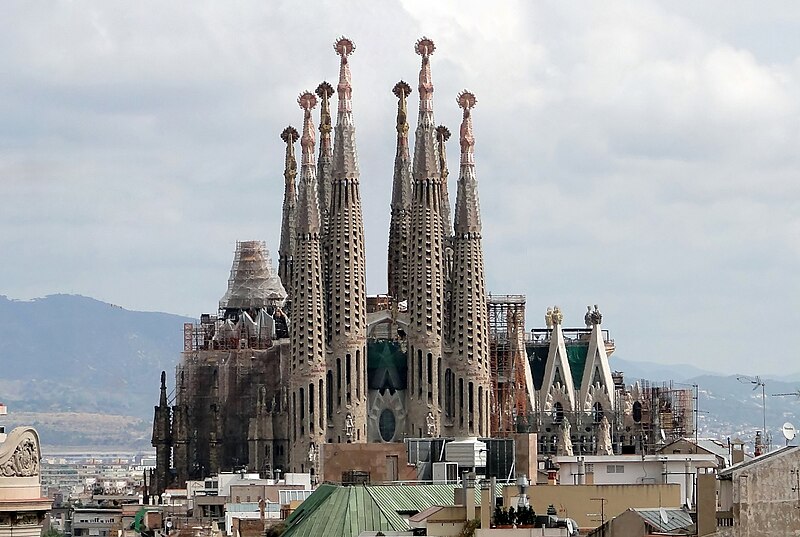
Consecration of Sagrada Familia


So the pope is planning to visit Spain in November and will consecrate the infamous Sagrada Familia.
Regarding the stop in Barcelona, Cardinal Martínez Sistach already last month said the Holy Father had expressed interest in consecrating the church of the Sagrada Familia (Holy Family).

The cardinal noted that the church's architect, Antoni Gaudí, has a cause of canonization being studied.

The church is also important to the Holy Father, according to the cardinal, because of its title, "given the maximum importance that the family has for the Holy Father, since the good of people, society and the Church is directly related with the protection, defense and promotion of the family."
Awesome! Thank you, Benedict!

7 Reasons why...

... you should go to confession during Lent. Courtesy of Taylor Marshall.
1. Priestly absolution is an awesome gift that Jesus gave us.
2. You are a sinner.
3. Confession is a means of grace.
4. You may have committed mortal sin.
5. Guilt is unpleasant.
6. Confession unites you more fully to the Church.
7. Receiving the Eucharist becomes even more powerful.
Speaking of which, I plan to go this weekend :)

LinkWithin

Related Posts with Thumbnails