Saturday, December 19, 2009
Monday, December 07, 2009
Film: The 13th Day
My wife and I attended a screening of the recently released film, The 13th Day: a film that portrays the events surrounding the legendary apparitions of Mary in Fatima, Portugal in 1917. I largely agree with Steve Greydanus' review. While at times, we found the acting to be a bit hollow and contrived, the cinematography of the film is simply amazing. The film does not portray every detail of the story, but it is still quite effective. Here's a clip:
It helps to be familiar with our theology of redemptive suffering to understand the many references to suffering in the film and its importance.
It helps to be familiar with our theology of redemptive suffering to understand the many references to suffering in the film and its importance.
Tuesday, November 24, 2009
Vietnamese Dominican Martyrs
Today we remember the 117 martyrs who suffered for their faith during the 18th and 19th centuries in Vietnam, 59 of which were Dominicans. In particular, we remember Dominican friars Ignatius Delgado and Vincent Liem and Lay Dominican Dominic An-Kham.
O God, you watered the country of Vietnam with the blood of St. Ignatius Delgado and his companions. Through their intercession may the knowledge of Christ continue to flourish there. We ask this through our Lord Jesus Christ, your Son, who lives and reigns with you and the Holy Spirit, one God, for ever and ever. Amen.
O God, you watered the country of Vietnam with the blood of St. Ignatius Delgado and his companions. Through their intercession may the knowledge of Christ continue to flourish there. We ask this through our Lord Jesus Christ, your Son, who lives and reigns with you and the Holy Spirit, one God, for ever and ever. Amen.
Thursday, November 12, 2009
De Lisle's Dream Come True
Beware the Litanies of the Dominicans!
Fr. Brian Mulcahy, O.P., of the Dominican Province of St. Joseph (Eastern Province) posts an article written by Leon Pereira, O.P. entitled, "De Lisle’s Dream Come True". It concerns the desire of Ambrose Philips de Lisle, founder of Mount St. Bernard's Abbey in England, for Anglican unity with the Catholic Church and its fulfillment with the new Apostolic Constitution, Anglicanorum coetibus, which provides for the reception of large portions of the Anglican Communion into Full Communion with the Catholic Church.
It should also come as no surprise that Dominicans also played an important role in this effort to respond to the requests of Anglicans to enter into full communion with the Catholic Church. Pereira notes:
Hat tip to Mark at Dominican Idaho
Fr. Brian Mulcahy, O.P., of the Dominican Province of St. Joseph (Eastern Province) posts an article written by Leon Pereira, O.P. entitled, "De Lisle’s Dream Come True". It concerns the desire of Ambrose Philips de Lisle, founder of Mount St. Bernard's Abbey in England, for Anglican unity with the Catholic Church and its fulfillment with the new Apostolic Constitution, Anglicanorum coetibus, which provides for the reception of large portions of the Anglican Communion into Full Communion with the Catholic Church.
Two hundred years ago an extraordinary man was born in Leicestershire, Ambrose Philips de Lisle. He was a scion of the ancient De Lisle family, and the founder of Mount St. Bernard's Abbey. His descendants still come to Mass at Holy Cross. Ambrose de Lisle was a visionary ahead of his time. A convert to the Catholic faith, he dreamed of Christian unity. He wrote a pamphlet in 1876, voicing the idea of a corporate re-union of the Anglican Communion with the Catholic Church, whilst retaining Anglican juridical structures, liturgy and spirituality. When his friend Cardinal John Henry Newman read it, he wrote to him,Indeed! Read the whole article.Nothing will rejoice me more than to find that the Holy See considers it safe and promising to sanction some such plan as the Pamphlet suggests. I give my best prayers, such as they are, that some means of drawing to us so many good people, who are now shivering at our gates, may be discovered.The plan was doomed to be thwarted in De Lisle's lifetime. To console him, Newman said:It seems to me there must be some divine purpose in it. It often has happened in sacred and in ecclesiastical history, that a thing is in itself good, but the time has not come for it ... And thus I reconcile myself to many, many things, and put them into God's hands. I can quite believe that the conversion of Anglicans may be more thorough and more extended, if it is delayed - and our Lord knows more than we do.
It should also come as no surprise that Dominicans also played an important role in this effort to respond to the requests of Anglicans to enter into full communion with the Catholic Church. Pereira notes:
On 21 February this year, our brother Fr. Augustine DiNoia, O.P., then Under-secretary of the Congregation for the Doctrine of the Faith, asked all Dominicans to pray the Litany of Dominican Saints from February 22 (the Feast of the Chair of St Peter) till March 25 (the Solemnity of the Annunciation) for an at-the-time undisclosed intention - it was for this intention. It is no wonder that in our history people have remarked, 'Beware the Litanies of the Dominicans!'
Hat tip to Mark at Dominican Idaho
The Reform of the Roman Liturgy
... and the Position of the Celebrant of the Altar.
An article by Uwe Michael Lang, taken from his book, "Turning Towards the Lord: Orientation in Liturgical Prayer". Excerpt:
An article by Uwe Michael Lang, taken from his book, "Turning Towards the Lord: Orientation in Liturgical Prayer". Excerpt:
Cardinal Ratzinger is equally emphatic that the celebration of the Eucharist, just as Christian prayer in general, has a trinitarian direction and discusses the question of how this can be communicated most fittingly in liturgical gesture. When we speak to someone, we obviously face that person. Accordingly, the whole liturgical assembly, priest and people, should face the same way, turning towards God to whom prayers and offerings are addressed in this common act of trinitarian worship. Ratzinger rightly protests against the mistaken idea that in this case the celebrating priest is facing "towards the altar", "towards the tabernacle", or even "towards the wall". The catchphrase often heard nowadays that the priest is "turning his back on the people" is a classic example of confounding theology and topography, for the crucial point is that the Mass is a common act of worship where priest and people together, representing the pilgrim Church, reach out for the transcendent God.
Vincent Ferrer, Doctor of the Church?
Hat tip to the Dominican nuns over at Moniales:
The French diocese of Vannes, in which St. Vincent Ferrer died in 1419 and where he is buried in the Cathedral, has adhered to the petition to declare the saint a Doctor of the Church. This was confirmed by the bishop Raymond Centène, who was received by the Archbishop of Valencia (Spain), Carlos Osoro.I took the name Vincent Ferrer when I was admitted to the Order of Preachers as a lay member. I did so because I was inspired by Ferrer's determination to preach the Gospel to those of his own land who had gone years without having heard it. He describes in many of his letters his experiences among the inhabitants of the villages of the backhills of Europe who had essentially become isolated from the Church and had fallen into bizarre heresies. In many ways, I consider my vocation, both as a lay Catholic and as a Dominican, to be one of reaching out to those of my own generation who have become isolated, in some sense, from the Church, and have fallen into nihilism or a rigid scientism.
Mgr. Centène declared that he had spoken to the Archbishop about this proposal, which is being promoted by the Dominican Order, to whom the saint from Valencia belonged, and the Chapter of the Knights of Saint Vincent Ferrer, together with several other entities, in order to «start this work together», as the Archdiocese of Valencia informed. The French bishop cited the Faculty of Theology of the Catholic University of Valencia and the Bishoprics of Vannes, Valencia and Perpignan, among the institutions that participate in this proposal.
This proposal wants to «indicate Saint Vincent Ferrer as an eminent master of the faith for the faithful of all times», as was asserted by the president of the Knights of Saint Vincent Ferrer, Ignacio Carrau.
Mgr. Centène recalled that each year thousands of Valencians make the pilgrimage to the Cathedral of Vannes in order to venerate the relics of their patron saint. The temple, built during the 13th century in the gothic style, guards the tomb of the Valencian saint who died in the French city on the 5th of April 1419.
During his four day visit to the Diocese of Valencia, the French bishop met the provincial and the community of the Dominicans and other civil authorities in the house where Saint Vincent Ferrer was born.
Tuesday, November 03, 2009
Solemn Feast of All Souls

Yesterday, we observed the solemn feast of All Souls. As Scripture witnesses, it is truly a "holy and pious thought" to offer prayer for the dead. We do it as we look toward the resurrection of the dead. We do it because we are united with those who have died through our common baptism into Christ who conquered death. It is also a testimony as to the power of God's grace. I offered prayer for many of my family and friends who have died in the past year and beyond. The subject is never lacking for opportunities for meditation. I always think of one of my favorite mystical meditations on the reality Purgatory from St. Catherine of Genoa's Treatise on Purgatory (excerpt):
When with its inner sight the soul sees itself drawn by God with such loving fire, then it is melted by the heat of the glowing love for God, its most dear Lord, which it feels overflowing it. And it sees by the divine light that God does not cease from drawing it, nor from leading it, lovingly and with much care and unfailing foresight, to its full perfection, doing this of His pure love. But the soul, being hindered by sin, cannot go whither God draws it; it cannot follow the uniting look with which He would draw it to Himself. Again the soul perceives the grievousness of being held back from seeing the divine light; the soul's instinct too, being drawn by that uniting look, craves to be unhindered. I say that it is the sight of these things which begets in the souls the pain they feel in Purgatory. Not that they make account of their pain; most great though it be, they deem it a far less evil than to find themselves going against the will of God, whom they clearly see to be on fire with extreme and pure love for them.My wife and I met friends at our parish for a celebration of a Latin Requiem mass (Novus Ordo/Liturgy of Vatican II) with Gregorian Chant that was, incidentally, celebrated ad orientem and with black vestments (like last year). Those of you who follow my blog know that I am a great proponent of celebrating the mass ad orientem; I have to say that this liturgical orientation was quite proper for this day, particularly because the day and the orientation call to mind our profound hope (with a certain amount of hopeful terror) as we look to the East (the oriens, where the sun rises) for the coming of Our Lord who will come to judge the living and the dead.
Afterward, we went out for coffee with friends and a game of Scrabble. I wish you a very happy and peaceful November!
Sunday, November 01, 2009
Papal Address to Astronomy Congress
Pope Benedict XVI gave an address to attendees of the two-day congress celebrating the International Year of Astronomy, convoked by UNESCO in memory of the 400th anniversary of Galileo's first use of the telescope. Courtesy of ZENIT.
I am pleased to greet this assembly of distinguished astronomers from throughout the world meeting in the Vatican for the celebration of the International Year of Astronomy, and I thank Cardinal Giovanni Lajolo for his kind words of introduction. This celebration, which marks the four hundredth anniversary of Galileo Galilei’s first observations of the heavens by telescope, invites us to consider the immense progress of scientific knowledge in the modern age and, in a particular way, to turn our gaze anew to the heavens in a spirit of wonder, contemplation and commitment to the pursuit of truth, wherever it is to be found.
Your meeting also coincides with the inauguration of the new facilities of the Vatican Observatory in Castel Gandolfo. As you know, the history of the Observatory is in a very real way linked to the figure of Galileo, the controversies which surrounded his research, and the Church’s attempt to attain a correct and fruitful understanding of the relationship between science and religion. I take this occasion to express my gratitude not only for the careful studies which have clarified the precise historical context of Galileo’s condemnation, but also for the efforts of all those committed to ongoing dialogue and reflection on the complementarity of faith and reason in the service of an integral understanding of man and his place in the universe. I am particularly grateful to the staff of the Observatory, and to the friends and benefactors of the Vatican Observatory Foundation, for their efforts to promote research, educational opportunities and dialogue between the Church and the world of science.
The International Year of Astronomy is meant not least to recapture for people throughout our world the extraordinary wonder and amazement which characterized the great age of discovery in the sixteenth century. I think, for example, of the exultation felt by the scientists of the Roman College who just a few steps from here carried out the observations and calculations which led to the worldwide adoption of the Gregorian calendar. Our own age, poised at the edge of perhaps even greater and more far-ranging scientific discoveries, would benefit from that same sense of awe and the desire to attain a truly humanistic synthesis of knowledge which inspired the fathers of modern science. Who can deny that responsibility for the future of humanity, and indeed respect for nature and the world around us, demand -- today as much as ever -- the careful observation, critical judgement, patience and discipline which are essential to the modern scientific method? At the same time, the great scientists of the age of discovery remind us also that true knowledge is always directed to wisdom, and, rather than restricting the eyes of the mind, it invites us to lift our gaze to the higher realm of the spirit.
Knowledge, in a word, must be understood and pursued in all its liberating breadth. It can certainly be reduced to calculation and experiment, yet if it aspires to be wisdom, capable of directing man in the light of his first beginnings and his final ends, it must be committed to the pursuit of that ultimate truth which, while ever beyond our complete grasp, is nonetheless the key to our authentic happiness and freedom (cf. Jn 8:32), the measure of our true humanity, and the criterion for a just relationship with the physical world and with our brothers and sisters in the great human family.
Dear friends, modern cosmology has shown us that neither we, nor the earth we stand on, is the centre of our universe, composed of billions of galaxies, each of them with myriads of stars and planets. Yet, as we seek to respond to the challenge of this Year -- to lift up our eyes to the heavens in order to rediscover our place in the universe -- how can we not be caught up in the marvel expressed by the Psalmist so long ago? Contemplating the starry sky, he cried out with wonder to the Lord: "When I see your heavens, the work of your fingers, the moon and the stars which you set in place, what is man that you should be mindful of him, or the son of man, that you should care for him?" (Ps 8:4-5). It is my hope that the wonder and exaltation which are meant to be the fruits of this International Year of Astronomy will lead beyond the contemplation of the marvels of creation to the contemplation of the Creator, and of that Love which is the underlying motive of his creation -- the Love which, in the words of Dante Alighieri, "moves the sun and the other stars" (Paradiso XXXIII, 145). Revelation tells us that, in the fullness of time, the Word through whom all things were made came to dwell among us. In Christ, the new Adam, we acknowledge the true centre of the universe and all history, and in him, the incarnate Logos, we see the fullest measure of our grandeur as human beings, endowed with reason and called to an eternal destiny.
Sunday, October 25, 2009
The Infused Moral Virtues
Don Paco of the blog Ite ad Thomam posts today a treatise on the Infused Moral Virtues from Chapter 3 of The Three Ages of the Interior Life by Fr. Reginald Garrigou-Lagrange, O.P. Worth your study.
The Thomistic Tradition
Edward Feser brings us a brief survey of the different contemporary Thomistic schools: Part I, Part II. Feser covers the history and influence of these schools, which include Neo-Scholastic Thomism, Existential Thomism, Laval or River Forest Thomism, Transcendental Thomism, Lublin Thomism, and Analytical Thomism. Check it out!
Sunday, October 18, 2009
Visit of the Promoter General
Today the Dominican Promoter General for the Laity, Fr. David Kammler, visited with our group here in Houston. Fr. Kammler comes to us from the ancient basilica of Santa Sabina in Rome after a lengthy trip around the country. We had a great visit with him. He took the time to report to us the state of the lay movements within the Order of Preachers, which are quite extensive, and his experience with the work of the Order around the world, particularly in Vietnam and Indonesia. In some of these regions, Lay Dominicans have been responsible for keeping the faith alive. Fr. Kammler returns to Rome tomorrow.
Requiescant In Pace
Please pray for the repose of the souls of Nikki Eyler Bomicino and her husband Tim who died tragically in an automobile accident in California last week. I knew Nikki going back many years into elementary school. Apparently they were also expecting their first child. Pray for them and for the consolation of their family and friends. May they rest in peace.
While you are at it, pray for Fr. Campion Aspinall, C.J., who died unexpectedly a couple of weeks ago while visiting family in his beloved England at the age of 83. Fr. Campion was found one morning by his sister slumped over in his chair with the rosary in his hand. His desire had always been to die near his family in his beloved homeland of England, and it looks like he got his wish (apparently he carried a picture of the Queen of England in his wallet). Obviously, Fr. Campion's death wasn't so much tragic as it was unexpected. He had been officially retired and in residence at my home parish of St. Louis de Montfort in Santa Maria but still assisted with daily and weekly liturgies. I'll always remember his knack for, ahem, lengthy and idiosyncratic homilies, but I have to say, he knew his history well, and I also personally found him to be a great confessor. May he rest in peace.
While you are at it, pray for Fr. Campion Aspinall, C.J., who died unexpectedly a couple of weeks ago while visiting family in his beloved England at the age of 83. Fr. Campion was found one morning by his sister slumped over in his chair with the rosary in his hand. His desire had always been to die near his family in his beloved homeland of England, and it looks like he got his wish (apparently he carried a picture of the Queen of England in his wallet). Obviously, Fr. Campion's death wasn't so much tragic as it was unexpected. He had been officially retired and in residence at my home parish of St. Louis de Montfort in Santa Maria but still assisted with daily and weekly liturgies. I'll always remember his knack for, ahem, lengthy and idiosyncratic homilies, but I have to say, he knew his history well, and I also personally found him to be a great confessor. May he rest in peace.
Catholic Chaplain Offers Mass in Iraqi Monastery
I thought this was a cool post by Taylor Marshall.
A friend of mine Father Jeff Whorton is a married Catholic priest (former Anglican priest under the Pastoral Provision) recently offered the Holy Sacrifice of the Mass in an abandoned monastery in Mosul, Iraq (allegedly ancient Nineveh). It is the oldest Christian monastery in Iraq and it was recently rediscovered (see Smithsonian article). In the 1700s, 150 were martyred at this location. Today it lies in ruins.Pray for Fr. Jeff and for all military chaplains - they are sorely needed and do incredible work for our men and women military, regardless of whether we officially agree or disagree with the jobs these men and women are asked to do.
Please pray for Fr. Jeff. He is a true hero. I am so inspired by his faith. He's a living saint. Not only is he a Catholic priest, he's also a U.S. chaplain. Not only is he a priest and chaplain, he's a married man and father of seven! Keep him in your prayers and say a Rosary for the good man.
Sunday, October 11, 2009
St. Francisco Coll y Guitart

The holy nuns at the Moniales OP blog have more information about this man.
Thursday, October 08, 2009
What are 'Latinizations'?
For those interested, Josephus Flavius refers to some of what are generally considered "Latinizations" in Eastern Catholicism. We are fortunate to be alive to see this trend reverse in recent decades.
For an idea of just how extreme Latinization can get, be sure to check out the Ukrainian Greek Catholic Priestly Society of Saint Josaphat, which is affiliated with the SSPX. here are some other pictures from their website.
The notorious Richard Williamson of the SSPX ordained two priests and seven deacons for the SSJK in 2006. Here are some pictures of that event.
For an idea of just how extreme Latinization can get, be sure to check out the Ukrainian Greek Catholic Priestly Society of Saint Josaphat, which is affiliated with the SSPX. here are some other pictures from their website.
The notorious Richard Williamson of the SSPX ordained two priests and seven deacons for the SSJK in 2006. Here are some pictures of that event.
Sunday, October 04, 2009
Holy Father Francis
Happy feast of St. Francis!
From the Primitive Constitutions of the Order of Friars Preachers (Dominicans):
From the Primitive Constitutions of the Order of Friars Preachers (Dominicans):
Let Friars Minor, as well as our own, be received in a charitable and cheerful spirit, and be treated with the care and consideration which the means of the house allow.Be sure to join me by praying the rosary as we approach a major feast this week: Our Lady of the Rosary (Wednesday, Oct. 7th).
Pastors and indiscreet speech
From today's Office of Readings from the Pastoral Guide of Pope St. Gregory the Great:
A spiritual guide should be silent when discretion requires and speak when words are of service. Otherwise he may say what he should not or be silent when he should speak. Indiscreet speech may lead men into error and an imprudent silence may leave in error those who could have been taught. Pastors who lack foresight hesitate to say openly what is right because they fear losing the favor of men. As the voice of truth tells us, such leaders are not zealous pastors who protect their flocks, rather they are like mercenaries who flee by taking refuge in silence when the wolf appears.
Monday, September 28, 2009
Praying the Rosary, and Dominican Life
Dominicans, in general, have always had a strong attachment to the rosary as a powerful tool of prayer and meditation. I grew into it very gradually. About a year prior to becoming Catholic, I recall picking up a rosary that had been given to me by a friend and struggling through the prayers. What impressed me then about it, more than the theology behind the prayers, was that there was an almost prayerful rhythm behind the simple gestures of moving my fingers around the beads.
It was at that time that I began to "get" the texture of Catholic devotion and prayer. It truly is made up of the very stuff of the earth. Certainly we don't need these types of sacramentals to pray, but even today, I often find myself reaching into my pocket for my rosary and moving the beads through my fingers, a gesture that always serves to remind me, even in those moments, of the power of prayer, the presence of God's grace, and the gracious intercession of the Mother of God.
Lately, of course, I have sought, as a Lay Dominican "novice" (preparing to make my first profession in four months), to integrate the rosary into the regular rhythm of life. As much as I love the rosary now, I can't say that praying it regularly has been easy. After I entered the Church, I rarely prayed the rosary on my own. It wasn't until a few years ago that I began to fully appreciate the rosary and the different forms of prayer associated with it. Learning about the Dominican method of praying the rosary has helped me the most.
For Dominicans, this is the standard form of praying the rosary. This is not to be confused with the "Dominican Rosary", which is what the "rosary" actually is. Nevertheless, there are many folks who aren't aware that Dominicans pray the rosary in a slightly different manner.
After each decade, there is the Glory be, but we omit the traditionally included Fatima Prayer and move directly into the next mystery. As much as the Fatima Prayer is most certainly a sincere and holy prayer, it always seemed a little out of place to me. And beyond that, I've been to some places where there were so many additional prayers tacked on to the end of each decade, it almost seemed that the decade itself was merely incidental, and the intention behind the mysteries seemed obscured. But take note: that is just my own personal opinion. Some still choose to include it.
Finally, as we finish the prayer, we make reference to the Blessed Mother under the very Dominican title of Queen of the Most Holy Rosary.
It was at that time that I began to "get" the texture of Catholic devotion and prayer. It truly is made up of the very stuff of the earth. Certainly we don't need these types of sacramentals to pray, but even today, I often find myself reaching into my pocket for my rosary and moving the beads through my fingers, a gesture that always serves to remind me, even in those moments, of the power of prayer, the presence of God's grace, and the gracious intercession of the Mother of God.
Lately, of course, I have sought, as a Lay Dominican "novice" (preparing to make my first profession in four months), to integrate the rosary into the regular rhythm of life. As much as I love the rosary now, I can't say that praying it regularly has been easy. After I entered the Church, I rarely prayed the rosary on my own. It wasn't until a few years ago that I began to fully appreciate the rosary and the different forms of prayer associated with it. Learning about the Dominican method of praying the rosary has helped me the most.
For Dominicans, this is the standard form of praying the rosary. This is not to be confused with the "Dominican Rosary", which is what the "rosary" actually is. Nevertheless, there are many folks who aren't aware that Dominicans pray the rosary in a slightly different manner.
In the name of the Father and of the Son, and of the Holy Spirit. AmenNotice a few things. We omit the Apostles Creed and instead open the prayer with the Angelic Salutation followed by the rejoice of Elizabeth. And so we have already arrived into two of the profound mysteries elucidated by the rosary itself! Next, we proceed to ask for God's assistance in our prayer as in the psalms. Yes, this is also how we open the Liturgy of the Hours. After the Glory be, we move straight into the mysteries.
V. Hail Mary, full of grace. the Lord is with thee.
R. Blessed art thou among women and blessed is the fruit of Thy womb, Jesus
V. Lord, open my lips.
R. and my mouth will proclaim your praise.
V. God, come to my assistance.
R. Lord, make haste to help me.
V. Glory be to the Father, and to the Son and to the Holy Spirit,
R. as it was in the beginning, is now and shall be, world with out end.
For each of the five Mysteries, the Mystery to be meditated upon is announced; then follows the recitation of Our Father; then follows the recitation of Hail Mary ten times in responsory fashion; finally the Glory be... is recited. Then follows the next Mystery.
After the last Mystery. All.
Hail, Holy Queen...
V. Pray for us, Queen of the Most Holy Rosary.
R. That we might be made worthy of the promises of Christ.
All. Let us Pray.
O God, whose only begotten Son...
V. May the Divine assistance remain always with us.
R. And may the souls of the faithful departed through the mercy of God rest in peace.
Amen.
After each decade, there is the Glory be, but we omit the traditionally included Fatima Prayer and move directly into the next mystery. As much as the Fatima Prayer is most certainly a sincere and holy prayer, it always seemed a little out of place to me. And beyond that, I've been to some places where there were so many additional prayers tacked on to the end of each decade, it almost seemed that the decade itself was merely incidental, and the intention behind the mysteries seemed obscured. But take note: that is just my own personal opinion. Some still choose to include it.
Finally, as we finish the prayer, we make reference to the Blessed Mother under the very Dominican title of Queen of the Most Holy Rosary.
Monday, September 14, 2009
Byzantine Vespers at the Co-Cathedral
My wife and I attended Great Vespers for the Apodosis of the Nativity of the Theotokos at the Co-Cathedral of the Sacred Heart in Houston last Friday evening. The event was organized by the Eastern Catholic (Byzantine) communities of St. Basil's in Irving and St. John Chrysostom in Houston as part of the Call to Holiness Evangelization Conference. Bishop Nicholas, retired Auxiliary Bishop of the Melkite Greek Catholic Eparchy of the United States, was present, as was Cardinal DiNardo, Archbishop of Galveston-Houston. I invited several people from the parish and local communities to attend as well. It was brilliant!
Byzantine, TX has posted some pictures. My wife and I are in one of them ;-)
Byzantine, TX has posted some pictures. My wife and I are in one of them ;-)
Exaltation of the Holy Cross

Adoramus te, Christe, et benedicimus tibi, quia per sanctam crucem tuam redemisti mundum.
From St. Andrew of Crete (from today's Office of Readings):
We are celebrating the feast of the cross which drove away darkness and brought in the light. As we keep this feast, we are lifted up with the crucified Christ, leaving behind us earth and sin so that we may gain the things above. So great and outstanding a possession is the cross that he who wins it has won a treasure. Rightly could I call this treasure the fairest of all fair things and the costliest, in fact as well as in name, for on it and through it and for its sake the riches of salvation that had been lost were restored to us.
Had there been no cross, Christ could not have been crucified. Had there been no cross, life itself could not have been nailed to the tree. And if life had not been nailed to it, there would be no streams of immortality pouring from Christ's side, blood and water for the world's cleansing. The legal bond of our sin would not be canceled, we should not have obtained our freedom, we should not have enjoyed the fruit of the tree of life and the gates of paradise would not stand open. Had there been no cross, death would not have been trodden underfoot, nor hell despoiled.
Therefore, the cross is something wonderfully great and honorable. It is great because through the cross the many noble acts of Christ found their consummation -- very many indeed, for both his miracles and his sufferings were fully rewarded with victory. The cross is honorable because it is both the sign of God's suffering and the trophy of his victory. It stands for his suffering because on it he freely suffered unto death. But it is also his trophy because it was the means by which the devil was wounded and death conquered; the barred gates of hell were smashed, and the cross became the one common salvation of the whole world.
The cross is called Christ's glory; it is saluted as his triumph. We recognize it as the cup he longed to drink and the climax of the sufferings he endured for our sake. As to the cross being Christ's glory, listen to his words:Now is the Son of Man glorified, and in him God is glorified, and God will glorify him at once.And again:Father, glorify me with the glory I had with you before the world came to be.And once more:Father, glorify your name. Then a voice came from heaven: I have glorified it and will glorify it again.Here he speaks of the glory that would accrue to him through the cross. And if you would understand that the cross is Christ's triumph, hear what he himself also said:When I am lifted up, then I will draw all men to myself.Now you can see that the cross is Christ's glory and triumph.
Incivility hurts pro-life message
I am unapologetically pro-life. I have participated in pro-life vigils, rallies, protests, and marches, and I will continue to be as active as I can in the pro-life movement. But I agree with John Allen, who has several good points here. Whatever your view of Sr. Carol Keehan or Fr. Tom Rosica.
One bit of gallows humor in Catholic circles is that sometimes the worst enemies of the pro-life movement are pro-lifers themselves. The point is that a handful of activists occasionally come off as so shrill, so angry and judgmental, that fair-minded people simply tune out the pro-life message.Allen mentions some of the antics of "LifeSiteNews", a newsite that I generally avoid as I have caught them distorting facts on several occasions. I also generally avoid the bloviating of Judie Brown and the American Life League. I realize they are sincere, but when American Life League proudly takes credit for producing signs like this, it's hard to believe we can be taken seriously in this country. I'll echo John Allen in closing:
... There’s a world of difference, however, between respectful disagreement and character assassination, and some of what we’ve seen in recent days doesn’t just cross that line but obliterates it.
There’s much more I could say, but I’ll restrict myself to this: If Sr. Carol Keehan or Fr. Tom Rosica are your idea of enemies of the faith, it’s time for a reality check.
Moving forward, it’s important that influential Catholic leaders, particularly those with the greatest credibility in pro-life circles, find ways to call off the rhetorical fireworks. They don’t help the pro-life cause, and good people end up as collateral damage.
Abraham Lincoln once said, “I destroy my enemies when I make them my friends.” Pro-life activists, like everyone else, ought to remember that this principle also works in reverse.
Trinitarian attentiveness
Interesting and thoughtful post by Fr. Thomas Kocik at the New Liturgical Movement concerning the attention we pay to the Trinity in prayer (and the annoyance of bad translations).
Saturday, September 12, 2009
Ave Maria: Corporeal Drama
Each Ave Maria suggests the individual journey that each of us must make, from birth to death. It is marked by the biological rhythm of each human life. It mentions the only three moments of our lives which we can know with absolute certainty: that we are born, that we live now, and that we shall die. It starts with the beginning of every human life, a conception in the womb. It situates us now, as we ask for Mary's prayers. It looks forward to death, our death. It is an amazingly physical prayer. It is marked by the inevitable corporeal drama of every human body, which is born and must die.
- Timothy Radcliffe, O.P.
The Little Office of St. Dominic
Br. Peter Totleben, OP on the Little Office of St. Dominic:
Lay Dominicans make a commitment to pray the Divine Office daily, at least morning and evening prayer. Although my soul yearns for a new English translation, which I most likely will not see before my death to this world, praying the Office is a truly beautiful way in which we are able to frame our day by grounding ourselves in the prayer and liturgical life of the Church. Ideally, this should be combined with daily mass and reception of Holy Communion, as we are able. It helps prayer throughout the day to be dynamic, merged with one's very breath. Speaking for myself, I find that when I do this, including offering the day and my daily work to God, even the most obscure tasks of the day (e.g. developing a compiler toolchain) become intense moments of contemplation.
For centuries, lay people have prayed popularized forms of the Liturgy of the Hours. The most popular of these is the well-known “Little Office of the Blessed Virgin Mary.” But there are others. Some years ago, a small booklet of these was published for the use of the Dominican Laity. Br. Thomas More Garrett, O. P. has reproduced the Little Office of St. Dominic. This Little Office is a set of psalms, readings, and classic prayers to St. Dominic, formatted according to the plan of the traditional Divine Office, which is great for growing in devotion to him.Neat. For those who are interested, you can download the text for the Little Office.
Lay Dominicans make a commitment to pray the Divine Office daily, at least morning and evening prayer. Although my soul yearns for a new English translation, which I most likely will not see before my death to this world, praying the Office is a truly beautiful way in which we are able to frame our day by grounding ourselves in the prayer and liturgical life of the Church. Ideally, this should be combined with daily mass and reception of Holy Communion, as we are able. It helps prayer throughout the day to be dynamic, merged with one's very breath. Speaking for myself, I find that when I do this, including offering the day and my daily work to God, even the most obscure tasks of the day (e.g. developing a compiler toolchain) become intense moments of contemplation.
On Fr. McBrien and the Eucharist
Teófilo at the Vivificat! blog posts a response written by Fr. Al Kimel to Fr. Richard McBrien's feelings on Eucharistic Adoration. I'll just leave it there for the moment.
Tuesday, September 08, 2009
The Absence of God
Every now and then, I find myself taking a detour through the theology and spirituality of Eastern Christianity... I am challenged by its depth, but it also helps me to keep my Western Christian ways of thinking in perspective. Lately, I've been rereading some of the writings of Metropolitan Anthony Bloom of Sourozh. These books were given to me back when I was investigating the Catholic Church by one of my high school teachers who was Eastern Orthodox at the time (and is now in full communion with the Church of Rome).
In the book "Beginning to Pray", Met. Anthony devotes a chapter discussing what he calls "The Absence of God". Of course, what he is suggesting is not that God is absent, but that there are times when our perception would suggest to us that He is absent. We need to take care when we pray not to let even those things or persons for whom we are praying get in the way of the focus of our prayer - the eternal God. Met. Anthony writes:
In the book "Beginning to Pray", Met. Anthony devotes a chapter discussing what he calls "The Absence of God". Of course, what he is suggesting is not that God is absent, but that there are times when our perception would suggest to us that He is absent. We need to take care when we pray not to let even those things or persons for whom we are praying get in the way of the focus of our prayer - the eternal God. Met. Anthony writes:
Let us think of our prayers, yours and mine; think of the warmth, the depth and intensity of your prayer when it concerns someone you love or something which matters to your life. Then your heart is open, all your inner self is recollected in the prayer. Does it mean that God matters to you? No, it does not. It simply means that the subject matter of your prayer matters to you. For when you have made your passionate, deep, intense prayer concerning the person you love or the situation that worries you, and you turn to the next item, which does not matter so much -- if you suddenly grow cold, what has changed? Has God grown cold? Has He gone? No, it means that all the elation, all the intensity in your prayer was not born of God's presence, of your faith in Him, of your longing for Him, of your awareness of Him; it was born of nothing but concern for him or her or it, not For God.Is God absent? Those times are actually moments when we must recognize most fully our need for Him. Met. Anthony continues:
As long as we ourselves are real, as long as we are truly ourselves, God can be present and do something with us. But the moment we try to be what we are not, there is nothing left to say or have; we become a fictitious personality, an unreal presence, and this unreal presence cannot be approached by God...Isn't this the basic principle that underlies our own human relationships?
In order to be able to pray, we must be within the situation which is defined as the kingdom of God. We must recognize that He is God, that He is King, we must surrender to Him.
Monday, September 07, 2009
On being rudderless
The commentary in the wake of the ELCA's majority vote granting non-celibate homosexual ministers the privilege of serving as rostered leaders in the ELCA has been interesting. There are those who celebrate it, and there are those who are using this as an opportunity to truly reflect on the problems inherent in the roots of Lutheranism itself.
Chris Blosser calls our attention to an essay written by ELCA Lutheran Robert Benne, who is director of the Center for Religion and Society at Roanoke College. In the essay, Benne seems to recognize the root of their current predicament as something that is thoroughly embedded in what Blosser calls "the very fabric of their tradition". Benne writes:
Chris Blosser calls our attention to an essay written by ELCA Lutheran Robert Benne, who is director of the Center for Religion and Society at Roanoke College. In the essay, Benne seems to recognize the root of their current predicament as something that is thoroughly embedded in what Blosser calls "the very fabric of their tradition". Benne writes:
What was truly chilling about the Assembly's debates was that the revisionists seemed to quote Jesus and the Bible as knowledgeably and persuasively as the orthodox. Passages reinforcing their respective agendas were selected and then brilliantly woven into their arguments. Both sides seemed to have the Bible on their side. The revisionists "contextualized" and relativized the relevant texts. The orthodox claimed a plain sense reading of Scripture. The Lutheran Confessions were utilized effectively by both sides. There was no authoritative interpretation conveyed by any agent or agency in the church. The church was and is rudderless.Of course, other Protestants are responding to this by inviting folks to join their own particular sects, and based solely on their own interpretations. We can easily see why the Church needs a rudder, lest souls be endlessly thrown about by the waves of the world until they are beaten against the rocks and drowned.
Sola Scriptura, a Lutheran principle adopted by evangelicals, did not seem to be sufficient in such circumstances. An authoritative tradition of interpretation of the Bible seemed to be essential. More was needed than the Word alone. Protestants seem to lack such an authoritative tradition so they fight and split. In this situation the option of swimming the Tiber [i.e. becoming Catholic] seems all the more tempting.

Monday, August 31, 2009
A Different Kind of Liberal
Excellent op-ed in the New York Times by Ross Douthat on the pro-life influence of the late Eunice Kennedy Shriver.
Along with her husband, Sargent Shriver, Eunice belonged to America’s dwindling population of outspoken pro-life liberals. Like her church, she saw a continuity, rather than a contradiction, between championing the poor, the marginalized and the oppressed and protecting unborn human life.Read the whole thing.
Her brother took a different path...
At times, Ted Kennedy’s fervor on abortion felt like an extended apology to his party’s feminists for the way the men of his dynasty behaved in private. Eunice, by contrast, had nothing to apologize for. She knew what patriarchy meant: she was born into a household out of “Mad Men,” where the father paraded his mistress around his family, the sons were groomed for high office, and the daughters were expected to marry well, rear children and suffer silently. And she transcended that stifling milieu, doing more than most men to change the world, and earning the right to disagree with her fellow liberals about what true feminism required.
Sunday, August 30, 2009
St. Anne's Byzantine Catholic Church
St. Anne Byzantine Catholic Church (Ruthenian - Eastern Rite) in San Luis Obispo, California, has certainly changed since we left California. For one thing, they remodeled their building and finally added their iconostasis (see below), and just recently, they also installed a new pastor, Fr. James Lane.
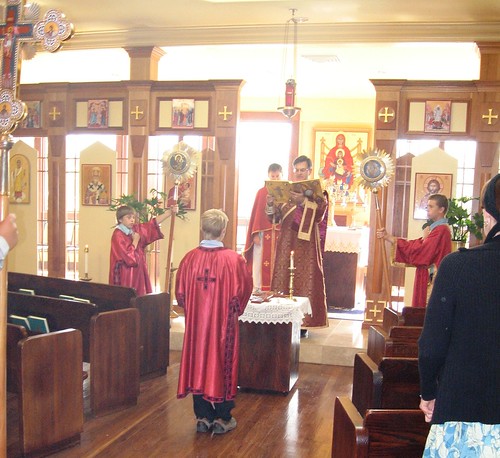
I miss our occasional visits to St. Anne's and the ancient Divine Liturgy of St. John Chrysostom.
I miss our occasional visits to St. Anne's and the ancient Divine Liturgy of St. John Chrysostom.
To be or not to be a lawyer
Interesting post from the American Catholic blog on reasons why folks shouldn't consider becoming lawyers today. Some good points, although I would add that this would also depend on the type of law. But I'll summarize my general thoughts by reposting this video:
Sunday, August 23, 2009
What does "and with your spirit" mean?
In view of the new translation of the Order of Mass from the Roman Missal, a friend recently asked whether the move from "and also with you" to "and with your spirit" (et cum spiritu tuo) implied that the reference to "you" in the current translation was not equal to the reference to "your spirit" in the new translation.
First, it must be noted that the reference to "your spirit" is used in greetings by St. Paul in his letters to the Timothy, Philemon, and other places. The new translation of the Order of Mass is therefore more precise and explicitly biblical, and because of this, it is my hope (and indeed the Church's hope) that the deeper realities and meaning behind the sacred liturgy will be better brought out.
Second, the use of "and with your spirit" in the context of the liturgy is quite truly brimming with meaning from the earliest forms of the liturgy. The translation notes feature this Q&A:
St. John Chrysostom, father of the early church (AD 347–407) preached this in his "Homily on the Holy Pentecost" concerning the expression:
First, it must be noted that the reference to "your spirit" is used in greetings by St. Paul in his letters to the Timothy, Philemon, and other places. The new translation of the Order of Mass is therefore more precise and explicitly biblical, and because of this, it is my hope (and indeed the Church's hope) that the deeper realities and meaning behind the sacred liturgy will be better brought out.
Second, the use of "and with your spirit" in the context of the liturgy is quite truly brimming with meaning from the earliest forms of the liturgy. The translation notes feature this Q&A:
Where does this dialogue come from?The reference to "your spirit" can therefore be contemplated as a reference to the indwelling gift of the Spirit, precisely that Spirit poured out at ordination, and precisely the very same Spirit through which the action of the mass is to be performed. The current reference to "you" in the current translation only refers to this indirectly and is therefore imprecise. It doesn't seem to evoke or sustain the spiritual and mystical reality of what is taking place.
The response et cum spiritu tuo is found in the Liturgies of both East and West, from the earliest days of the Church. One of the first instances of its use is found in the Traditio Apostolica of Saint Hippolytus, composed in Greek around AD 215.
How is this dialogue used in the Liturgy?
The dialogue is only used between the priest and the people, or exceptionally, between the deacon and the people. The greeting is never used in the Roman Liturgy between a non-ordained person and the gathered assembly.
Why does the priest mean when he says “The Lord be with you”?
By greeting the people with the words “The Lord be with you,” the priest expresses his desire that the dynamic activity of God’s spirit be given to the people of God, enabling them to do the work of transforming the world that God has entrusted to them.
What do the people mean when they respond “and with your spirit”?
The expression et cum spiritu tuo is only addressed to an ordained minister. Some scholars have suggested that spiritu refers to the gift of the spirit he received at ordination. In their response, the people assure the priest of the same divine assistance of God’s spirit and, more specifically, help for the priest to use the charismatic gifts given to him in ordination and in so doing to fulfill his prophetic function in the Church.
St. John Chrysostom, father of the early church (AD 347–407) preached this in his "Homily on the Holy Pentecost" concerning the expression:
If the Holy Spirit were not in [Bishop Flavian of Antioch] when he gave the peace to all shortly before ascending to his holy sanctuary, you would not have replied to him all together, And with your spirit. This is why you reply with this expression not only when he ascends to the sanctuary, nor when he preaches to you, nor when he prays for you, but when he stands at this holy altar, when he is about to offer this awesome sacrifice. You don't first partake of the offerings until he has prayed for you the grace from the Lord, and you have answered him, And with your spirit, reminding yourselves by this reply that he who is here does nothing of his own power, nor are the offered gifts the work of human nature, but is it the grace of the Spirit present and hovering over all things which prepared that mystic sacrifice.A great deal could be said about the remaining translation revisions. We'll visit those later.
Walker Nickless on Healthcare Reform
My pastor included this letter in our parish bulletin today; I thought it was apropos and makes some very good distinctions, so here it is:
Health Care Reform
Most Reverend R. Walker Nickless
Bishop of Sioux City
The current national debate about health care reform should concern all of us. There is much at stake in this political struggle, and also much confusion and inaccurate information being thrown around. My brother bishops have described some clear “goal-posts” to mark out what is acceptable reform, and what must be rejected.
First and most important, the Church will not accept any legislation that mandates coverage, public or private, for abortion, euthanasia, or embryonic stem-cell research. We refuse to be made complicit in these evils, which frankly contradict what “health care” should mean. We refuse to allow our own parish, school, and diocesan health insurance plans to be forced to include these evils. As a corollary of this, we insist equally on adequate protection of individual rights of conscience for patients and health care providers not to be made complicit in these evils. A so-called reform that imposes these evils on us would be far worse than keeping the health care system we now have.
Second, the Catholic Church does not teach that “health care” as such, without distinction, is a natural right. The “natural right” of health care is the divine bounty of food, water, and air without which all of us quickly die. This bounty comes from God directly. None of us own it, and none of us can morally withhold it from others. The remainder of health care is a political, not a natural, right, because it comes from our human efforts, creativity, and compassion. As a political right, health care should be apportioned according to need, not ability to pay or to benefit from the care. We reject the rationing of care. Those who are sickest should get the most care, regardless of age, status, or wealth. But how to do this is not self-evident. The decisions that we must collectively make about how to administer health care therefore fall under “prudential judgment.”
Third, in that category of prudential judgment, the Catholic Church does not teach that government should directly provide health care. Unlike a prudential concern like national defense, for which government monopolization is objectively good – it both limits violence overall and prevents the obvious abuses to which private armies are susceptible – health care should not be subject to federal monopolization. Preserving patient choice (through a flourishing private sector) is the only way to prevent a health care monopoly from denying care arbitrarily, as we learned from HMOs in the recent past. While a government monopoly would not be motivated by profit, it would be motivated by such bureaucratic standards as quotas and defined “best procedures,” which are equally beyond the influence of most citizens. The proper role of the government is to regulate the private sector, in order to foster healthy competition and to curtail abuses. Therefore any legislation that undermines the viability of the private sector is suspect. Private, religious hospitals and nursing homes, in particular, should be protected, because these are the ones most vigorously offering actual health care to the poorest of the poor.
The best way in practice to approach this balance of public and private roles is to spread the risks and costs of health care over the largest number of people. This is the principle underlying Medicaid and Medicare taxes, for example. But this ... principle assumes that the pool of taxable workers is sufficiently large, compared to those who draw the benefits, to be reasonably inexpensive and just. This assumption is at root a pro-life assumption! Indeed, we were a culture of life when such programs began. Only if we again foster a culture of life can we perpetuate the economic justice of taxing workers to pay health care for the poor. Without a growing population of youth, our growing population of retirees is outstripping our distribution systems. In a culture of death such as we have now, taxation to redistribute costs of medical care becomes both unjust and unsustainable.
Fourth, preventative care is a moral obligation of the individual to God and to his or her family and loved ones, not a right to be demanded from society. The gift of life comes only from God; to spurn that gift by seriously mistreating our own health is morally wrong. The most effective preventative care for most people is essentially free – good diet, moderate exercise, and sufficient sleep. But pre-natal and neo-natal care are examples of preventative care requiring medical expertise, and therefore cost; and this sort of care should be made available to all as far as possible.
Within these limits, the Church has been advocating for decades that health care be made more accessible to all, especially to the poor. Will the current health care reform proposals achieve these goals?
The current House reform bill, HR 3200, does not meet the first or the fourth standard. As Cardinal Justin Rigali has written for the USCCB Secretariat of Pro-life Activities, this bill circumvents the Hyde amendment (which prohibits federal funds from being used to pay for abortions) by drawing funding from new sources not covered by the Hyde amendment, and by creatively manipulating how federal funds covered by the Hyde amendment are accounted. It also provides a “public insurance option” without adequate limits, so that smaller employers especially will have a financial incentive to push all their employees into this public insurance. This will effectively prevent those employees from choosing any private insurance plans. This will saddle the working classes with additional taxes for inefficient and immoral entitlements. The Senate bill, HELP, is better than the House bill, as I understand it. It subsidizes care for the poor, rather than tending to monopolize care. But, it designates the limit of four times federal poverty level for the public insurance option, which still includes more than half of all workers. This would impinge on the vitality of the private sector. It also does not meet the first standard of explicitly excluding mandatory abortion coverage.
I encourage all of you to make your voice heard to our representatives in Congress. Tell them what they need to hear from us: no health care reform is better than the wrong sort of health care reform. Insist that they not permit themselves to be railroaded into the current too-costly and pro-abortion health care proposals. Insist on their support for proposals that respect the life and dignity of every human person, especially the unborn. And above all, pray for them, and for our country. (Please see the website for the Iowa Catholic Conference at www.iowacatholicconference.org and www.usccb.org/healthcare for more information)
Your brother in Christ,
Most Reverend R. Walker Nickless, Bishop of Sioux City
Saturday, August 22, 2009
LCMS to ELCA Lutherans
President Gerald Kieschnick of the Lutheran Church—Missouri Synod has issued a response to the Churchwide Assembly of the Evangelical Lutheran Church in America in the wake of their majority vote granting non-celibate homosexual ministers the privilege of serving as rostered leaders in the ELCA and affirming same gender unions as pleasing to God. An excerpt:
I speak these next words in deep humility, with a heavy heart and no desire whatsoever to offend. The decisions by this assembly to grant non-celibate homosexual ministers the privilege of serving as rostered leaders in the ELCA and the affirmation of same gender unions as pleasing to God will undoubtedly cause additional stress and disharmony within the ELCA. It will also negatively affect the relationships between our two church bodies. The current division between our churches threatens to become a chasm. This grieves my heart and the hearts of all in the ELCA, the LCMS, and other Christian church bodies throughout the world who do not see these decisions as compatible with the Word of God, or in agreement with the consensus of 2000 years of Christian theological affirmation regarding what Scripture teaches about human sexuality. Simply stated, this matter is fundamentally related to significant differences in how we understand the authority of Holy Scripture and the interpretation of God’s revealed and infallible Word.Serious business. Please pray for our Lutheran brothers and sisters; Let us join in the prayer of Christ from John 17:
Only by the mercy of our Almighty God does hope remain for us poor, miserable sinners. By His grace, through Word and Sacraments, the evangelical witness and authentic message of sin and grace, Law and Gospel, must resound to a troubled world so desperately in need of His love in Christ.
I do not pray for these only, but also for those who believe in me through their word, that they may all be one; even as thou, Father, art in me, and I in thee, that they also may be in us, so that the world may believe that thou hast sent me.Ut unum sint.
And with your spirit
The USCCB has put up a website introducing the Third Edition of the Roman Missal, which includes an updated translation of the English text of the mass. For those of you who haven't seen the new translation, here are some examples of the changes in the priest's parts and the responses of the faithful.
The website notes:
The website notes:
The Missale Romanum (the Roman Missal), the ritual text for the celebration of the Mass, was first promulgated by Pope Paul VI in 1970 as the definitive text of the reformed liturgy of the Second Vatican Council. A second edition followed in 1975.Amen to that. Here's hoping that the implementation is not done hastily without regard for truly helping folks appreciate the depth that is opened up with this new translation. Naturally, it will shake things up a bit. Perhaps that's a good thing.
Pope John Paul II issued a revised version of the Missale Romanum during the Jubilee Year 2000. The English translation of the revised Roman Missal is nearing completion, and the Bishops of the United States will vote on the final sections of the text this November. Among other things, the revised edition of the Missale Romanum contains prayers for the observances of recently canonized saints, additional prefaces for the Eucharistic Prayers, additional Votive Masses and Masses and Prayers for Various Needs and Intentions, and some updated and revised rubrics (instructions) for the celebration of the Mass. The English translation of the Roman Missal will also include updated translations of existing prayers, including some of the well–known responses and acclamations of the people.
This website has been prepared to help you prepare for the transition. As this site continues to be expanded, you will find helpful resources for the faithful, for the clergy, and for parish and diocesan leaders.
May this process of the implementation of the revised Roman Missal be a time of deepening, nurturing, and celebrating our faith through our worship and the celebration of the Sacred Liturgy.
Subscribe to:
Comments (Atom)
LinkWithin
