Sunday, March 07, 2010

The Anglican Church in America

Last week, the big news was that the House of Bishops of the Anglican Church in America (ANA - belonging to the worldwide Traditional Anglican Communion) voted to implement the provisions of Anglicanorum Coetibus, which means they will join many others worldwide who have elected to enter full communion with the Roman Catholic Church. This group looks to include about 3000 members in 120 or so parishes. As they report on their website:
We, the House of Bishops of the Anglican Church in America of the Traditional Anglican Communion have met in Orlando, Florida, together with our Primate and the Reverend Christopher Phillips of the "Anglican Use" Parish of Our Lady of the Atonement (San Antonio, Texas) and others.

At this meeting, the decision was made formally to request the implementation of the provisions of the Apostolic Constitution Anglicanorum coetibus in the United States of America by the Congregation for the Doctrine of the Faith.
The National Catholic Register has more:
The bishops of the Anglican Church in America have voted to accept Pope Benedict XVI’s invitation to bring their 3,000 members into the Catholic Church.

The unanimous vote of eight members of the House of Bishops, who met in Orlando, Fla., brings 120 parishes in four dioceses across the country into the Church.

Also present at the March 3 vote and in support of it were representatives of “Anglican use” parishes admitted on a one-by-one basis to the Catholic Church in accordance with the Pastoral Provision of Pope John Paul II in 1980.

The move is seen as significant for both the “AngloCatholics” in the Anglican Church in America and the worldwide Traditional Anglican Communion — and the Catholic Church.

“We are returning to the Roman Catholic Church as community with a common past and a common future,” commented Christian Campbell, a Florida lay member of the Anglican Church in America and coordinator of a blog called theanglocatholic.com.
There are those who have ignorantly sought to downplay the significance of Anglicanorum Coetibus, describing it as merely "an extension" of the pastoral provision already in existence. It's certainly rooted in that effort, but this is proof that what the pope has done here is truly something new, as we now have the means to implement meaningful structures to allow for significantly large groups of Anglicans to become Catholic. But I'm just glad that it looks like the Anglican Church of St. Mary of the Angels in Los Feliz, CA, will finally be Catholic. Several years back, it looked like the community was ready to join via the pastoral provision as an Anglican Use parish, but for several reasons (some trivial, some not), that fell through. Ut unum sint.

UPDATE: I just want to correct a point here. It is now my understanding that even though the Anglican Church in America has voted to implement Anglicanorum Coetibus, it is still the responsibility of each parish to vote on whether it will join the movement or not. Thus, it is not a fait accompli that all 120 or so parishes will automatically join the Anglican ordinariate that is set up.

Thursday, March 04, 2010

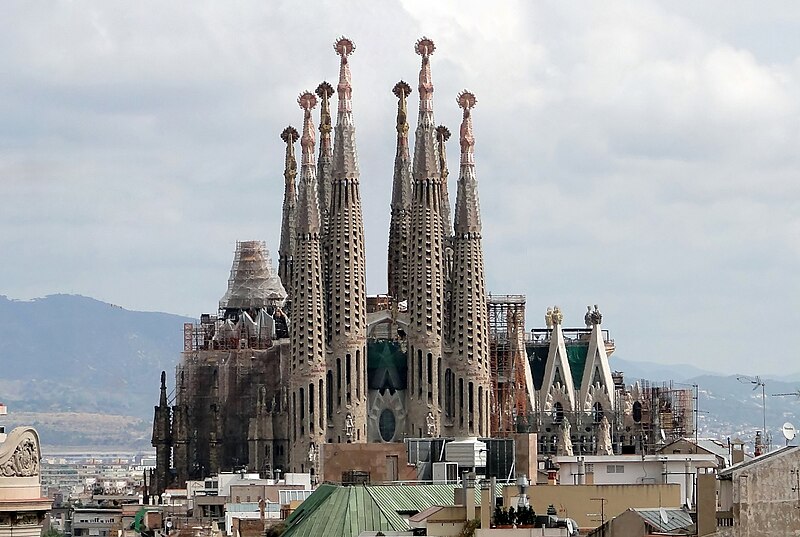
Consecration of Sagrada Familia


So the pope is planning to visit Spain in November and will consecrate the infamous Sagrada Familia.
Regarding the stop in Barcelona, Cardinal Martínez Sistach already last month said the Holy Father had expressed interest in consecrating the church of the Sagrada Familia (Holy Family).

The cardinal noted that the church's architect, Antoni Gaudí, has a cause of canonization being studied.

The church is also important to the Holy Father, according to the cardinal, because of its title, "given the maximum importance that the family has for the Holy Father, since the good of people, society and the Church is directly related with the protection, defense and promotion of the family."
Awesome! Thank you, Benedict!

7 Reasons why...

... you should go to confession during Lent. Courtesy of Taylor Marshall.
1. Priestly absolution is an awesome gift that Jesus gave us.
2. You are a sinner.
3. Confession is a means of grace.
4. You may have committed mortal sin.
5. Guilt is unpleasant.
6. Confession unites you more fully to the Church.
7. Receiving the Eucharist becomes even more powerful.
Speaking of which, I plan to go this weekend :)

The 5th Marian Dogma

In light of a recent forum in Rome concerning the so-called "Fifth Marian Dogma" (which hasn't yet been formally declared as such), Eric Sammons has an excellent post explaining the implications of what a formal, dogmatic declaration would entail as well as a couple reasons why one might want to oppose such an act. I am speaking, of course, of the understanding of Mary as Coredemptrix and Mediatrix of All Graces. Is it time for the pope to formally define this as dogma?

I first encountered speculation concerning this dogma not too long after I entered the Church in 1997. A sensationalistic article was published in Newsweek, I believe, and I spent much of the following year correcting and explaining the issue to my Evangelical friends who thought Catholics wanted to make Mary a fourth person of the Godhead. Being a new Catholic who was still making sense of all things Catholic, I remember feeling a bit angry and left out that the Church was moving too fast - but since when is that ever true? I came to realize that I wasn't angry at the Church but rather at the stupid article. Nevertheless, while I acknowledge Mary as coredemptrix, I'd have to place myself in the "not-right-now" camp insofar as a formal declaration of dogma is concerned. I suspect that this is where Pope Benedict XVI is as well. It is my opinion that such a move would have series ramifications on our relationship with the Eastern Orthodox, and this has been a significant theme of his pontificate. That said, I understand also why one might want the pope to act.

Tuesday, March 02, 2010

The Bell

Every time I hear the bell on my cat's collar ring, I can't help but think of John Donne: therefore never send to know for whom the bell tolls; it tolls for thee. Memento mori. I hope Lent has been a formative experience for all of you!

LinkWithin

Related Posts with Thumbnails