What do a bunch of livestock, Alan Jackson, Kenny Chesney, Mary J. Blige, the Jonas Brothers, Tim McGraw, Darius Rucker, Rascal Flatts, Brad Paisley, Toby Keith, Lady Antebellum, Keith Urban, the Black Eyed Peas, Brooks & Dunn, and Selena Gomez have in common? They are all featured at this year's Houston Livestock Show and Rodeo. And which local band is notably missing from this list for the first time in I don't know how long? ZZ Top. What's up, guys? The Eliminator must be in the shop. We've been here almost four years now, and we still have only made it to one Rodeo event: the 2007 opening BBQ cook-off.
And what's the other big deal down south? The annual South by Southwest (SXSW) live music festival in Austin. It's not too far away from here.
Saturday, March 13, 2010

Wednesday, March 10, 2010
Faith and Reason Lecture Series (#2)

Our monthly Faith and Reason lecture series at St. Theresa's in Sugar Land continues next Tuesday, March 16th. Our last lecture with Fr. Jeff Reed was quite excellent and well attended. In our next lecture, Joseph Magee, Ph.D., will explore the rational limits and requirements of faith with regard to the individual and the community. Can we believe anything we want to believe? If you are in the Houston area, come on down Tuesday evening to Sugar Land (705 St. Theresa Blvd.) and check it out! Everyone is invited and bring a friend!
The lecture begins at 7pm and will take place in the new school library of the St. Theresa Catholic School building (upstairs and at the end of the hallway through the double doors). I look forward to seeing you there!
Also, by way of a preview, Fr. Brian Mullady, O.P., will be at St. Theresa's on Monday, March 22nd, to give our annual Lenten parish mission. Details to come, everyone invited.
Sunday, March 07, 2010
The Anglican Church in America
Last week, the big news was that the House of Bishops of the Anglican Church in America (ANA - belonging to the worldwide Traditional Anglican Communion) voted to implement the provisions of Anglicanorum Coetibus, which means they will join many others worldwide who have elected to enter full communion with the Roman Catholic Church. This group looks to include about 3000 members in 120 or so parishes. As they report on their website:
UPDATE: I just want to correct a point here. It is now my understanding that even though the Anglican Church in America has voted to implement Anglicanorum Coetibus, it is still the responsibility of each parish to vote on whether it will join the movement or not. Thus, it is not a fait accompli that all 120 or so parishes will automatically join the Anglican ordinariate that is set up.
We, the House of Bishops of the Anglican Church in America of the Traditional Anglican Communion have met in Orlando, Florida, together with our Primate and the Reverend Christopher Phillips of the "Anglican Use" Parish of Our Lady of the Atonement (San Antonio, Texas) and others.The National Catholic Register has more:
At this meeting, the decision was made formally to request the implementation of the provisions of the Apostolic Constitution Anglicanorum coetibus in the United States of America by the Congregation for the Doctrine of the Faith.
The bishops of the Anglican Church in America have voted to accept Pope Benedict XVI’s invitation to bring their 3,000 members into the Catholic Church.There are those who have ignorantly sought to downplay the significance of Anglicanorum Coetibus, describing it as merely "an extension" of the pastoral provision already in existence. It's certainly rooted in that effort, but this is proof that what the pope has done here is truly something new, as we now have the means to implement meaningful structures to allow for significantly large groups of Anglicans to become Catholic. But I'm just glad that it looks like the Anglican Church of St. Mary of the Angels in Los Feliz, CA, will finally be Catholic. Several years back, it looked like the community was ready to join via the pastoral provision as an Anglican Use parish, but for several reasons (some trivial, some not), that fell through. Ut unum sint.
The unanimous vote of eight members of the House of Bishops, who met in Orlando, Fla., brings 120 parishes in four dioceses across the country into the Church.
Also present at the March 3 vote and in support of it were representatives of “Anglican use” parishes admitted on a one-by-one basis to the Catholic Church in accordance with the Pastoral Provision of Pope John Paul II in 1980.
The move is seen as significant for both the “AngloCatholics” in the Anglican Church in America and the worldwide Traditional Anglican Communion — and the Catholic Church.
“We are returning to the Roman Catholic Church as community with a common past and a common future,” commented Christian Campbell, a Florida lay member of the Anglican Church in America and coordinator of a blog called theanglocatholic.com.
UPDATE: I just want to correct a point here. It is now my understanding that even though the Anglican Church in America has voted to implement Anglicanorum Coetibus, it is still the responsibility of each parish to vote on whether it will join the movement or not. Thus, it is not a fait accompli that all 120 or so parishes will automatically join the Anglican ordinariate that is set up.
Thursday, March 04, 2010
Consecration of Sagrada Familia
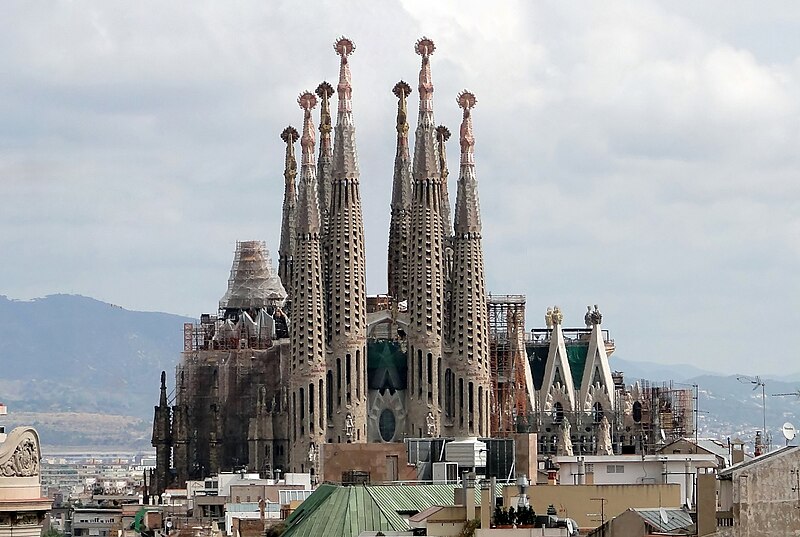
So the pope is planning to visit Spain in November and will consecrate the infamous Sagrada Familia.
Regarding the stop in Barcelona, Cardinal Martínez Sistach already last month said the Holy Father had expressed interest in consecrating the church of the Sagrada Familia (Holy Family).Awesome! Thank you, Benedict!
The cardinal noted that the church's architect, Antoni Gaudí, has a cause of canonization being studied.
The church is also important to the Holy Father, according to the cardinal, because of its title, "given the maximum importance that the family has for the Holy Father, since the good of people, society and the Church is directly related with the protection, defense and promotion of the family."
7 Reasons why...
... you should go to confession during Lent. Courtesy of Taylor Marshall.
1. Priestly absolution is an awesome gift that Jesus gave us.Speaking of which, I plan to go this weekend :)
2. You are a sinner.
3. Confession is a means of grace.
4. You may have committed mortal sin.
5. Guilt is unpleasant.
6. Confession unites you more fully to the Church.
7. Receiving the Eucharist becomes even more powerful.
The 5th Marian Dogma
In light of a recent forum in Rome concerning the so-called "Fifth Marian Dogma" (which hasn't yet been formally declared as such), Eric Sammons has an excellent post explaining the implications of what a formal, dogmatic declaration would entail as well as a couple reasons why one might want to oppose such an act. I am speaking, of course, of the understanding of Mary as Coredemptrix and Mediatrix of All Graces. Is it time for the pope to formally define this as dogma?
I first encountered speculation concerning this dogma not too long after I entered the Church in 1997. A sensationalistic article was published in Newsweek, I believe, and I spent much of the following year correcting and explaining the issue to my Evangelical friends who thought Catholics wanted to make Mary a fourth person of the Godhead. Being a new Catholic who was still making sense of all things Catholic, I remember feeling a bit angry and left out that the Church was moving too fast - but since when is that ever true? I came to realize that I wasn't angry at the Church but rather at the stupid article. Nevertheless, while I acknowledge Mary as coredemptrix, I'd have to place myself in the "not-right-now" camp insofar as a formal declaration of dogma is concerned. I suspect that this is where Pope Benedict XVI is as well. It is my opinion that such a move would have series ramifications on our relationship with the Eastern Orthodox, and this has been a significant theme of his pontificate. That said, I understand also why one might want the pope to act.
I first encountered speculation concerning this dogma not too long after I entered the Church in 1997. A sensationalistic article was published in Newsweek, I believe, and I spent much of the following year correcting and explaining the issue to my Evangelical friends who thought Catholics wanted to make Mary a fourth person of the Godhead. Being a new Catholic who was still making sense of all things Catholic, I remember feeling a bit angry and left out that the Church was moving too fast - but since when is that ever true? I came to realize that I wasn't angry at the Church but rather at the stupid article. Nevertheless, while I acknowledge Mary as coredemptrix, I'd have to place myself in the "not-right-now" camp insofar as a formal declaration of dogma is concerned. I suspect that this is where Pope Benedict XVI is as well. It is my opinion that such a move would have series ramifications on our relationship with the Eastern Orthodox, and this has been a significant theme of his pontificate. That said, I understand also why one might want the pope to act.
Tuesday, March 02, 2010
The Bell
Every time I hear the bell on my cat's collar ring, I can't help but think of John Donne: therefore never send to know for whom the bell tolls; it tolls for thee. Memento mori. I hope Lent has been a formative experience for all of you!
Saturday, February 27, 2010
The Profession Approaches...
This is what I will profess during tomorrow's liturgy:
To the honor of Almighty God: the Father, the Son, and the Holy Spirit, and of the Blessed Virgin Mary and of St. Dominic, I, Alan Phipps, before you, the Moderator of this group, and Fr. N, the religious promoter, representing the Master of the Order of Friars Preachers, promise to live according to the Rule and Directory of the Dominican Laity for three years.I will then receive the scapular, which is a sign and a reminder of dedication to God, to the Church, and to the Order. The scapular should serve more precisely as a reminder, as the Moderator will say during the Rite, "to preach the message of Jesus' love through your thoughts, words, deeds, and life."
Thursday, February 25, 2010
O.P. First Profession
This Sunday, I will officially complete my candidacy (aka "novitiate") as a Lay Dominican and will make my first profession, which is a 3-year temporary profession. Superficially, it means that I will no longer be a novice and, in committing myself to live out the Rule of the Laity, I will also have also been granted the privilege of adding the "O.P" post-nominal initials to my name. The spiritual reality, however, it is much more deep. This is my vocation. This is my mission: to preach - in every way a person can really preach without actually mounting a pulpit. In studying and reading the writings of so many great Dominicans, I am truly humbled to have even made it to this point. I pale in comparison to so many of the great giants of the Dominican Order, particularly those of the Third Order such as Catherine of Siena and Rose of Lima. It's almost as though I'm sneaking in the back door. Who am I to even ask? Please pray for me!
Yves Cardinal Congar, O.P.

I attended a lecture downtown last night on the inimitable and controversial 20th century theologian Yves Congar, O.P. (pictured above, at right, speaking with Josef Ratzinger (aka Benedict XVI) at the Second Vatican Council) I confess that while I was peripherally aware of Congar's theology, and his often being lumped together with the likes of Rahner, Schillebeeckx, and Küng, I wasn't really aware of the influence his theology had on the theology of the laity expressed at the Second Vatican Council. It was quite extraordinary. Even in his on-again-off-again relationship with Rome, and many of his controversial ideas concerning ecumenism, I find him to be a fascinating figure, and I'm actually more curious to spend some time studying some of his treatises on church reform - We shall see!
Wednesday, February 24, 2010
The Eleventh Doctor
As an anxious schoolboy, I await the coming of the Eleventh Doctor, who, I am told, will be making his appearance around Easter of this year. I have to say I am personally attached to the Tenth Doctor, but who knows what can happen. Having a Doctor who is younger than I am is a bit off-putting, I must say.
If you have no idea what I am talking about - don't worry too much about it. All will be made clear :)
If you have no idea what I am talking about - don't worry too much about it. All will be made clear :)
Saturday, February 20, 2010
Early Morning Adoration
A friend from my church recently moved, and so I took over his early morning weekly Holy Hour for Adoration of the Blessed Sacrament in our parish's perpetual adoration chapel. I have known for a long time that this was something I wanted to do - I frequent the adoration chapel often as it is. But I guess you could say I was waiting for a little guidance as to what time was actually right when this opportunity presented itself. I wasn't sure at first how it would work out, but it has turned out to be quite awesome. I am amazed at how lucid my prayer is during that time, and there's something about being with Our Lord in the midst of the night's hush as the rest of the city rests. Thank you, my Lord and My God. Thank you.
Thursday, February 18, 2010
Fr. Robert Barron on the Discipline
Fr. Barron comments on the controversy surrounding the revelation that Pope John Paul II frequently took the discipline and the subject of mortification and redemptive suffering.
In the light of Da Vinci Code mania, the practice of mortifying the flesh in any fashion has been highly misunderstood. In fact, as Fr. Barron states, mortification has been a treasured part of Catholic spiritual practice for centuries. This is certainly true of St. Dominic and the Dominicans -- it is one of the treasured Nine Ways of Prayer of St. Dominic, as related in early manuscripts about St. Dominic based on testimonies of his contemporaries:

In the light of Da Vinci Code mania, the practice of mortifying the flesh in any fashion has been highly misunderstood. In fact, as Fr. Barron states, mortification has been a treasured part of Catholic spiritual practice for centuries. This is certainly true of St. Dominic and the Dominicans -- it is one of the treasured Nine Ways of Prayer of St. Dominic, as related in early manuscripts about St. Dominic based on testimonies of his contemporaries:
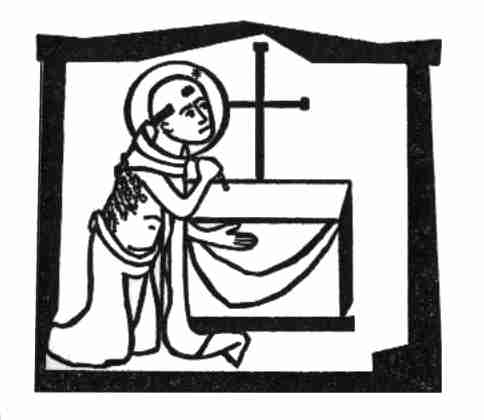
AT THE END of the prayer which has just been described, Saint Dominic would rise from the ground and give himself the discipline with an iron chain, saying, "Thy discipline has corrected me unto the end" [Ps. 17:36]. This is why the Order decreed, in memory of his example, that all the brethren should receive the discipline with wooden switches upon their shoulders as they were bowing down in worship and reciting the psalm "Miserere" or "De Profundis" after Compline on ferial days. This is performed for their own faults or for those of others whose alms they receive and rely upon. No matter how sinless he may be, no one is to desist from this holy example which is shown in the drawing.Extreme cases such as this are rare today, and taking the discipline, even with a lightweight rope like the one Fr. Barron describes (which is also what the numeraries of Opus Dei utilize), should be done in full consultation with a spiritual director. Now, it has to be acknowledged that there are many ways to embrace suffering and mortification. Denying the physical urges and keeping them in check can be as simple as getting up on time in the morning, foregoing that next helping of food at dinner, or skipping dessert. Otherwise our passions can easily enslave us.
Saturday, February 13, 2010
Blessed Reginald of Orleans

We observed the Memorial of Blessed Reginald of Orleans yesterday according to the Dominican calendar. Blessed Reginald had an inspirational zeal for the salvation of souls and was given to teaching and preaching in a very convincing manner. He is associated with a well known miracle that is recorded by his friend and later Master of the Order, Blessed Jordan of Saxony:
While Master Dominic was in Rome in 1218, Master Reginald, then dean of St. Aignan in Orleans, arrived there, intending to go overseas. He was very highly thought of, a most learned man and a prominent public figure. He had taught canon law in Paris for five years.
On his arrival in Rome, he fell seriously ill, and Master Dominic went to vist him several times, urging him to follow the poverty of Christ and to join his Order. He prevailed upon him to agree, fully and freely, to enter the Order, so much so that he bound himself to it by vow.
So he was rescued from the serious, well-nigh desperate peril of his illness, not without a miracle of divine power. While he was feverish, with a high temperature, the queen of heaven and mother of mercy, the Virgin Mary, came to him visibly and anointed his eyes, ears, nose, mouth, navel, hands, and feet with a healing balm which she had brought wth her, saying as she did so things like, “I anoint your feet with holy oil to make them ready to spread the gospel of peace.” She also showed him the complete habit of the Order.
He was cured immediately, and his whole body was restored to perfect health. It happened so suddenly that the doctors, who had more or less given up hope of his recovery, were astonished to see him looking so well. This remarkable miracle was made known afterwards by Master Dominic to many people who are still with us today. I was present myself on one occasion when he told the story publicly during a conference he was giving in Paris.
His health restored, Master Reginald fulfilled his desire to go overseas, although he was already bound to the Order by profession. On his return, he went to Bologna, which he reached on December 21, and at once he threw himself utterly into preaching. His fervent eloquence fired the hearts of all who heard it as if it had been a blazing torch; hardly anyone was rock-like enough to be proof against its heat. The whole of Bologna was in ferment; a new Elijah seemed to have arisen among them.
During this period he received many people into the Order in Bologna, and the number of the disciples began to grow, as more and more were added to them.
Brother Reginald, of holy memory, came to Paris and preached Christ Jesus and him crucified. But God soon took him from the earth. Finishing his course in a short time, he had accomplished a full life’s work.
Brother Matthew, who had known him when he was living in honor and luxury in the world, several times asked him, in some amazement, “Do you ever fell depressed, Master, that you put on the habit?” With his eyes lowered, he replied, “I very much doubt if there is any merit in it for me, because I have always found so much pleasure in the Order.”
Sunday, February 07, 2010
Faith and Reason Lecture Series

If you are in the Houston area, be sure to come down Tuesday evening to St. Theresa's in Sugar Land where Fr. Jeff Reed will be presenting a lecture on the complementarity of Faith and Reason through the mind of Pope John Paul II - largely reflecting on the late Holy Father's brilliant encyclical, Fides et Ratio. Everyone is invited, even if the topic is completely new to you!
The lecture begins at 7pm and will take place in the new school library of the St. Theresa Catholic School building (upstairs and at the end of the hallway). I look forward to seeing you!
Friday, January 29, 2010
Eucharistic Adoration at St. Mark's
I was very happy to discover recently that the new pastor of my former parish of St. Mark's in Isla Vista, CA, which is associated with UC Santa Barbara, has started offering regular Eucharistic exposition and adoration for the student community in a big way, including more opportunities for confession and concluding with Benediction!

This is quite a significant development. Absolutely awesome. I came upon that old monstrance they're using back in 2001 in the sacristy and, after I polished it up, I requested permission from the staff to start evenings of Eucharistic adoration with friends and others who wanted to join. We did this for two years, and for reasons that continue to frustrate me, we decided to stop, and I put the monstrance back in the cupboard where it remained for more years. The tide has definitely turned...
Join with me...
Te Deum laudamus: te Dominum confitemur.
Te aeternum Patrem omnis terra veneratur.
Tibi omnes Angeli; tibi caeli et universae Potestates...

This is quite a significant development. Absolutely awesome. I came upon that old monstrance they're using back in 2001 in the sacristy and, after I polished it up, I requested permission from the staff to start evenings of Eucharistic adoration with friends and others who wanted to join. We did this for two years, and for reasons that continue to frustrate me, we decided to stop, and I put the monstrance back in the cupboard where it remained for more years. The tide has definitely turned...
Join with me...
Te Deum laudamus: te Dominum confitemur.
Te aeternum Patrem omnis terra veneratur.
Tibi omnes Angeli; tibi caeli et universae Potestates...
Sunday, January 10, 2010
On St. Martin de Porres, Obedience, and Charity
Yesterday, I finished Giuliana Cavallini's excellent biography of St. Martin de Porres of 16th/17th century Lima, Peru. Rather than focus on many of Martin's apparent spiritual gifts, for which there exists much testimony, I want to focus in on a couple aspects of Martin's virtue and sanctity. Often when we discuss things like obedience and service today, the understanding of these things is usually distorted. Obedience, for example, is shunned in our society. On Martin's obedience, Cavallini writes:
Martin often described himself as a "poor mulatto". For those who don't know what "mulatto" means, I refer to wikipedia. He actively sought to serve those around him, be they poor or rich. Yet he stands in stark contrast to our present culture. Martin did not see himself as an instrument of shame for the rich or special empowerment of the poor. His aim was not social warfare but spiritual awakening. Cavallini notes:
Obedience is not a "passive virtue," as many seem to think who look at it in the grayish perspective of such expressions as "blind obedience," "obedient as a corpse" and the like. These expressions are often used and abused in contemporary spiritual literature. Obedience is certainly the renunciation of one's own will, but a renunciation effected by a free act of the will...In other words, true obedience is a willful act, something we choose to do that still involves the active engagement of our intellect. Nevertheless, it recognizes a humility to put a desire for our best interest over our own personal satisfaction and indulgence.
Martin often described himself as a "poor mulatto". For those who don't know what "mulatto" means, I refer to wikipedia. He actively sought to serve those around him, be they poor or rich. Yet he stands in stark contrast to our present culture. Martin did not see himself as an instrument of shame for the rich or special empowerment of the poor. His aim was not social warfare but spiritual awakening. Cavallini notes:
Martin's whole apostolate of charity had only one purpose: to awaken the love of God in souls; in all souls, without exception, in the souls of the rich as well as those of the poor. Some people do not know how to love the poor without hating the rich. They really love only themselves, and are the hypocrites who sound the trumpets when they give alms so that they may be honored by men... In Martin's eyes, the rich and the poor were not two irreconcilable opposites, two extremes of opposition. They were simply two different ways of life in the infinite variety of the universe, two states willed by uncreated Goodness so that men might exercise the divine work of charity among themselves.And it so was the case that Martin inspired many of the rich to freely give of themselves to the causes of the poor and sick without desiring to call attention to themselves. Yes, the rich can succumb to greed, but in the cultivation of good virtue, they may also become wise stewards of their wealth, seeing it as something to be shared rather than to be hoarded.
I promise that I do live...
I know that I haven't posted much in the last month or so. I apologize for that. I do intend on continuing to post, but like most of you, I have a number of projects going on simultaneously at work, church, and with the Dominican Laity.
On the Dominican front, I am in the final run preparing for my first profession as a Lay Dominican at the end of February. If you recall, I was admitted to the Order in January of 2009. The final run of the novitiate formation involves a lot of reading, including getting into a bit of St. Thomas' Summa Theologica and Summa Contra Gentiles, which I am doing now.
On the Dominican front, I am in the final run preparing for my first profession as a Lay Dominican at the end of February. If you recall, I was admitted to the Order in January of 2009. The final run of the novitiate formation involves a lot of reading, including getting into a bit of St. Thomas' Summa Theologica and Summa Contra Gentiles, which I am doing now.
Saturday, December 19, 2009
Monday, December 07, 2009
Film: The 13th Day
My wife and I attended a screening of the recently released film, The 13th Day: a film that portrays the events surrounding the legendary apparitions of Mary in Fatima, Portugal in 1917. I largely agree with Steve Greydanus' review. While at times, we found the acting to be a bit hollow and contrived, the cinematography of the film is simply amazing. The film does not portray every detail of the story, but it is still quite effective. Here's a clip:
It helps to be familiar with our theology of redemptive suffering to understand the many references to suffering in the film and its importance.
It helps to be familiar with our theology of redemptive suffering to understand the many references to suffering in the film and its importance.
Tuesday, November 24, 2009
Vietnamese Dominican Martyrs
Today we remember the 117 martyrs who suffered for their faith during the 18th and 19th centuries in Vietnam, 59 of which were Dominicans. In particular, we remember Dominican friars Ignatius Delgado and Vincent Liem and Lay Dominican Dominic An-Kham.
O God, you watered the country of Vietnam with the blood of St. Ignatius Delgado and his companions. Through their intercession may the knowledge of Christ continue to flourish there. We ask this through our Lord Jesus Christ, your Son, who lives and reigns with you and the Holy Spirit, one God, for ever and ever. Amen.
O God, you watered the country of Vietnam with the blood of St. Ignatius Delgado and his companions. Through their intercession may the knowledge of Christ continue to flourish there. We ask this through our Lord Jesus Christ, your Son, who lives and reigns with you and the Holy Spirit, one God, for ever and ever. Amen.
Thursday, November 12, 2009
De Lisle's Dream Come True
Beware the Litanies of the Dominicans!
Fr. Brian Mulcahy, O.P., of the Dominican Province of St. Joseph (Eastern Province) posts an article written by Leon Pereira, O.P. entitled, "De Lisle’s Dream Come True". It concerns the desire of Ambrose Philips de Lisle, founder of Mount St. Bernard's Abbey in England, for Anglican unity with the Catholic Church and its fulfillment with the new Apostolic Constitution, Anglicanorum coetibus, which provides for the reception of large portions of the Anglican Communion into Full Communion with the Catholic Church.
It should also come as no surprise that Dominicans also played an important role in this effort to respond to the requests of Anglicans to enter into full communion with the Catholic Church. Pereira notes:
Hat tip to Mark at Dominican Idaho
Fr. Brian Mulcahy, O.P., of the Dominican Province of St. Joseph (Eastern Province) posts an article written by Leon Pereira, O.P. entitled, "De Lisle’s Dream Come True". It concerns the desire of Ambrose Philips de Lisle, founder of Mount St. Bernard's Abbey in England, for Anglican unity with the Catholic Church and its fulfillment with the new Apostolic Constitution, Anglicanorum coetibus, which provides for the reception of large portions of the Anglican Communion into Full Communion with the Catholic Church.
Two hundred years ago an extraordinary man was born in Leicestershire, Ambrose Philips de Lisle. He was a scion of the ancient De Lisle family, and the founder of Mount St. Bernard's Abbey. His descendants still come to Mass at Holy Cross. Ambrose de Lisle was a visionary ahead of his time. A convert to the Catholic faith, he dreamed of Christian unity. He wrote a pamphlet in 1876, voicing the idea of a corporate re-union of the Anglican Communion with the Catholic Church, whilst retaining Anglican juridical structures, liturgy and spirituality. When his friend Cardinal John Henry Newman read it, he wrote to him,Indeed! Read the whole article.Nothing will rejoice me more than to find that the Holy See considers it safe and promising to sanction some such plan as the Pamphlet suggests. I give my best prayers, such as they are, that some means of drawing to us so many good people, who are now shivering at our gates, may be discovered.The plan was doomed to be thwarted in De Lisle's lifetime. To console him, Newman said:It seems to me there must be some divine purpose in it. It often has happened in sacred and in ecclesiastical history, that a thing is in itself good, but the time has not come for it ... And thus I reconcile myself to many, many things, and put them into God's hands. I can quite believe that the conversion of Anglicans may be more thorough and more extended, if it is delayed - and our Lord knows more than we do.
It should also come as no surprise that Dominicans also played an important role in this effort to respond to the requests of Anglicans to enter into full communion with the Catholic Church. Pereira notes:
On 21 February this year, our brother Fr. Augustine DiNoia, O.P., then Under-secretary of the Congregation for the Doctrine of the Faith, asked all Dominicans to pray the Litany of Dominican Saints from February 22 (the Feast of the Chair of St Peter) till March 25 (the Solemnity of the Annunciation) for an at-the-time undisclosed intention - it was for this intention. It is no wonder that in our history people have remarked, 'Beware the Litanies of the Dominicans!'
Hat tip to Mark at Dominican Idaho
The Reform of the Roman Liturgy
... and the Position of the Celebrant of the Altar.
An article by Uwe Michael Lang, taken from his book, "Turning Towards the Lord: Orientation in Liturgical Prayer". Excerpt:
An article by Uwe Michael Lang, taken from his book, "Turning Towards the Lord: Orientation in Liturgical Prayer". Excerpt:
Cardinal Ratzinger is equally emphatic that the celebration of the Eucharist, just as Christian prayer in general, has a trinitarian direction and discusses the question of how this can be communicated most fittingly in liturgical gesture. When we speak to someone, we obviously face that person. Accordingly, the whole liturgical assembly, priest and people, should face the same way, turning towards God to whom prayers and offerings are addressed in this common act of trinitarian worship. Ratzinger rightly protests against the mistaken idea that in this case the celebrating priest is facing "towards the altar", "towards the tabernacle", or even "towards the wall". The catchphrase often heard nowadays that the priest is "turning his back on the people" is a classic example of confounding theology and topography, for the crucial point is that the Mass is a common act of worship where priest and people together, representing the pilgrim Church, reach out for the transcendent God.
Vincent Ferrer, Doctor of the Church?
Hat tip to the Dominican nuns over at Moniales:
The French diocese of Vannes, in which St. Vincent Ferrer died in 1419 and where he is buried in the Cathedral, has adhered to the petition to declare the saint a Doctor of the Church. This was confirmed by the bishop Raymond Centène, who was received by the Archbishop of Valencia (Spain), Carlos Osoro.I took the name Vincent Ferrer when I was admitted to the Order of Preachers as a lay member. I did so because I was inspired by Ferrer's determination to preach the Gospel to those of his own land who had gone years without having heard it. He describes in many of his letters his experiences among the inhabitants of the villages of the backhills of Europe who had essentially become isolated from the Church and had fallen into bizarre heresies. In many ways, I consider my vocation, both as a lay Catholic and as a Dominican, to be one of reaching out to those of my own generation who have become isolated, in some sense, from the Church, and have fallen into nihilism or a rigid scientism.
Mgr. Centène declared that he had spoken to the Archbishop about this proposal, which is being promoted by the Dominican Order, to whom the saint from Valencia belonged, and the Chapter of the Knights of Saint Vincent Ferrer, together with several other entities, in order to «start this work together», as the Archdiocese of Valencia informed. The French bishop cited the Faculty of Theology of the Catholic University of Valencia and the Bishoprics of Vannes, Valencia and Perpignan, among the institutions that participate in this proposal.
This proposal wants to «indicate Saint Vincent Ferrer as an eminent master of the faith for the faithful of all times», as was asserted by the president of the Knights of Saint Vincent Ferrer, Ignacio Carrau.
Mgr. Centène recalled that each year thousands of Valencians make the pilgrimage to the Cathedral of Vannes in order to venerate the relics of their patron saint. The temple, built during the 13th century in the gothic style, guards the tomb of the Valencian saint who died in the French city on the 5th of April 1419.
During his four day visit to the Diocese of Valencia, the French bishop met the provincial and the community of the Dominicans and other civil authorities in the house where Saint Vincent Ferrer was born.
Tuesday, November 03, 2009
Solemn Feast of All Souls

Yesterday, we observed the solemn feast of All Souls. As Scripture witnesses, it is truly a "holy and pious thought" to offer prayer for the dead. We do it as we look toward the resurrection of the dead. We do it because we are united with those who have died through our common baptism into Christ who conquered death. It is also a testimony as to the power of God's grace. I offered prayer for many of my family and friends who have died in the past year and beyond. The subject is never lacking for opportunities for meditation. I always think of one of my favorite mystical meditations on the reality Purgatory from St. Catherine of Genoa's Treatise on Purgatory (excerpt):
When with its inner sight the soul sees itself drawn by God with such loving fire, then it is melted by the heat of the glowing love for God, its most dear Lord, which it feels overflowing it. And it sees by the divine light that God does not cease from drawing it, nor from leading it, lovingly and with much care and unfailing foresight, to its full perfection, doing this of His pure love. But the soul, being hindered by sin, cannot go whither God draws it; it cannot follow the uniting look with which He would draw it to Himself. Again the soul perceives the grievousness of being held back from seeing the divine light; the soul's instinct too, being drawn by that uniting look, craves to be unhindered. I say that it is the sight of these things which begets in the souls the pain they feel in Purgatory. Not that they make account of their pain; most great though it be, they deem it a far less evil than to find themselves going against the will of God, whom they clearly see to be on fire with extreme and pure love for them.My wife and I met friends at our parish for a celebration of a Latin Requiem mass (Novus Ordo/Liturgy of Vatican II) with Gregorian Chant that was, incidentally, celebrated ad orientem and with black vestments (like last year). Those of you who follow my blog know that I am a great proponent of celebrating the mass ad orientem; I have to say that this liturgical orientation was quite proper for this day, particularly because the day and the orientation call to mind our profound hope (with a certain amount of hopeful terror) as we look to the East (the oriens, where the sun rises) for the coming of Our Lord who will come to judge the living and the dead.
Afterward, we went out for coffee with friends and a game of Scrabble. I wish you a very happy and peaceful November!
Sunday, November 01, 2009
Papal Address to Astronomy Congress
Pope Benedict XVI gave an address to attendees of the two-day congress celebrating the International Year of Astronomy, convoked by UNESCO in memory of the 400th anniversary of Galileo's first use of the telescope. Courtesy of ZENIT.
I am pleased to greet this assembly of distinguished astronomers from throughout the world meeting in the Vatican for the celebration of the International Year of Astronomy, and I thank Cardinal Giovanni Lajolo for his kind words of introduction. This celebration, which marks the four hundredth anniversary of Galileo Galilei’s first observations of the heavens by telescope, invites us to consider the immense progress of scientific knowledge in the modern age and, in a particular way, to turn our gaze anew to the heavens in a spirit of wonder, contemplation and commitment to the pursuit of truth, wherever it is to be found.
Your meeting also coincides with the inauguration of the new facilities of the Vatican Observatory in Castel Gandolfo. As you know, the history of the Observatory is in a very real way linked to the figure of Galileo, the controversies which surrounded his research, and the Church’s attempt to attain a correct and fruitful understanding of the relationship between science and religion. I take this occasion to express my gratitude not only for the careful studies which have clarified the precise historical context of Galileo’s condemnation, but also for the efforts of all those committed to ongoing dialogue and reflection on the complementarity of faith and reason in the service of an integral understanding of man and his place in the universe. I am particularly grateful to the staff of the Observatory, and to the friends and benefactors of the Vatican Observatory Foundation, for their efforts to promote research, educational opportunities and dialogue between the Church and the world of science.
The International Year of Astronomy is meant not least to recapture for people throughout our world the extraordinary wonder and amazement which characterized the great age of discovery in the sixteenth century. I think, for example, of the exultation felt by the scientists of the Roman College who just a few steps from here carried out the observations and calculations which led to the worldwide adoption of the Gregorian calendar. Our own age, poised at the edge of perhaps even greater and more far-ranging scientific discoveries, would benefit from that same sense of awe and the desire to attain a truly humanistic synthesis of knowledge which inspired the fathers of modern science. Who can deny that responsibility for the future of humanity, and indeed respect for nature and the world around us, demand -- today as much as ever -- the careful observation, critical judgement, patience and discipline which are essential to the modern scientific method? At the same time, the great scientists of the age of discovery remind us also that true knowledge is always directed to wisdom, and, rather than restricting the eyes of the mind, it invites us to lift our gaze to the higher realm of the spirit.
Knowledge, in a word, must be understood and pursued in all its liberating breadth. It can certainly be reduced to calculation and experiment, yet if it aspires to be wisdom, capable of directing man in the light of his first beginnings and his final ends, it must be committed to the pursuit of that ultimate truth which, while ever beyond our complete grasp, is nonetheless the key to our authentic happiness and freedom (cf. Jn 8:32), the measure of our true humanity, and the criterion for a just relationship with the physical world and with our brothers and sisters in the great human family.
Dear friends, modern cosmology has shown us that neither we, nor the earth we stand on, is the centre of our universe, composed of billions of galaxies, each of them with myriads of stars and planets. Yet, as we seek to respond to the challenge of this Year -- to lift up our eyes to the heavens in order to rediscover our place in the universe -- how can we not be caught up in the marvel expressed by the Psalmist so long ago? Contemplating the starry sky, he cried out with wonder to the Lord: "When I see your heavens, the work of your fingers, the moon and the stars which you set in place, what is man that you should be mindful of him, or the son of man, that you should care for him?" (Ps 8:4-5). It is my hope that the wonder and exaltation which are meant to be the fruits of this International Year of Astronomy will lead beyond the contemplation of the marvels of creation to the contemplation of the Creator, and of that Love which is the underlying motive of his creation -- the Love which, in the words of Dante Alighieri, "moves the sun and the other stars" (Paradiso XXXIII, 145). Revelation tells us that, in the fullness of time, the Word through whom all things were made came to dwell among us. In Christ, the new Adam, we acknowledge the true centre of the universe and all history, and in him, the incarnate Logos, we see the fullest measure of our grandeur as human beings, endowed with reason and called to an eternal destiny.
Sunday, October 25, 2009
The Infused Moral Virtues
Don Paco of the blog Ite ad Thomam posts today a treatise on the Infused Moral Virtues from Chapter 3 of The Three Ages of the Interior Life by Fr. Reginald Garrigou-Lagrange, O.P. Worth your study.
The Thomistic Tradition
Edward Feser brings us a brief survey of the different contemporary Thomistic schools: Part I, Part II. Feser covers the history and influence of these schools, which include Neo-Scholastic Thomism, Existential Thomism, Laval or River Forest Thomism, Transcendental Thomism, Lublin Thomism, and Analytical Thomism. Check it out!
Sunday, October 18, 2009
Visit of the Promoter General
Today the Dominican Promoter General for the Laity, Fr. David Kammler, visited with our group here in Houston. Fr. Kammler comes to us from the ancient basilica of Santa Sabina in Rome after a lengthy trip around the country. We had a great visit with him. He took the time to report to us the state of the lay movements within the Order of Preachers, which are quite extensive, and his experience with the work of the Order around the world, particularly in Vietnam and Indonesia. In some of these regions, Lay Dominicans have been responsible for keeping the faith alive. Fr. Kammler returns to Rome tomorrow.
Requiescant In Pace
Please pray for the repose of the souls of Nikki Eyler Bomicino and her husband Tim who died tragically in an automobile accident in California last week. I knew Nikki going back many years into elementary school. Apparently they were also expecting their first child. Pray for them and for the consolation of their family and friends. May they rest in peace.
While you are at it, pray for Fr. Campion Aspinall, C.J., who died unexpectedly a couple of weeks ago while visiting family in his beloved England at the age of 83. Fr. Campion was found one morning by his sister slumped over in his chair with the rosary in his hand. His desire had always been to die near his family in his beloved homeland of England, and it looks like he got his wish (apparently he carried a picture of the Queen of England in his wallet). Obviously, Fr. Campion's death wasn't so much tragic as it was unexpected. He had been officially retired and in residence at my home parish of St. Louis de Montfort in Santa Maria but still assisted with daily and weekly liturgies. I'll always remember his knack for, ahem, lengthy and idiosyncratic homilies, but I have to say, he knew his history well, and I also personally found him to be a great confessor. May he rest in peace.
While you are at it, pray for Fr. Campion Aspinall, C.J., who died unexpectedly a couple of weeks ago while visiting family in his beloved England at the age of 83. Fr. Campion was found one morning by his sister slumped over in his chair with the rosary in his hand. His desire had always been to die near his family in his beloved homeland of England, and it looks like he got his wish (apparently he carried a picture of the Queen of England in his wallet). Obviously, Fr. Campion's death wasn't so much tragic as it was unexpected. He had been officially retired and in residence at my home parish of St. Louis de Montfort in Santa Maria but still assisted with daily and weekly liturgies. I'll always remember his knack for, ahem, lengthy and idiosyncratic homilies, but I have to say, he knew his history well, and I also personally found him to be a great confessor. May he rest in peace.
Catholic Chaplain Offers Mass in Iraqi Monastery
I thought this was a cool post by Taylor Marshall.
A friend of mine Father Jeff Whorton is a married Catholic priest (former Anglican priest under the Pastoral Provision) recently offered the Holy Sacrifice of the Mass in an abandoned monastery in Mosul, Iraq (allegedly ancient Nineveh). It is the oldest Christian monastery in Iraq and it was recently rediscovered (see Smithsonian article). In the 1700s, 150 were martyred at this location. Today it lies in ruins.Pray for Fr. Jeff and for all military chaplains - they are sorely needed and do incredible work for our men and women military, regardless of whether we officially agree or disagree with the jobs these men and women are asked to do.
Please pray for Fr. Jeff. He is a true hero. I am so inspired by his faith. He's a living saint. Not only is he a Catholic priest, he's also a U.S. chaplain. Not only is he a priest and chaplain, he's a married man and father of seven! Keep him in your prayers and say a Rosary for the good man.
Sunday, October 11, 2009
St. Francisco Coll y Guitart

The holy nuns at the Moniales OP blog have more information about this man.
Thursday, October 08, 2009
What are 'Latinizations'?
For those interested, Josephus Flavius refers to some of what are generally considered "Latinizations" in Eastern Catholicism. We are fortunate to be alive to see this trend reverse in recent decades.
For an idea of just how extreme Latinization can get, be sure to check out the Ukrainian Greek Catholic Priestly Society of Saint Josaphat, which is affiliated with the SSPX. here are some other pictures from their website.
The notorious Richard Williamson of the SSPX ordained two priests and seven deacons for the SSJK in 2006. Here are some pictures of that event.
For an idea of just how extreme Latinization can get, be sure to check out the Ukrainian Greek Catholic Priestly Society of Saint Josaphat, which is affiliated with the SSPX. here are some other pictures from their website.
The notorious Richard Williamson of the SSPX ordained two priests and seven deacons for the SSJK in 2006. Here are some pictures of that event.
Sunday, October 04, 2009
Holy Father Francis
Happy feast of St. Francis!
From the Primitive Constitutions of the Order of Friars Preachers (Dominicans):
From the Primitive Constitutions of the Order of Friars Preachers (Dominicans):
Let Friars Minor, as well as our own, be received in a charitable and cheerful spirit, and be treated with the care and consideration which the means of the house allow.Be sure to join me by praying the rosary as we approach a major feast this week: Our Lady of the Rosary (Wednesday, Oct. 7th).
Pastors and indiscreet speech
From today's Office of Readings from the Pastoral Guide of Pope St. Gregory the Great:
A spiritual guide should be silent when discretion requires and speak when words are of service. Otherwise he may say what he should not or be silent when he should speak. Indiscreet speech may lead men into error and an imprudent silence may leave in error those who could have been taught. Pastors who lack foresight hesitate to say openly what is right because they fear losing the favor of men. As the voice of truth tells us, such leaders are not zealous pastors who protect their flocks, rather they are like mercenaries who flee by taking refuge in silence when the wolf appears.
Subscribe to:
Posts (Atom)
LinkWithin

