Saturday, September 12, 2009

Ave Maria: Corporeal Drama

Each Ave Maria suggests the individual journey that each of us must make, from birth to death. It is marked by the biological rhythm of each human life. It mentions the only three moments of our lives which we can know with absolute certainty: that we are born, that we live now, and that we shall die. It starts with the beginning of every human life, a conception in the womb. It situates us now, as we ask for Mary's prayers. It looks forward to death, our death. It is an amazingly physical prayer. It is marked by the inevitable corporeal drama of every human body, which is born and must die.
- Timothy Radcliffe, O.P.

The Making of a Pantokrator


Tip of the wand to Byzantine, TX

The Little Office of St. Dominic

Br. Peter Totleben, OP on the Little Office of St. Dominic:
For centuries, lay people have prayed popularized forms of the Liturgy of the Hours. The most popular of these is the well-known “Little Office of the Blessed Virgin Mary.” But there are others. Some years ago, a small booklet of these was published for the use of the Dominican Laity. Br. Thomas More Garrett, O. P. has reproduced the Little Office of St. Dominic. This Little Office is a set of psalms, readings, and classic prayers to St. Dominic, formatted according to the plan of the traditional Divine Office, which is great for growing in devotion to him.
Neat. For those who are interested, you can download the text for the Little Office.

Lay Dominicans make a commitment to pray the Divine Office daily, at least morning and evening prayer. Although my soul yearns for a new English translation, which I most likely will not see before my death to this world, praying the Office is a truly beautiful way in which we are able to frame our day by grounding ourselves in the prayer and liturgical life of the Church. Ideally, this should be combined with daily mass and reception of Holy Communion, as we are able. It helps prayer throughout the day to be dynamic, merged with one's very breath. Speaking for myself, I find that when I do this, including offering the day and my daily work to God, even the most obscure tasks of the day (e.g. developing a compiler toolchain) become intense moments of contemplation.

On Fr. McBrien and the Eucharist

Teófilo at the Vivificat! blog posts a response written by Fr. Al Kimel to Fr. Richard McBrien's feelings on Eucharistic Adoration. I'll just leave it there for the moment.

Tuesday, September 08, 2009

The Absence of God

Every now and then, I find myself taking a detour through the theology and spirituality of Eastern Christianity... I am challenged by its depth, but it also helps me to keep my Western Christian ways of thinking in perspective. Lately, I've been rereading some of the writings of Metropolitan Anthony Bloom of Sourozh. These books were given to me back when I was investigating the Catholic Church by one of my high school teachers who was Eastern Orthodox at the time (and is now in full communion with the Church of Rome).

In the book "Beginning to Pray", Met. Anthony devotes a chapter discussing what he calls "The Absence of God". Of course, what he is suggesting is not that God is absent, but that there are times when our perception would suggest to us that He is absent. We need to take care when we pray not to let even those things or persons for whom we are praying get in the way of the focus of our prayer - the eternal God. Met. Anthony writes:
Let us think of our prayers, yours and mine; think of the warmth, the depth and intensity of your prayer when it concerns someone you love or something which matters to your life. Then your heart is open, all your inner self is recollected in the prayer. Does it mean that God matters to you? No, it does not. It simply means that the subject matter of your prayer matters to you. For when you have made your passionate, deep, intense prayer concerning the person you love or the situation that worries you, and you turn to the next item, which does not matter so much -- if you suddenly grow cold, what has changed? Has God grown cold? Has He gone? No, it means that all the elation, all the intensity in your prayer was not born of God's presence, of your faith in Him, of your longing for Him, of your awareness of Him; it was born of nothing but concern for him or her or it, not For God.
Is God absent? Those times are actually moments when we must recognize most fully our need for Him. Met. Anthony continues:
As long as we ourselves are real, as long as we are truly ourselves, God can be present and do something with us. But the moment we try to be what we are not, there is nothing left to say or have; we become a fictitious personality, an unreal presence, and this unreal presence cannot be approached by God...

In order to be able to pray, we must be within the situation which is defined as the kingdom of God. We must recognize that He is God, that He is King, we must surrender to Him.
Isn't this the basic principle that underlies our own human relationships?

Monday, September 07, 2009

On being rudderless

The commentary in the wake of the ELCA's majority vote granting non-celibate homosexual ministers the privilege of serving as rostered leaders in the ELCA has been interesting. There are those who celebrate it, and there are those who are using this as an opportunity to truly reflect on the problems inherent in the roots of Lutheranism itself.

Chris Blosser calls our attention to an essay written by ELCA Lutheran Robert Benne, who is director of the Center for Religion and Society at Roanoke College. In the essay, Benne seems to recognize the root of their current predicament as something that is thoroughly embedded in what Blosser calls "the very fabric of their tradition". Benne writes:
What was truly chilling about the Assembly's debates was that the revisionists seemed to quote Jesus and the Bible as knowledgeably and persuasively as the orthodox. Passages reinforcing their respective agendas were selected and then brilliantly woven into their arguments. Both sides seemed to have the Bible on their side. The revisionists "contextualized" and relativized the relevant texts. The orthodox claimed a plain sense reading of Scripture. The Lutheran Confessions were utilized effectively by both sides. There was no authoritative interpretation conveyed by any agent or agency in the church. The church was and is rudderless.

Sola Scriptura, a Lutheran principle adopted by evangelicals, did not seem to be sufficient in such circumstances. An authoritative tradition of interpretation of the Bible seemed to be essential. More was needed than the Word alone. Protestants seem to lack such an authoritative tradition so they fight and split. In this situation the option of swimming the Tiber [i.e. becoming Catholic] seems all the more tempting.
Of course, other Protestants are responding to this by inviting folks to join their own particular sects, and based solely on their own interpretations. We can easily see why the Church needs a rudder, lest souls be endlessly thrown about by the waves of the world until they are beaten against the rocks and drowned.

Monday, August 31, 2009

A Different Kind of Liberal

Excellent op-ed in the New York Times by Ross Douthat on the pro-life influence of the late Eunice Kennedy Shriver.
Along with her husband, Sargent Shriver, Eunice belonged to America’s dwindling population of outspoken pro-life liberals. Like her church, she saw a continuity, rather than a contradiction, between championing the poor, the marginalized and the oppressed and protecting unborn human life.

Her brother took a different path...

At times, Ted Kennedy’s fervor on abortion felt like an extended apology to his party’s feminists for the way the men of his dynasty behaved in private. Eunice, by contrast, had nothing to apologize for. She knew what patriarchy meant: she was born into a household out of “Mad Men,” where the father paraded his mistress around his family, the sons were groomed for high office, and the daughters were expected to marry well, rear children and suffer silently. And she transcended that stifling milieu, doing more than most men to change the world, and earning the right to disagree with her fellow liberals about what true feminism required.
Read the whole thing.

Sunday, August 30, 2009

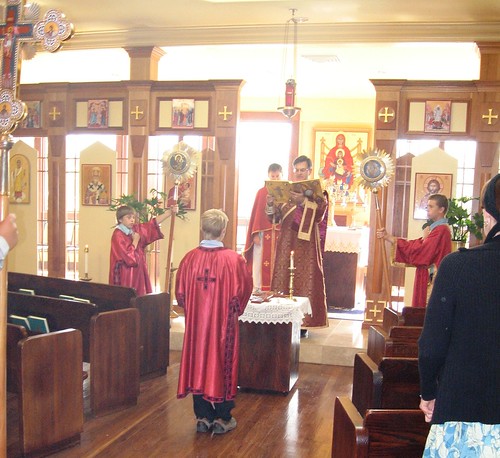
St. Anne's Byzantine Catholic Church

St. Anne Byzantine Catholic Church (Ruthenian - Eastern Rite) in San Luis Obispo, California, has certainly changed since we left California. For one thing, they remodeled their building and finally added their iconostasis (see below), and just recently, they also installed a new pastor, Fr. James Lane.


I miss our occasional visits to St. Anne's and the ancient Divine Liturgy of St. John Chrysostom.

To be or not to be a lawyer

Interesting post from the American Catholic blog on reasons why folks shouldn't consider becoming lawyers today. Some good points, although I would add that this would also depend on the type of law. But I'll summarize my general thoughts by reposting this video:

Sunday, August 23, 2009

What does "and with your spirit" mean?

In view of the new translation of the Order of Mass from the Roman Missal, a friend recently asked whether the move from "and also with you" to "and with your spirit" (et cum spiritu tuo) implied that the reference to "you" in the current translation was not equal to the reference to "your spirit" in the new translation.

First, it must be noted that the reference to "your spirit" is used in greetings by St. Paul in his letters to the Timothy, Philemon, and other places. The new translation of the Order of Mass is therefore more precise and explicitly biblical, and because of this, it is my hope (and indeed the Church's hope) that the deeper realities and meaning behind the sacred liturgy will be better brought out.

Second, the use of "and with your spirit" in the context of the liturgy is quite truly brimming with meaning from the earliest forms of the liturgy. The translation notes feature this Q&A:
Where does this dialogue come from?
The response et cum spiritu tuo is found in the Liturgies of both East and West, from the earliest days of the Church. One of the first instances of its use is found in the Traditio Apostolica of Saint Hippolytus, composed in Greek around AD 215.

How is this dialogue used in the Liturgy?
The dialogue is only used between the priest and the people, or exceptionally, between the deacon and the people. The greeting is never used in the Roman Liturgy between a non-ordained person and the gathered assembly.

Why does the priest mean when he says “The Lord be with you”?
By greeting the people with the words “The Lord be with you,” the priest expresses his desire that the dynamic activity of God’s spirit be given to the people of God, enabling them to do the work of transforming the world that God has entrusted to them.

What do the people mean when they respond “and with your spirit”?
The expression et cum spiritu tuo is only addressed to an ordained minister. Some scholars have suggested that spiritu refers to the gift of the spirit he received at ordination. In their response, the people assure the priest of the same divine assistance of God’s spirit and, more specifically, help for the priest to use the charismatic gifts given to him in ordination and in so doing to fulfill his prophetic function in the Church.
The reference to "your spirit" can therefore be contemplated as a reference to the indwelling gift of the Spirit, precisely that Spirit poured out at ordination, and precisely the very same Spirit through which the action of the mass is to be performed. The current reference to "you" in the current translation only refers to this indirectly and is therefore imprecise. It doesn't seem to evoke or sustain the spiritual and mystical reality of what is taking place.

St. John Chrysostom, father of the early church (AD 347–407) preached this in his "Homily on the Holy Pentecost" concerning the expression:
If the Holy Spirit were not in [Bishop Flavian of Antioch] when he gave the peace to all shortly before ascending to his holy sanctuary, you would not have replied to him all together, And with your spirit. This is why you reply with this expression not only when he ascends to the sanctuary, nor when he preaches to you, nor when he prays for you, but when he stands at this holy altar, when he is about to offer this awesome sacrifice. You don't first partake of the offerings until he has prayed for you the grace from the Lord, and you have answered him, And with your spirit, reminding yourselves by this reply that he who is here does nothing of his own power, nor are the offered gifts the work of human nature, but is it the grace of the Spirit present and hovering over all things which prepared that mystic sacrifice.
A great deal could be said about the remaining translation revisions. We'll visit those later.

Walker Nickless on Healthcare Reform

My pastor included this letter in our parish bulletin today; I thought it was apropos and makes some very good distinctions, so here it is:
Health Care Reform

Most Reverend R. Walker Nickless
Bishop of Sioux City

The current national debate about health care reform should concern all of us. There is much at stake in this political struggle, and also much confusion and inaccurate information being thrown around. My brother bishops have described some clear “goal-posts” to mark out what is acceptable reform, and what must be rejected.

First and most important, the Church will not accept any legislation that mandates coverage, public or private, for abortion, euthanasia, or embryonic stem-cell research. We refuse to be made complicit in these evils, which frankly contradict what “health care” should mean. We refuse to allow our own parish, school, and diocesan health insurance plans to be forced to include these evils. As a corollary of this, we insist equally on adequate protection of individual rights of conscience for patients and health care providers not to be made complicit in these evils. A so-called reform that imposes these evils on us would be far worse than keeping the health care system we now have.

Second, the Catholic Church does not teach that “health care” as such, without distinction, is a natural right. The “natural right” of health care is the divine bounty of food, water, and air without which all of us quickly die. This bounty comes from God directly. None of us own it, and none of us can morally withhold it from others. The remainder of health care is a political, not a natural, right, because it comes from our human efforts, creativity, and compassion. As a political right, health care should be apportioned according to need, not ability to pay or to benefit from the care. We reject the rationing of care. Those who are sickest should get the most care, regardless of age, status, or wealth. But how to do this is not self-evident. The decisions that we must collectively make about how to administer health care therefore fall under “prudential judgment.”

Third, in that category of prudential judgment, the Catholic Church does not teach that government should directly provide health care. Unlike a prudential concern like national defense, for which government monopolization is objectively good – it both limits violence overall and prevents the obvious abuses to which private armies are susceptible – health care should not be subject to federal monopolization. Preserving patient choice (through a flourishing private sector) is the only way to prevent a health care monopoly from denying care arbitrarily, as we learned from HMOs in the recent past. While a government monopoly would not be motivated by profit, it would be motivated by such bureaucratic standards as quotas and defined “best procedures,” which are equally beyond the influence of most citizens. The proper role of the government is to regulate the private sector, in order to foster healthy competition and to curtail abuses. Therefore any legislation that undermines the viability of the private sector is suspect. Private, religious hospitals and nursing homes, in particular, should be protected, because these are the ones most vigorously offering actual health care to the poorest of the poor.

The best way in practice to approach this balance of public and private roles is to spread the risks and costs of health care over the largest number of people. This is the principle underlying Medicaid and Medicare taxes, for example. But this ... principle assumes that the pool of taxable workers is sufficiently large, compared to those who draw the benefits, to be reasonably inexpensive and just. This assumption is at root a pro-life assumption! Indeed, we were a culture of life when such programs began. Only if we again foster a culture of life can we perpetuate the economic justice of taxing workers to pay health care for the poor. Without a growing population of youth, our growing population of retirees is outstripping our distribution systems. In a culture of death such as we have now, taxation to redistribute costs of medical care becomes both unjust and unsustainable.

Fourth, preventative care is a moral obligation of the individual to God and to his or her family and loved ones, not a right to be demanded from society. The gift of life comes only from God; to spurn that gift by seriously mistreating our own health is morally wrong. The most effective preventative care for most people is essentially free – good diet, moderate exercise, and sufficient sleep. But pre-natal and neo-natal care are examples of preventative care requiring medical expertise, and therefore cost; and this sort of care should be made available to all as far as possible.

Within these limits, the Church has been advocating for decades that health care be made more accessible to all, especially to the poor. Will the current health care reform proposals achieve these goals?

The current House reform bill, HR 3200, does not meet the first or the fourth standard. As Cardinal Justin Rigali has written for the USCCB Secretariat of Pro-life Activities, this bill circumvents the Hyde amendment (which prohibits federal funds from being used to pay for abortions) by drawing funding from new sources not covered by the Hyde amendment, and by creatively manipulating how federal funds covered by the Hyde amendment are accounted. It also provides a “public insurance option” without adequate limits, so that smaller employers especially will have a financial incentive to push all their employees into this public insurance. This will effectively prevent those employees from choosing any private insurance plans. This will saddle the working classes with additional taxes for inefficient and immoral entitlements. The Senate bill, HELP, is better than the House bill, as I understand it. It subsidizes care for the poor, rather than tending to monopolize care. But, it designates the limit of four times federal poverty level for the public insurance option, which still includes more than half of all workers. This would impinge on the vitality of the private sector. It also does not meet the first standard of explicitly excluding mandatory abortion coverage.

I encourage all of you to make your voice heard to our representatives in Congress. Tell them what they need to hear from us: no health care reform is better than the wrong sort of health care reform. Insist that they not permit themselves to be railroaded into the current too-costly and pro-abortion health care proposals. Insist on their support for proposals that respect the life and dignity of every human person, especially the unborn. And above all, pray for them, and for our country. (Please see the website for the Iowa Catholic Conference at www.iowacatholicconference.org and www.usccb.org/healthcare for more information)

Your brother in Christ,

Most Reverend R. Walker Nickless, Bishop of Sioux City

Saturday, August 22, 2009

LCMS to ELCA Lutherans

President Gerald Kieschnick of the Lutheran Church—Missouri Synod has issued a response to the Churchwide Assembly of the Evangelical Lutheran Church in America in the wake of their majority vote granting non-celibate homosexual ministers the privilege of serving as rostered leaders in the ELCA and affirming same gender unions as pleasing to God. An excerpt:
I speak these next words in deep humility, with a heavy heart and no desire whatsoever to offend. The decisions by this assembly to grant non-celibate homosexual ministers the privilege of serving as rostered leaders in the ELCA and the affirmation of same gender unions as pleasing to God will undoubtedly cause additional stress and disharmony within the ELCA. It will also negatively affect the relationships between our two church bodies. The current division between our churches threatens to become a chasm. This grieves my heart and the hearts of all in the ELCA, the LCMS, and other Christian church bodies throughout the world who do not see these decisions as compatible with the Word of God, or in agreement with the consensus of 2000 years of Christian theological affirmation regarding what Scripture teaches about human sexuality. Simply stated, this matter is fundamentally related to significant differences in how we understand the authority of Holy Scripture and the interpretation of God’s revealed and infallible Word.

Only by the mercy of our Almighty God does hope remain for us poor, miserable sinners. By His grace, through Word and Sacraments, the evangelical witness and authentic message of sin and grace, Law and Gospel, must resound to a troubled world so desperately in need of His love in Christ.
Serious business. Please pray for our Lutheran brothers and sisters; Let us join in the prayer of Christ from John 17:
I do not pray for these only, but also for those who believe in me through their word, that they may all be one; even as thou, Father, art in me, and I in thee, that they also may be in us, so that the world may believe that thou hast sent me.
Ut unum sint.

And with your spirit

The USCCB has put up a website introducing the Third Edition of the Roman Missal, which includes an updated translation of the English text of the mass. For those of you who haven't seen the new translation, here are some examples of the changes in the priest's parts and the responses of the faithful.

The website notes:
The Missale Romanum (the Roman Missal), the ritual text for the celebration of the Mass, was first promulgated by Pope Paul VI in 1970 as the definitive text of the reformed liturgy of the Second Vatican Council. A second edition followed in 1975.

Pope John Paul II issued a revised version of the Missale Romanum during the Jubilee Year 2000. The English translation of the revised Roman Missal is nearing completion, and the Bishops of the United States will vote on the final sections of the text this November. Among other things, the revised edition of the Missale Romanum contains prayers for the observances of recently canonized saints, additional prefaces for the Eucharistic Prayers, additional Votive Masses and Masses and Prayers for Various Needs and Intentions, and some updated and revised rubrics (instructions) for the celebration of the Mass. The English translation of the Roman Missal will also include updated translations of existing prayers, including some of the well–known responses and acclamations of the people.

This website has been prepared to help you prepare for the transition. As this site continues to be expanded, you will find helpful resources for the faithful, for the clergy, and for parish and diocesan leaders.

May this process of the implementation of the revised Roman Missal be a time of deepening, nurturing, and celebrating our faith through our worship and the celebration of the Sacred Liturgy.
Amen to that. Here's hoping that the implementation is not done hastily without regard for truly helping folks appreciate the depth that is opened up with this new translation. Naturally, it will shake things up a bit. Perhaps that's a good thing.

Thursday, August 20, 2009

Benedictines on Mount Athos


Irenaeus over at the (Orthodox) Eirenikon blog has posted a fine article by Dom Leo Bonsall from the Eastern Churches Review (1969). The article discusses some of the history of the Benedictine Order in the East and the historical presence of a Benedictine monastery, the Benedictine Monastery of St Mary, on Mount Athos.
BENEDICTINE contacts with the Church of the East have been many and varied, but the foundation of the abbey of St Mary on Mount Athos and its continuing existence during a period when official relations between Rome and Constantinople were at a very low ebb is perhaps the outstanding example of monastic co-operation transcending the estrangement of East and West. The full history of the monastery has never been written, for much of it is shrouded in mystery. There are very few documents and the dating of some of these is difficult; all that visibly remains of the buildings is a tower and a few walls on the eastern side of the Athonite peninsula. It is hardly surprising that one of the first Benedictine foundations in the East should have been made by monks from the maritime city republic of Amalfi: Amalfitan merchant ships were trading throughout the area, and monks from that city continued their founding work with the monastery of St Mary the Latin in Jerusalem, and another monastery in Constantinople itself.
I highly encourage you to read the whole article.

Tuesday, August 18, 2009

Bishop Edward Slattery and Ad Orientem

The New Liturgical Movement blog is reporting that Bishop Edward Slattery of the Diocese of Tulsa is restoring the celebration of mass ad orientem in his own cathedral church. Bishop Slattery speaks on the subject in his diocesan newspaper:
An innovation with unforeseen consequences

In the last 40 years, however, this shared orientation was lost; now the priest and the people have become accustomed to facing in opposite directions. The priest faces the people while the people face the priest, even though the Eucharistic Prayer is directed to the Father and not to the people.

This innovation was introduced after the Vatican Council, partly to help the people understand the liturgical action of the Mass by allowing them to see what was going on, and partly as an accommodation to contemporary culture where people who exercise authority are expected to face directly the people they serve, like a teacher sitting behind her desk. Unfortunately this change had a number of unforeseen and largely negative effects. First of all, it was a serious rupture with the Church’s ancient tradition. Secondly, it can give the appearance that the priest and the people were engaged in a conversation about God, rather than the worship of God. Thirdly, it places an inordinate importance on the personality of the celebrant by placing him on a kind of liturgical stage...

Recovering the sacred

Even before his election as the successor to St. Peter, Pope Benedict has been urging us to draw upon the ancient liturgical practice of the Church to recover a more authentic Catholic worship. For that reason, I have restored the venerable ad orientem position when I celebrate Mass at the Cathedral. This change ought not to be misconstrued as the Bishop “turning his back on the faithful,” as if I am being inconsiderate or hostile. Such an interpretation misses the point that, by facing in the same direction, the posture of the celebrant and the congregation make explicit the fact that we journey together to God. Priest and people are on this pilgrimage together.
Bravo to the bishop for doing this and also for making sure folks understand it. It is a difficult move, though, given that so many Catholics today have grown so used to the current orientation. It is a given that some will feel alienated by a move such a this. However, it is my belief that restoring ad orientem, when done prudently and pastorally, will go a long way to more fully recover the sense of the sacred in the divine liturgy. Above all, I am just happy that we have such a gift as the mass.

Monday, August 17, 2009

There were no sponge-cake saints

It is inevitable that you should feel the rub of other people's characters against your own. After all, you are not a gold coin that everyone likes.

Besides, without that friction produced by contact with others, how would you ever lose those corners, those edges and projections — the imperfections and defects — of your character, and acquire the smooth and regular finish, the firm flexibility of charity, of perfection?

If your character and the characters of those who live with you were soft and sweet like sponge-cake you would never become a saint.

-St. JosemarĆ­a EscrivĆ”, from The Way, #20

Friday, August 14, 2009

Parish Education Center


Cardinal DiNardo came out to the parish last night to celebrate solemn vespers and also to dedicate our new parish education center. My wife sang in the choir for the vespers; they did a magnificent job, as usual!

The education center, which was designed by the well-known architect Duncan G. Stroik, houses our parish offices as well as our new parish school, St. Theresa Catholic School. Duncan also designed our recently renovated sanctuary as well as our daily mass chapel.

Compared with the type of new architecture I was used to seeing in California, I suppose one might say that our new education center has too many right angles! ;-) But then again, one might say it has precisely the number of right angles as are required, no more, no less.

Sunday, August 09, 2009

This may be useful...

From amazon.com:

"A "stay-at-home" server: you know it's the right thing for your family. But how do you explain this wonderful choice to your children? Finally, there's a book that talks about the home server using small words and fun pictures, perfect for kids. Written by Tom O'Connor and lovingly illustrated by Jill Dublin, this is a book you and your family will want to read over and over again."

Saturday, August 08, 2009

Solemnity of St. Dominic


We celebrated the Solemnity of St. Dominic with mass with the Dominicans down at Holy Rosary parish in Houston. Afterward, we met the new pastor, who recognized my name from my blog! It was good to meet you, Fr. Ian.

Tuesday, August 04, 2009

In Houston: VIANNEY

The one-man drama, VIANNEY, with actor Leonardo Defilippis as the holy priest of Ars in France, St. Jean-Marie Vianney, is currently in Houston. More information: www.vianneydrama.com.

Here is a list of locations.

It will be at my parish this Sunday evening at 7pm:
Sunday, August 9, 2009 @ 7:00 p.m.
Youth and Family Life Center of St. Theresa Church
115 7th St., Sugar Land, TX 77498
Admission: FREE
All Priests, Religious & Seminarians Welcome as Our Special Guests!
Information, contact the Parish Office at 281-494-1156
I plan to be there. Come on down!

Sunday, August 02, 2009

D&C 129: Ask him to shake hands with you

Interesting selection from the Doctrine and Covenants, a work believed by members of the Church of Jesus Christ of Latter-day Saints to be a part of the scriptural canon. I wasn't aware that you could discern good from evil personages using a handshake:
Instructions given by Joseph Smith the Prophet, at Nauvoo, Illinois, February 9, 1843, making known three grand keys by which the correct nature of ministering angels and spirits may be distinguished.

1 There are two kinds of beings in heaven, namely: Angels, who are resurrected personages, having bodies of flesh and bones

2 For instance, Jesus said: Handle me and see, for a spirit hath not flesh and bones, as ye see me have.

3 Secondly: the spirits of just men made perfect, they who are not resurrected, but inherit the same glory.

4 When a messenger comes saying he has a message from God, offer him your hand and request him to shake hands with you.

5 If he be an angel he will do so, and you will feel his hand.

6 If he be the spirit of a just man made perfect he will come in his glory; for that is the only way he can appear

7 Ask him to shake hands with you, but he will not move, because it is contrary to the order of heaven for a just man to deceive; but he will still deliver his message.

8 If it be the devil as an angel of light, when you ask him to shake hands he will offer you his hand, and you will not feel anything; you may therefore detect him.

9 These are three grand keys whereby you may know whether any administration is from God.
I know that Mormons will defend this by asserting their belief in ongoing public revelation, which historic Christianity rejects. Nevertheless, I post this as a contrast. This teaching's assertions are widely different from our belief in the incorporeal nature of angelic beings and the inability of human beings to become angels after reaching some level of spiritual and resurrected exaltation (the theology of the old favorite "It's a Wonderful Life" aside!). The notion appears to have a number of things confused.

JPII and Conscience

"Conscience itself does not create norms but discovers them in the objective order of morality."

So writes Richard Spinello in an HPR article about Pope John Paul II's thought on conscience. Conscience formation is a serious duty, overlooked, I have found, by many in the Church today. I think Spinello captures things well:
The Pope recognized the need for a proper understanding of conscience, and he was concerned with those who sought to undermine the orthodox doctrine of conscience with more subjectivist notions. Not only has this doctrine been distorted by some revisionist theologians, who diminish the moral law’s decisive role in human development, it has also been corrupted in modern culture. In recent centuries the notion of authenticity has displaced the traditional conception of conscience. The person is supposedly guided by an “inner voice” to make authentic moral choices that are consistent with his or her particular value system. Conscience is also equated with a Freudian superego, which makes us aware of superficial and conventional social standards. The pre-cursor of this idea was Nietzsche, who reduced conscience to the sublimation of instinct.
And he's correct, of course. Spinello goes into greater depth in this discussion, and so I would encourage you to read the whole article.

And what is conscience, really? The catechism defines it in a few ways (1778):
Conscience is a judgment of reason whereby the human person recognizes the moral quality of a concrete act that he is going to perform, is in the process of performing, or has already completed. In all he says and does, man is obliged to follow faithfully what he knows to be just and right. It is by the judgment of his conscience that man perceives and recognizes the prescriptions of the divine law.
It is also a place deep within our core in which God speaks. Quoting Newman, the catechism later states that conscience is the "aboriginal Vicar of Christ. (1778)". We are duty bound to obey our conscience.

Yet, what many overlook is that all of this presumes a conscience that has been (and is in the process of being) rightfully formed according to the teachings of the Gospel as handed on to us by Christ and his Church. In other words, conscience is not merely relative to subjective whim or preference or a mere value system we personally hold. Rather, conscience must be guided and formed against an objective standard or measure of truth that is given to us. And we are responsible for this formation -- indeed it is a lifelong task. A few paragraphs later, the Catechism goes into great length about this (1783-1785):
Conscience must be informed and moral judgment enlightened. A well-formed conscience is upright and truthful. It formulates its judgments according to reason, in conformity with the true good willed by the wisdom of the Creator. The education of conscience is indispensable for human beings who are subjected to negative influences and tempted by sin to prefer their own judgment and to reject authoritative teachings.

The education of the conscience is a lifelong task... In the formation of conscience the Word of God is the light for our path; we must assimilate it in faith and prayer and put it into practice. We must also examine our conscience before the Lord's Cross. We are assisted by the gifts of the Holy Spirit, aided by the witness or advice of others and guided by the authoritative teaching of the Church.
Of course, being flawed people, none of this absolutely guarantees that all of our judgments of conscience are correct. But if we are truly serious about following Christ, and we are serious about educating ourselves, as the Catechism says, in studying the Word of God (in Jesus Christ), assimilating it in faith and prayer and putting it into practice with the assistance of grace, then presumably it will become easier to form correct judgments. I can say in my own development as a Catholic that when I entered the church, my conscience was much more loose and confused in its soundness than it is today. I got started rather late.

St. Thomas More

pray for us!


Sunday, July 26, 2009

Robert Barron on Caritas in Veritate

Another analysis (albeit brief). Fr. Robert Barron reflects on Caritas in Veritate:


The pope's suggestion of a stronger, reformed united nations, or some entity of nations that has "teeth", should complement the pope's own insistence on the principle of subsidiarity. The pope himself notes this:
In the face of the unrelenting growth of global interdependence, there is a strongly felt need, even in the midst of a global recession, for a reform of the United Nations Organization, and likewise of economic institutions and international finance, so that the concept of the family of nations can acquire real teeth... Such an authority would need to be regulated by law, to observe consistently the principles of subsidiarity and solidarity, to seek to establish the common good, and to make a commitment to securing authentic integral human development inspired by the values of charity in truth. (67)

Aidan Nichols on Caritas in Veritate

Fr. Aidan Nichols, O.P., reflects on the pope's latest encyclical, Caritas in Veritate. Here is an excerpt:
For Benedict, charity needs illumining by both reason and faith (3; 9), two distinct yet convergent ways of knowing. Not surprisingly, then, there is more genuine theological doctrine in the new encyclical. Sometimes it is upfront, sometimes it is expressed in a coded way which is one of the reasons people may find this letter difficult to read - something which certainly could not be said about Paul VI's enviably clear and far more straightforward document. The upfront theology is easy to spot. Benedict's thought about social engagement is Christological and even (54) Trinitarian. Let me take some examples of his Christocentrism, itself a sine qua non of genuinely Christian thought. The "charity in truth" of his title is the human face of the divine person of the incarnate Word (1). It reflects the God who is simultaneously Logos and Agape (3). If "humanism" is what you are looking for, only Christ is the revelation of what humanity is (18), a passage indebted to Pope John Paul II's 1979 letter Redemptor Hominis (which itself initiated a more Christocentric reading of the Second Vatican Council's Pastoral Constitution on the Church in the Modern World, Gaudium et Spes). The Church's social doctrine points, therefore, to the "New Man", Christ "the principle of the charity that 'never ends' " (12).

Like Benedict's earlier letter Spe Salvi (2007), Caritas in Veritate is also eschatological, and this is another litmus test of thoroughly revelation-grounded thinking. If global society could achieve unity and peace it would, to that extent, prefigure the final City of God to which the Church directs her own longing (7). The cosmic nature in which human society is set and which it inevitably transforms will be re-capitulated in Christ at the end of time (48): a difficult concept but essential for any distinctively Christian attitude towards the environment.
What does the pope like?
He likes treating justice as inseparable from charity. He likes an objective account of the common good (not a subjective one based on opinion surveys). He likes human rights if they are fundamental ones that are genuinely linked to virtuous practices, and people recognise the corresponding duties. He likes markets so long as they operate in a humane fashion, and state intervention on condition it doesn't reduce people to passivity by welfarism. He likes helping farmers, whether by introducing new methods or improving traditional ones. He likes scientifically based industry if it is marked by generosity in making know-how available. He likes trade unions and, in general, institutions intermediate between the state and the individual - so long as their goals are genuinely civilising (or, in the case of trade unions, just). He likes ecology when it avoids neo-paganism and incorporates a "human ecology" which, among other things, shuns contraception and abortion, eugenics and euthanasia. He likes globalisation if it leads to a sense of a single worldwide interdependence of people, a kind of secular analogue to the catholicity of the Church.
What doesn't the pope like?
He doesn't like treating technology as the means to utopia, nor deploring it as an interference with our naturally paradisiac condition, Ć  la Rousseau. He doesn't like single-minded entrepreneurs motivated exclusively by the profit motive, nor financiers who juggle with notional assets in pursuit of miracles of unnatural growth. He doesn't like the diversion of aid to improper ends, whether by donors or beneficiaries. He doesn't like treating different cultures as obviously equal in every respect, nor does he like homogenising cultures and making them all the same. He doesn't like the mass media when they don't care a hoot for their possible effects in undermining human dignity.
How are things connnected?
The overall shape they belong with owes something to the more than half-century long concern of the popes with the interplay of "subsidiarity" and "solidarity" in economic and social life: roughly speaking, when to leave people or groups to act alone and when - by appeal to the sovereign - to make the members of a whole society act together. But just as John Paul II liked to filter these ideas through his (philosophical and theological) personalism, so Benedict XVI, without abandoning that personalism, fine-tunes them by reference to his key concept (philosophically and theologically) of relation. This helps him to articulate his master idea in Caritas in Veritate, the idea of a "person-based and community-oriented cultural process of worldwide integration that is open to transcendence" (42).
Read the whole analysis.

No posts?

Yes, I know - I haven't had many posts at all recently. But patience is a virtue, at least I like to think so! I've been a lot more busy at work over the last month, and on top of that, we just returned from a two-week vacation to California. The vacation was nice, and we managed to do a lot within that short time, starting in one end of the state (San Diego) and ending in another (East Bay Area).

Monday, July 06, 2009

The ravaging of Louisiana's Isle DerniĆØre

Meteorologist Dr. Jeff Masters has posted a very interesting book review of Dr. Abby Sallenger's Island in a Storm, which recounts the story of the destruction of Louisiana's Isle DerniĆØre island by the Cat 4 "Last Island" Hurricane of 1856. The island, a barrier island off the southern coast of Louisiana, was 24 miles long and 5-to-6 feet high. It was completely submerged by the storm surge, and many years of erosion over the last 150 years have reduced the land area of the island to less than 22% of what it once was, as shown in the image below:


The story is full of interesting details, as Masters writes:
I found it fascinating to read about the Yellow Fever epidemic that hit the region during 1856, which drove many of New Orleans' wealthy residents to seek sanctuary on the seemingly safe ocean front retreat of Isle DerniĆØre for the summer...

We hear the story of how the hurricane's winds gradually tore apart all the homes and hotels on Isle DerniĆØre, leaving the hundreds of people at the mercy of the storm surge. Many were swept away, but some survived harrowing voyages on pieces of debris during a dark and terrifying night. One group of survivors on the island managed to live by hanging on to a children's carousel, whose central post had been driven deep into the sand to anchor it. As the wind and water surged the around them, the desperate survivors hung onto the whirligig as it spun around. "The twirling and twisting, the dashing and splashing, the heeling and toeing, the flapping and floundering which ensued, would at any other time have produced a first-class comedy", one of the survivors relates.
And, of course, the story of the storm is not without its remarks of caution:
The survivors on the storm-ravaged island were not visited at first by relief ships, but by pirates eager to prey on the dead and the living. Relief eventually reached the 200 or so survivors on the island, and a romance leading to marriage is one happy outcome of the storm's wake.

Barrier islands are terrible places to build human settlements, and "the lesson of the flood was not forgotten," according to one of the survivors. The resorts on Isles DerniĆØres were never rebuilt. Sallenger notes that "such lessons are forgotten or ignored. In the last century and a half, the Village of Isle DerniĆØre was one of only a few seafront communities that were destroyed or severely damaged in a storm and never rebuilt. The common practice is not only to rebuild structures on devastated coasts but also to make them bigger and more elaborate...We continue in the United States to develop extremely hazardous coastal locations, like the low-lying areas on the Bolivar Peninsula east of Galveston, Texas, that were wiped out in 2008 by Hurricane Ike. The extreme vulnerability of such locations today will only increase as the world's seas rise."
Read the whole review...

Friday, June 26, 2009

Classic JosemarĆ­a EscrivĆ”

1974 in Chile

St. JosemarĆ­a EscrivĆ”, Founder of Opus Dei

Today we observe the memorial of St. JosemarĆ­a EscrivĆ”, founder of Opus Dei. I may be a Dominican, but I will always have a closeness to the spirituality and teachings of St. JosemarĆ­a. I think he spoke to me at a particular time in my life characterized by mounting frustration with the Church's intersection with Daily Life, both in my life as well as in the lives of those around me. It was a good period of maturity. The call to holiness is universal, something our Church emphasizes, particularly in the person of our late Holy Father, Pope John Paul II. But more than that, you don't have to live a lofty life, be ordained clergy, or even be connected to a religious order to be holy. It is the unfolding and work of God's grace in the ordinary work of life, precisely where God has called you to live and serve.

From Passionately Loving the World:
On the contrary, you must understand now, more clearly, that God is calling you to serve Him in and from the ordinary, material and secular activities of human life. He waits for us every day, in the laboratory, in the operating theatre, in the army barracks, in the university chair, in the factory, in the workshop, in the fields, in the home and in all the immense panorama of work. Understand this well: there is something holy, something divine, hidden in the most ordinary situations, and it is up to each one of you to discover it.
From Christ Is Passing By:
Let's not deceive ourselves: in our life we will find vigor and victory and depression and defeat. This has always been true of the earthly pilgrimage of Christians, even of those we venerate on the altars. Don't you remember Peter, Augustine, and Francis? I have never liked biographies of saints which naively -- but also with a lack of sound doctrine -- present their deeds as if they had been confirmed in grace from birth. No. The true life stories of Christian heroes resemble our own experience: they fought and won; they fought and lost. And then, repentant, they returned to the fray.
From The Forge, #846:
Constantly call to mind that at every moment you are cooperating in the human and spiritual formation of those around you, and of all souls — for the blessed Communion of Saints reaches as far as that. At every moment: when you work and when you rest; when people see you happy or when they see you worried; when at your job, or out in the street, you pray as does a child of God and the peace of your soul shows through; when people see that you have suffered, that you have wept, and you smile.

Busy...

Sorry for the lack of posts lately. It has been a really busy few days. Are you over the hill when you turn 31? ;-)

Sunday, June 14, 2009

Homer meets Dr. Strangelove

Just one of my favorite Simpson's clips. Not sure why...


Radiant cool, Crazy nightmares, Zen New Jersey nowhere, ...How now brown bureaucrat?

Prayer before Holy Mass

... from St. Thomas Aquinas
Almighty and ever-living God,

I approach the sacrament
of Your only-begotten Son
Our Lord Jesus Christ,
I come sick to the doctor of life,
unclean to the fountain of mercy,
blind to the radiance of eternal light,
and poor and needy to the Lord
of heaven and earth.

Lord, in your great generosity,
heal my sickness,
wash away my defilement,
enlighten my blindness, enrich my poverty,
and clothe my nakedness.
May I receive the bread of angels,
the King of kings and Lord of lords,
with humble reverence,
with the purity and faith,
the repentance and love,
and the determined purpose
that will help to bring me to salvation.
May I receive the sacrament
of the Lord's Body and Blood,
and its reality and power.

Kind God,
may I receive the Body
of Your only-begotten Son,
our Lord Jesus Christ,
born from the womb of the Virgin Mary,
and so be received into His mystical body
and numbered among His members.

Loving Father,
as on my earthly pilgrimage
I now receive Your beloved Son
under the veil of a sacrament,
may I one day see him face to face in glory,
who lives and reigns with You for ever.

Amen.

Friday, June 12, 2009

Tiller and Life

The murder of late-term abortionist Dr. George Tiller by an assassin with a history of mental heath problems was certainly a horror; what is also a horror is that Dr. Tiller is being labeled a "hero" and a "martyr" for some noble cause. It has also been suggested that the pro-life movement, and pro-life groups, should be hunted down as domestic terror organizations. Then there is all the just plain weird logic, like this:
LeRoy Carhart, a Nebraska abortionist and the plaintiff in Gonzales v. Carhart, the 2007 U.S. Supreme Court case that upheld the Partial-Birth Abortion Ban, offered a description of late-term abortion, "It's very much a three day, four day, even five day procedure. And in our procedure, after the first day, the fetus is no longer alive. So it's really a miscarriage of a stillborn fetus."
Uh, sure. Carl Olson has the best response to this:
Yeah, right. And poisoning your boss's drink leads to a "preemptive involuntary heart failure", shoving your spouse over a cliff results in "inconvenient gravitationally-motivated brain function cessation," and firing an 8-gauge shotgun into the mailman's belly brings about an unfortunate case of "shell shock" (more accurately, "pellet shock" or "shot shock"). Empty, deadly words.
Yep.

Tuesday, June 02, 2009

Teaching Children to Pray

... from an Eastern Orthodox perspective, from Adventures of an Orthodox Mom. Well worth a read, even for Catholics!
I remembered that in the back of the book Wounded By Love by Elder Porphyrios, there was a fantastic section on the upbringing of children. I opened the book to that section and that is when I read this,
Pray and then speak. That’s what to do with your children. If you are constantly lecturing them, you’ll become tiresome and when they grow up they’ll feel a kind of oppression. Prefer prayer and speak to them through prayer. Speak to God and God will speak to their hearts. That is, you shouldn’t give guidance to your children with a voice that they hear with their ears. You may do this too, but above all you should speak to God about your children. Say, ‘Lord Jesus Christ, give Your light to my children. I entrust them to You. You gave them to me, but I am weak and unable to guide them, so, please, illuminate them.’ And God will speak to them and they will say to themselves, ‘Oh dear, I shouldn’t have upset Mummy by doing that!’ And with the grace of God this will come from their heart.” He also said, “It is not sufficient for the parents to be devout. They mustn’t oppress the children to make them good by force. We may repel our children from Christ when we pursue the things of our religion with egotism.
You know the saying “the truth hurts”? Well, I’m sure in some cases it does but in this case it never felt so good.
Read the whole post. H/T Byzantine, Texas.

Sunday, May 31, 2009

On Pentecost

I hope y'all had a blessed Feast of Pentecost! This is usually the final Sunday for the choir at our parish (of whom my wife is a member) before they take their abnormally long summer break. The liturgy also included a small orchestra working with the choir.

Our parish also welcomed into the Catholic family today an 87 year old woman through baptism, confirmation, and first eucharist. As was reiterated today, and is certainly true, Our Lord never ceases to call us home to the sacraments, even after a full length of life as that - and surely she will have plenty more! And I still pray for those who have left the church, as I have had the blessing to see some of them return.

Now, on to the reflection. From St. Irenaeus of Lyons (2nd century) from Against Heresies (featured in today's Office of Readings):
When the Lord told his disciples to go and teach all nations and to baptize them in the name of the Father and of the Son and of the Holy Spirit, he conferred on them the power of giving men new life in God. He had promised through the prophets that in these last days he would pour out his Spirit on his servants and handmaids, and that they would prophesy. So when the Son of God became the Son of Man, the Spirit also descended upon him, becoming accustomed in this way to dwelling with the human race, to living in men and to inhabiting God’s creation. The Spirit accomplished the Father’s will in men who had grown old in sin, and gave them new life in Christ.

Luke says that the Spirit came down on the disciples at Pentecost, after the Lord’s ascension, with power to open the gates of life to all nations and to make known to them the new covenant. So it was that men of every language joined in singing one song of praise to God, and scattered tribes, restored to unity by the Spirit, were offered to the Father as the first fruits of all the nations.

This was why the Lord had promised to send the Advocate: he was to prepare us as an offering to God. Like dry flour, which cannot become one lump of dough, one loaf of bread, without moisture, we who are many could not become one in Christ Jesus without the water that comes down from heaven. And like parched ground, which yields no harvest unless it receives moisture, we who were once like a waterless tree could never have lived and borne fruit without this abundant rainfall from above. Through the baptism that liberates us from change and decay we have become one in body; through the Spirit we have become one in soul.

The Spirit of wisdom and understanding, the Spirit of counsel and strength, the Spirit of knowledge and the fear of God came down upon the Lord, and the Lord in turn gave this Spirit to his Church, sending the Advocate from heaven into all the world into which, according to his own words, the devil too had been cast down like lightning. If we are not to be scorched and made unfruitful, we need the dew of God. Since we have our accuser, we need an Advocate as well. And so the Lord in his pity for man, who had fallen into the hands of brigands, having himself bound up his wounds and left for his care two coins bearing the royal image, entrusted him to the Holy Spirit. Now, through the Spirit, the image and inscription of the Father and the Son have been given to us, and it is our duty to use the coin committed to our charge and make it yield a rich profit for the Lord.
I love that!! Especially this part:
Like dry flour, which cannot become one lump of dough, one loaf of bread, without moisture, we who are many could not become one in Christ Jesus without the water that comes down from heaven. And like parched ground, which yields no harvest unless it receives moisture, we who were once like a waterless tree could never have lived and borne fruit without this abundant rainfall from above. Through the baptism that liberates us from change and decay we have become one in body; through the Spirit we have become one in soul.
Thanks be to God.

LinkWithin

Related Posts with Thumbnails